Xiaomi has anticipated the launch of its Gaming Mouse 2, a peripheral that seeks to establish itself as the definitive benchmark for demanding users. Although the full specifications remain under wraps, the company confirms the integration of the PixArt PAW3395 optical sensor or its evolution, the PAW3950. For the 3D modeling professional, this choice is not trivial: these sensors represent the gold standard in tracking, offering sub-micron precision that transforms interaction with dense viewports and sculpting tools.
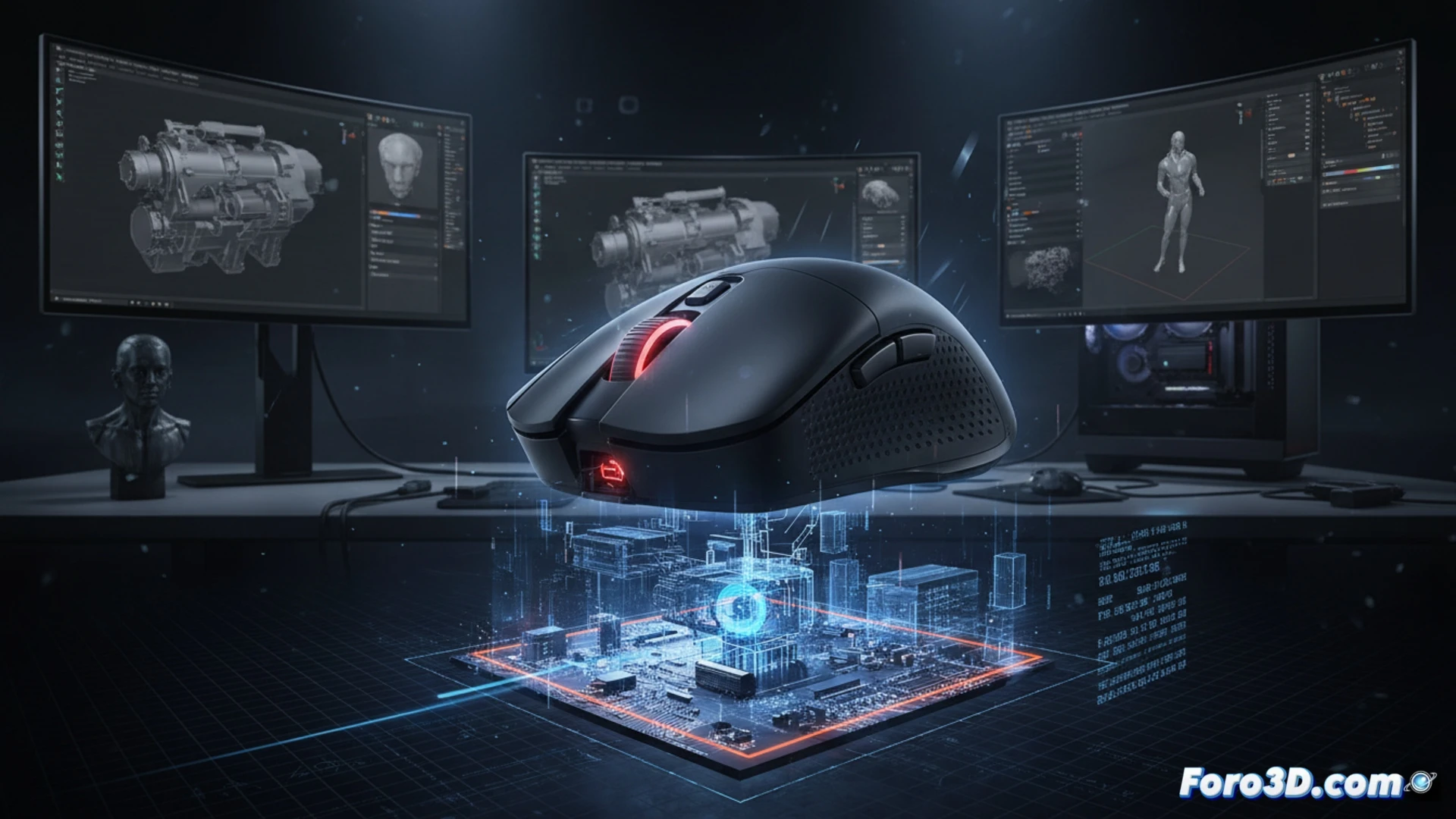
Technical analysis of the PAW3950 sensor in 3D workflows 🖱️
The PAW3950, successor to the acclaimed PAW3395, achieves a native polling rate of 4000 Hz, far exceeding the 1000 Hz of office mice like the Logitech MX Master. In Blender, this frequency eliminates lag in orbital camera rotations, allowing smooth tracking of complex polygonal meshes. In ZBrush, the 50G acceleration and 650 IPS speed ensure that brush strokes in DynaMesh respond without artificial interpolation. Compared to the Razer Pro Click (which uses a 16000 DPI sensor), the Xiaomi offers a native resolution of 26000 DPI adjustable in 50-step increments, ideal for switching between low-sensitivity vertex selections and high-sensitivity viewport navigation. Additionally, its 99.8% tracking accuracy minimizes jitter in Maya when manipulating NURBS curves or mesh deformers.
Implications for the 3D hardware professional ⚙️
The arrival of this mouse presents a strategic dilemma. While mice like the Logitech MX Master 3S prioritize ergonomics and battery life (up to 70 days), the Xiaomi Gaming Mouse 2 bets on real-time response, a critical factor in physical simulations and interactive rendering. For the professional working with dense 3D environments, where every millisecond of latency translates into selection errors, this optical sensor is not a luxury, but a tool of surgical precision. The final decision will depend on whether the user values comfort during long sessions more or tracking fidelity in high-demand operations, such as retopology or weight painting.
How could the implementation of the PixArt PAW3395 sensor in the Xiaomi Gaming Mouse 2 optimize movement precision in 3D modeling applications compared to the latency of other peripherals on the market?
(PS: If your computer smokes when opening Blender, maybe you need more than a fan and faith)