The Worlds Part 1 update for No Man's Sky represents a significant technical leap by fully exploiting the potential of its proprietary engine on Vulkan. This analysis breaks down the key aspects of advanced ocean and volumetric cloud rendering, explaining how new ambient shadows redefine procedural generation without sacrificing real-time performance.
Shadow optimization and real-time fluid simulation 🌊
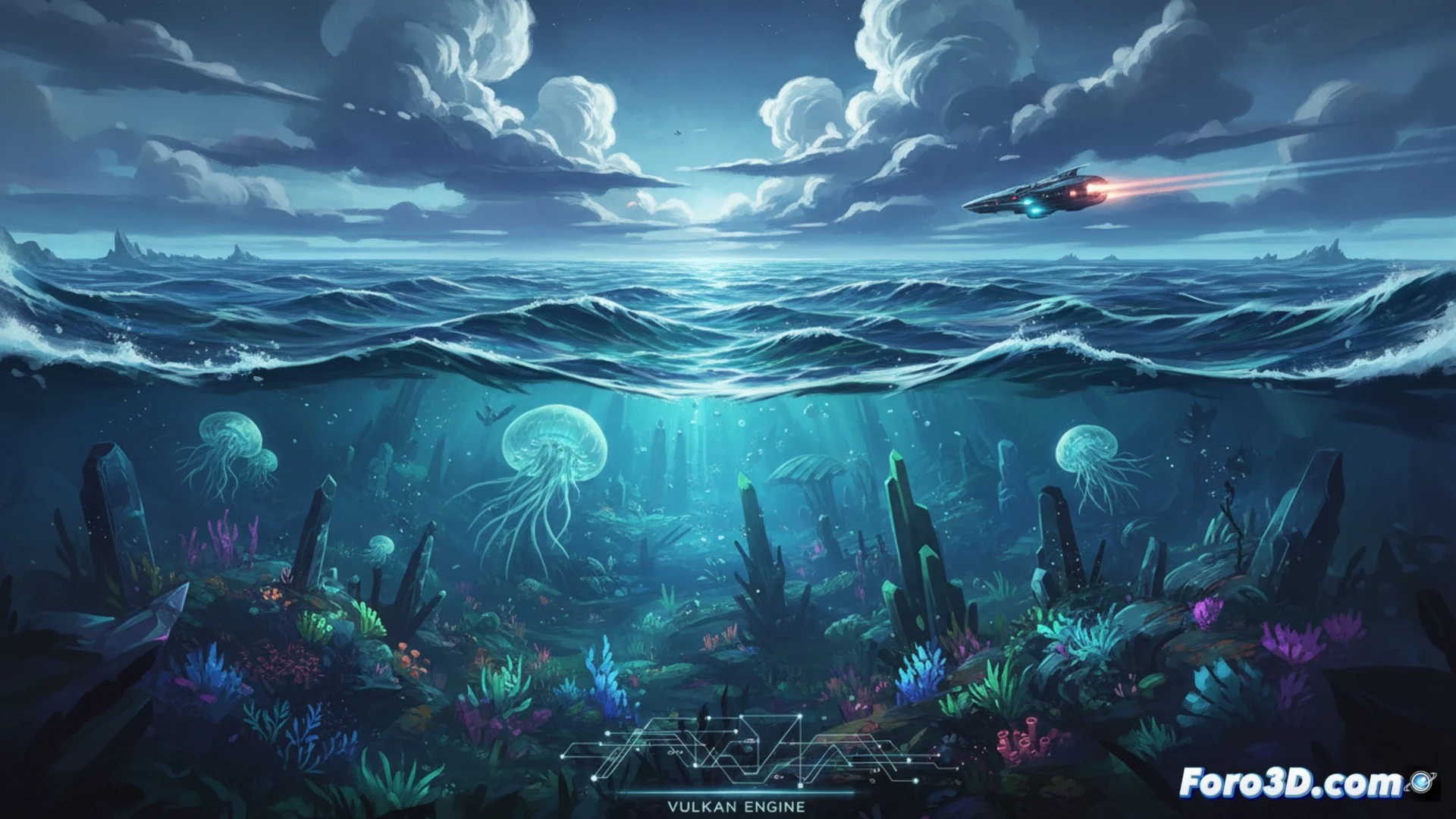
Hello Games' proprietary engine has implemented an enhanced ambient shadow system that integrates with procedurally generated geometry. Unlike traditional methods, the use of Vulkan enables highly efficient deferred shading, essential for correctly illuminating the new volumetric clouds. The biggest technical challenge has been synchronizing light dispersion in the oceans with wave physics, achieving reflectivity that varies depending on the time of day. This is accomplished through compute shaders that calculate the interaction between sunlight and dynamic foam, reducing aliasing on procedurally generated coastlines.
Technical debt as a driver of innovation ⚙️
While the proprietary engine remains a black box to the public, optimizations in Vulkan's memory management have been crucial. The ability to render oceans with infinite levels of detail without overloading VRAM demonstrates that procedural generation is not at odds with realism. For developers, this update is a case study in how to refine a legacy pipeline to support complex atmospheric effects, a path other open-world titles will need to consider.
How Vulkan manages the complexity of a procedural ocean in real-time without sacrificing performance on mid-range hardware
(PS: optimizing for mobile is like trying to fit an elephant into a Mini Cooper)