World's End Club, developed by Too Kyo Games and Grounding Inc., is a title that demonstrates how a standard engine like Unity can be used to generate a groundbreaking visual identity. The game's premise is simple: a group of children must survive in a post-apocalyptic Japan. However, its technical execution is anything but simple. The studio has achieved an almost impossible balance between kawaii aesthetics and desolation, turning a barren environment into a canvas of vibrant colors. For any indie developer, this title is a case study on how color palette and lighting can tell a story without the need for text.
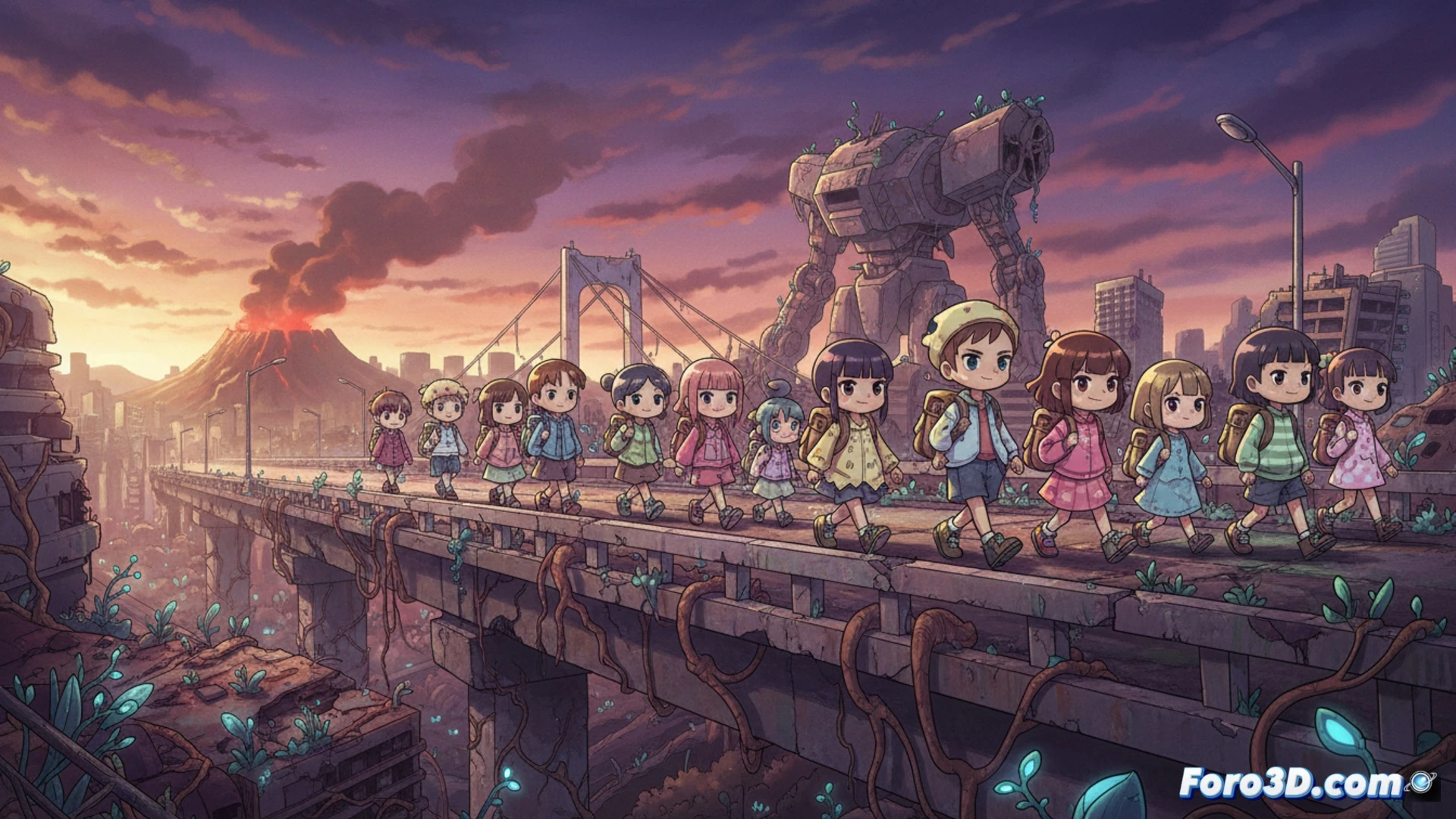
Lighting techniques and color palette in Unity 🎨
The visual success of World's End Club lies in the management of light and color within the Unity engine. Unlike other post-apocalyptic titles that opt for gray and brown tones, here high saturation is used. Technically, this is achieved through smart use of baked Global Illumination (GI) and materials with soft emission properties. The characters, modeled with cel shading (cartoon shading) shaders, ignore the realistic shadows of the environment, creating an intentional visual disconnect. Meanwhile, the backgrounds of a Japan reclaimed by nature use high-resolution textures and procedural vegetation with a slightly more realistic color filter. This technical duality (flat characters vs. detailed backgrounds) is key to preventing the game from looking empty and keeps the player immersed in the visual paradox of the pop apocalypse.
Lessons for indies: contrast as a narrative engine 💡
The main lesson World's End Club offers developers is that optimization is not at odds with artistic identity. By keeping characters in a simplified 2D style within a 3D world, the Unity engine can dedicate more resources to the environments and particle effects (dust, floating leaves). For a small studio, this is a smart production strategy: it reduces the cost of complex animation while maximizing the visual impact of the setting. If you are developing your own game in Unity, do not underestimate the power of a restricted but vibrant color palette; sometimes, painting a neon pink sky over a destroyed city generates more emotion than a thousand hyper-realistic textures.
How does Unity balance the vibrant aesthetic and unique apocalyptic style of World's End Club without sacrificing performance on consoles and mobile devices?
(PS: 90% of development time is polishing, the other 90% is fixing bugs)