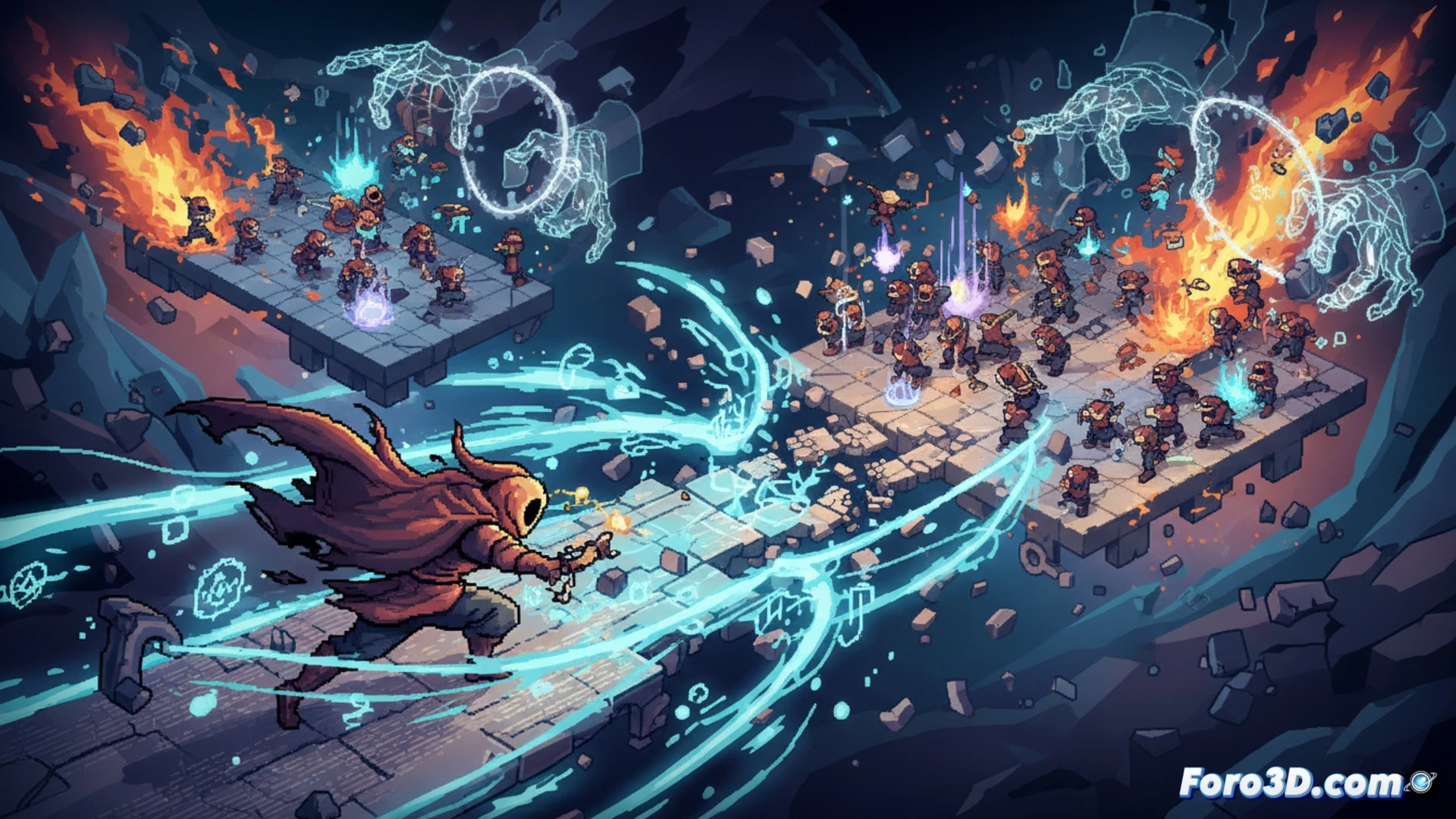
Motion Twin has demonstrated with Windblown that a commercial engine is not needed to achieve dizzying combat and a unique visual identity. Their proprietary engine, a direct successor to the one used in Dead Cells, has been rewritten to support fast isometric perspective and simplified 3D environments. The key lies in smooth 2D animation over these scenarios, a hybridization that allows maintaining the artisanal control of sprites without sacrificing level depth.
Spine, Photoshop and the 2D/3D Hybridization Pipeline 🎮
The workflow relies on three pillars. First, Photoshop for character and texture design, maintaining the studio's characteristic color saturation. Second, Spine for rigging and 2D skeletal animation, giving each hit and jump a fluidity that static pixel art could not achieve. Third, internal pixel rendering tools that project these animations onto simplified 3D meshes. This pipeline reduces the production cost of frame-by-frame sprites and allows the engine to efficiently manage dynamic lighting and collisions in a three-dimensional space, something critical for combat speed.
Performance and Visual Identity in a Saturated Genre ⚡
Motion Twin's decision is not just aesthetic, but deeply technical. By keeping animation in 2D, the team avoids the computational cost of animating complex 3D skeletons, freeing up resources for particles and high-speed effects. The result is a game that runs at a stable 60 fps even on modest hardware, while simplified 3D environments offer a sense of depth and verticality that Dead Cells, with its side-scrolling perspective, could not explore. This hybridization has become the studio's signature: a style that does not seek realism, but visual legibility and immediate response in every frame.
How does Motion Twin manage the complexity of real-time physics and collision calculations to maintain combat at a stable 60 fps in Windblown, considering the transition from a 2D engine to an isometric 3D scenario?
(PS: a game developer is someone who spends 1000 hours making a game that people complete in 2)