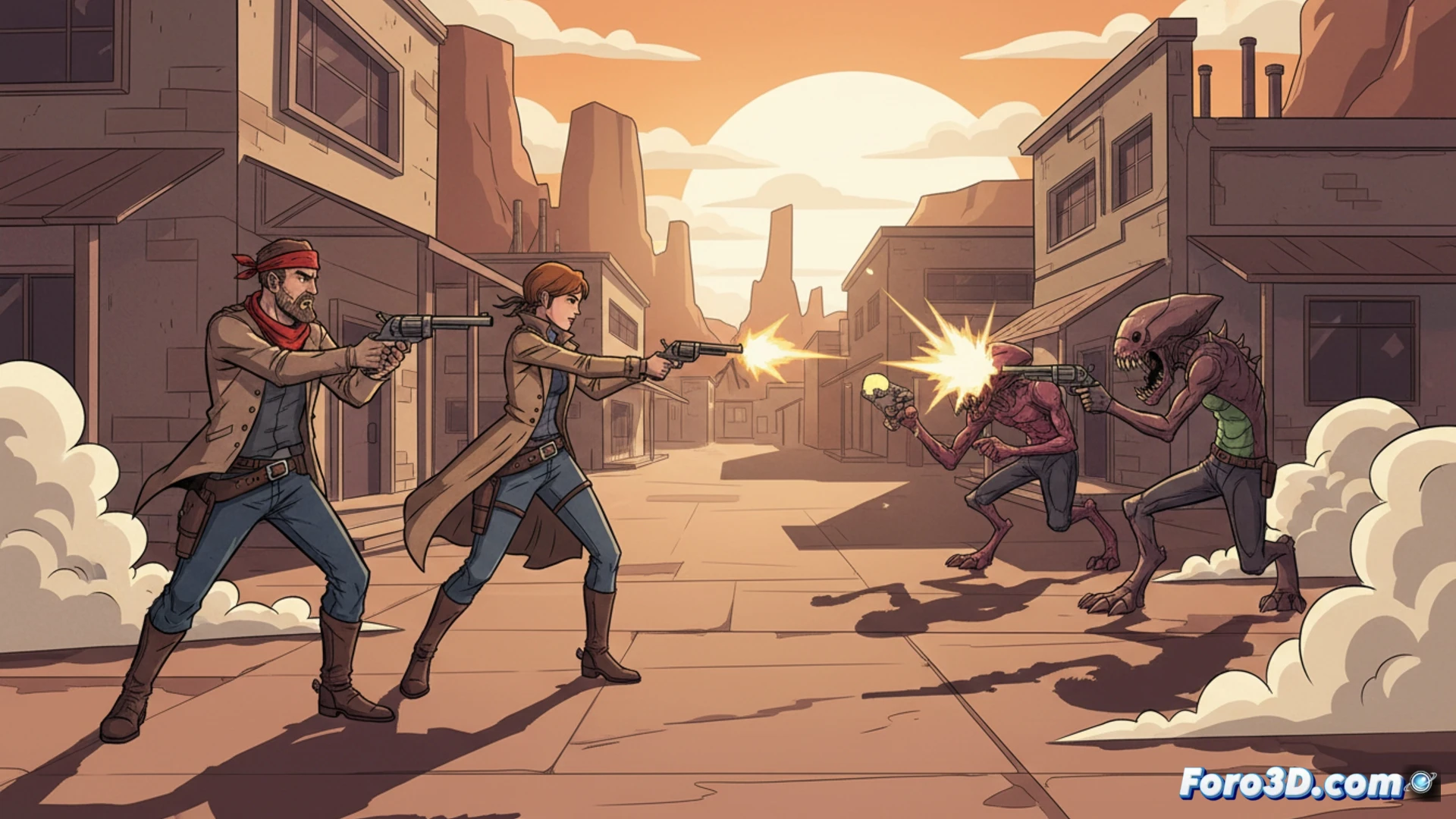
The launch of Wild Bastards, the spiritual successor to Void Bastards, has reignited interest in the saturated comic book aesthetic in Unity. The title achieves a technical feat by combining 2D-rendered characters with three-dimensional environments, maintaining impeccable action fluidity. This article breaks down the rendering, lighting, and post-processing techniques that enable this unique visual effect, analyzing how the engine handles the paradox of spatial depth with flat sprites.
Technical Pipeline: Shaders, Lighting, and Post-Processing in Unity 🎨
To achieve vibrant cell-shading, Wild Bastards employs custom shaders that apply toon mapping shading to the 3D environment models. The key lies in using the outline technique via a second camera pass that draws black borders around objects, mimicking comic book panels. The characters, being 2D sprites, are integrated using Unity's Billboarding system, which constantly rotates the flat texture so it always faces the camera. Lighting is resolved with low-frequency directional lights, avoiding complex dynamic shadows that would break the 2D illusion. Post-processing adds a slight chromatic aberration and film grain effect, while Color Grading saturates tones to the extreme, generating that characteristic psychedelic palette. Fluidity is maintained by limiting the LOD (Level of Detail) of environments and using GPU Instancing for enemies, allowing dozens of 2D sprites to move without sacrificing 60 FPS.
Lessons from Void Bastards: Technical Evolution and Optimization 🚀
Compared to Void Bastards, Wild Bastards represents a leap in managing 2D assets in Unity. While its predecessor used static sprites with simple animations, the sequel introduces 2D rigging on characters, allowing arms and legs to move independently despite being flat. This is achieved through Unity's 2D Animation package, which deforms the sprite mesh without losing the drawing aesthetic. Optimization for maintaining fluidity includes removing per-pixel lighting on sprites, replacing it with a pre-baked light texture overlaid as a blending layer. The result is a game that looks like an interactive comic, demonstrating that a technical limitation (2D characters) can become an artistic hallmark when mastering Unity's pipeline.
How does Wild Bastards manage to combine 2D cell-shading with a 3D engine like Unity to maintain the saturated comic book aesthetic without sacrificing performance in complex scenes?
(PS: a game developer is someone who spends 1000 hours making a game that people complete in 2)