Whiz Kid, the Marvel mutant created by Dan Slott and Stefano Caselli, defies physics with his super speed, but his true innovation lies in his technological wheelchair. This device not only allows him to move at extreme speeds but also channels his kinetic energy. From the perspective of additive manufacturing, we analyze how this chair could be built with real 3D scanning, CAD modeling, and composite material printing technologies, bridging the gap between fiction and cutting-edge prosthetics. ⚡
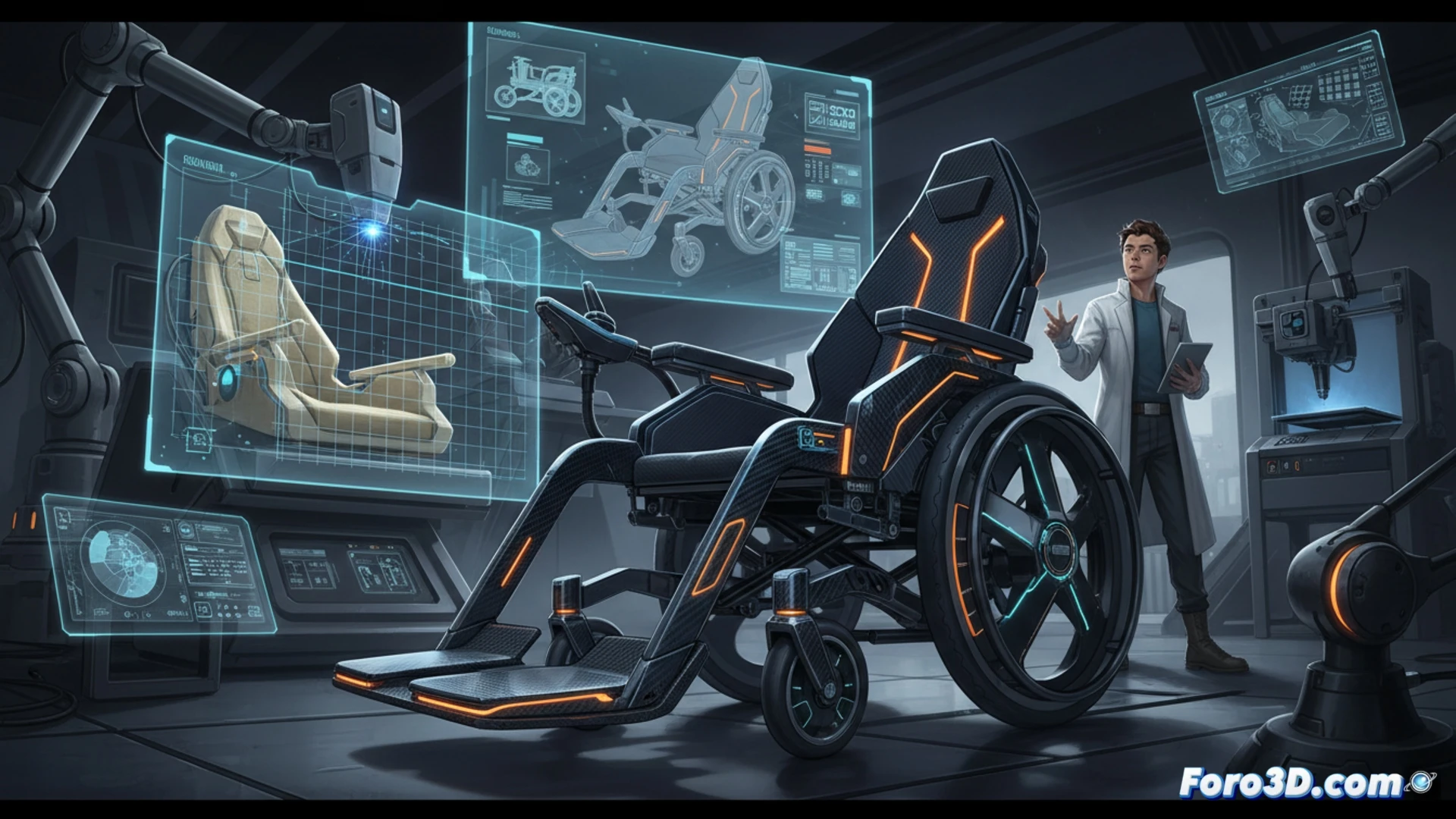
Parametric design and lightweight material simulation 🛠️
To replicate Whiz Kid's chair, the first step would be a 3D body scan of the user, capturing pressure points and anatomical curves. With that data, a monocoque chassis made of carbon fiber and titanium would be modeled in parametric CAD, optimizing rigidity to withstand extreme accelerations. 3D printing in carbon fiber-reinforced polyamide would allow for the fabrication of customized lumbar supports and footrests, reducing overall weight. Finite element simulations would validate the structure against forces of 5 G, comparable to those of a Formula 1 vehicle, ensuring safety without sacrificing aerodynamics.
Beyond the comic: real augmented mobility ♿
Projects like the Morph 3D chair or printed exoskeletons for paraplegia demonstrate that mass customization is already viable. Whiz Kid's chair, with its energy channeling system, could inspire real devices that store kinetic energy in flexible batteries integrated into the printed frame. The combination of 4D scanning and shape-memory polymers would allow for dynamic terrain adjustments, bringing fiction closer to inclusive, high-performance mobility for people with disabilities.
Is it possible to design a high-speed wheelchair, inspired by Whiz Kid, that integrates principles of biomechanics and 3D orthotics to ensure stability and safety at extreme speeds without compromising user ergonomics?
(PS: 3D prosthetics are so customized they even have fingerprints.)