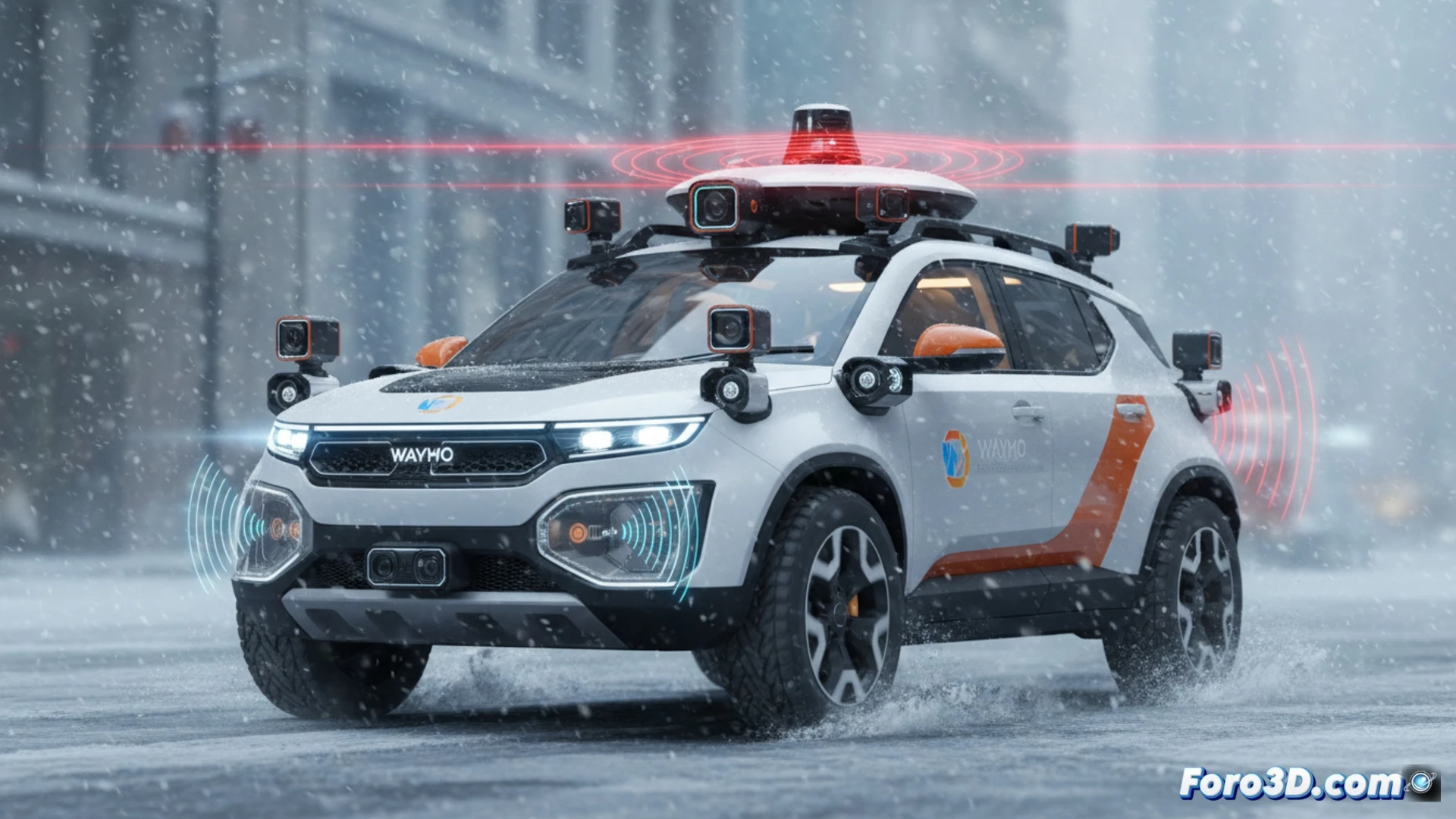
Waymo has presented its sixth generation of autonomous driving hardware, a platform that redefines perception standards in adverse conditions. This system integrates next-generation LiDAR sensors, high-resolution cameras, and long-range radars, specifically designed to operate in snow, heavy rain, and dense fog. The optimization aims to reduce manufacturing costs without sacrificing reliability, a critical step for the commercial scalability of the robotaxi. 🚗
Integration into digital twins and 3D simulation 🖥️
From the perspective of 3D modeling, the Gen6 represents an advance in the fidelity of digital twins. The new sensors allow for a more accurate representation of light scattering in water or snow particles, which improves perception algorithms in virtual environments. By simulating extreme conditions, engineers can validate the system's response without real risks, adjusting parameters such as LiDAR signal attenuation in fog. This reduction in physical components also simplifies the CAD design of the vehicle architecture, facilitating integration into 3D models of autonomous platforms like the Jaguar I-PACE.
The impact of efficiency on autonomous driving ⚡
The cost reduction in the Gen6 not only democratizes the technology but also accelerates the transition towards resilient autonomous vehicles. By optimizing hardware for extreme climates, Waymo demonstrates that autonomous driving can overcome geographical and meteorological barriers. For the 3D modeling industry, this implies new challenges: recreating complex climate scenarios in simulations to train neural networks. The key will be balancing sensory precision and computational efficiency, a challenge that will define the next decade of the sector.
How does the integration of sensors optimized for extreme weather in the Waymo Gen6 platform affect the design and validation of 3D printing systems for automotive components exposed to adverse conditions?
(PS: simulating an ECU is like programming a toaster: it seems easy until you order a croissant)