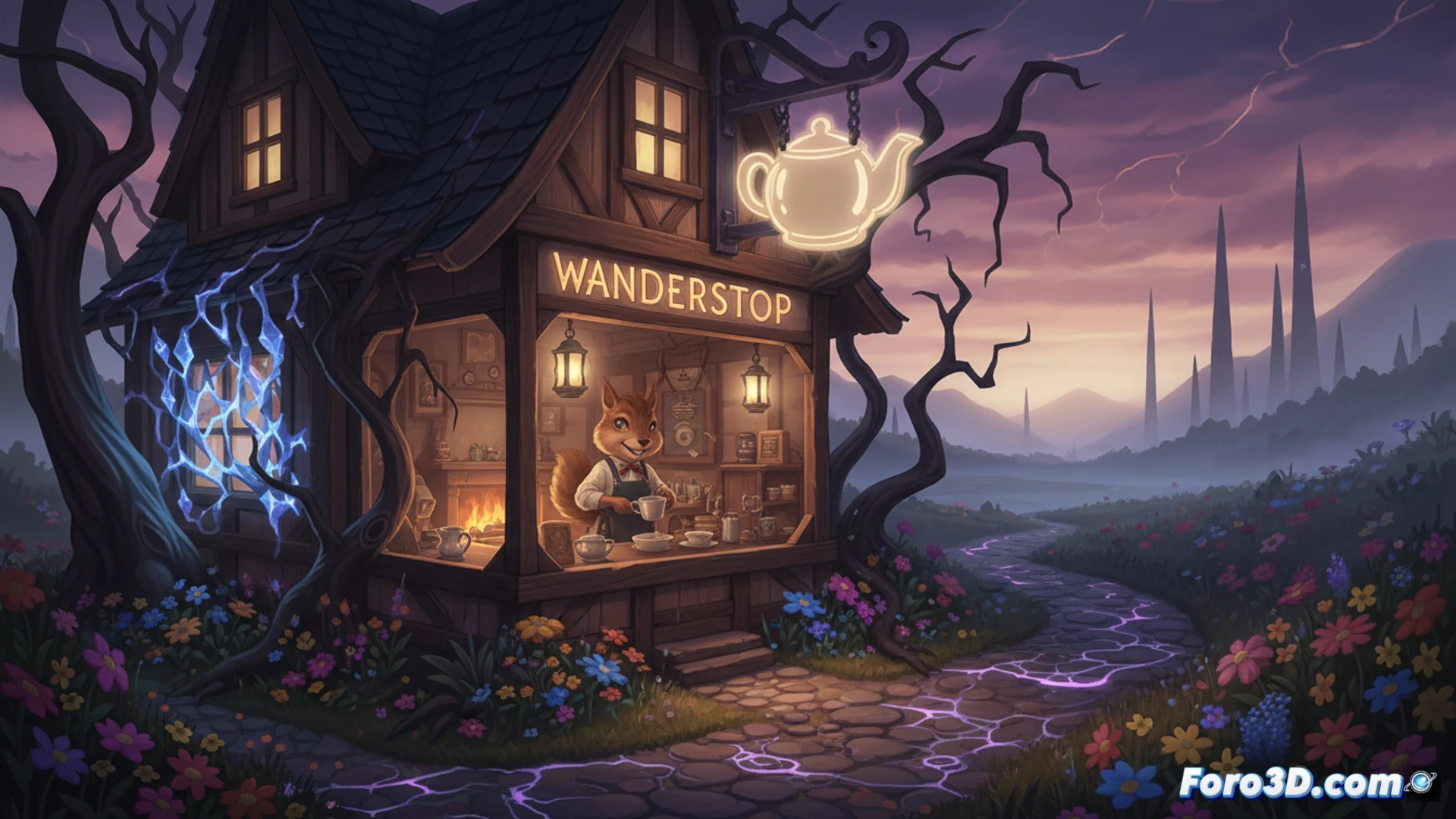
The team behind The Stanley Parable has revealed Wanderstop, a title that promises to subvert the cozy genre through the use of Unreal Engine 5. Far from merely creating a visually pleasing space, the game introduces subtle distortions into its vibrant world. This article breaks down the technical tools that enable this tonal contrast, analyzing how dynamic lighting and custom shaders build a dark narrative beneath a friendly facade.
Lighting and Post-Processing: The Engine of Duality 🎮
The secret of Wanderstop lies in the handling of UE5's Lumen global illumination. During seemingly calm sequences, the system bounces warm light softly, creating diffuse shadows that evoke safety. However, the game activates post-processing layers that alter color temperature and apply peripheral vignettes at key moments. The developers have configured materials in Blender with roughness maps that, under certain camera angles, generate anomalous specular reflections. Adobe Photoshop was used to texture assets with hidden details that are only visible under very specific lighting conditions, a technique inherited from The Stanley Parable's puzzle design.
The Stanley Legacy: Environmental Storytelling in 3D 🕵️
Wanderstop's level design applies the same philosophy as The Stanley Parable: the environment tells a story that contradicts the player's actions. The seemingly cozy hallways feature slight asymmetries in their geometry, modeled in Blender, which generate spatial discomfort. The object shaders react unpredictably to the character's proximity, changing opacity or emitting a faint flicker. This manipulation of perception, enhanced by UE5's physics engine, turns every corner into a clue that anticipates a dark narrative twist, demonstrating that true horror doesn't need monsters, only well-calculated distortions.
How does Wanderstop leverage the technical capabilities of Unreal Engine 5, such as Lumen and Nanite, to balance the cozy aesthetic and unsettling atmosphere without breaking player immersion?
(PS: shaders are like mayonnaise: if they break, you have to start all over again)