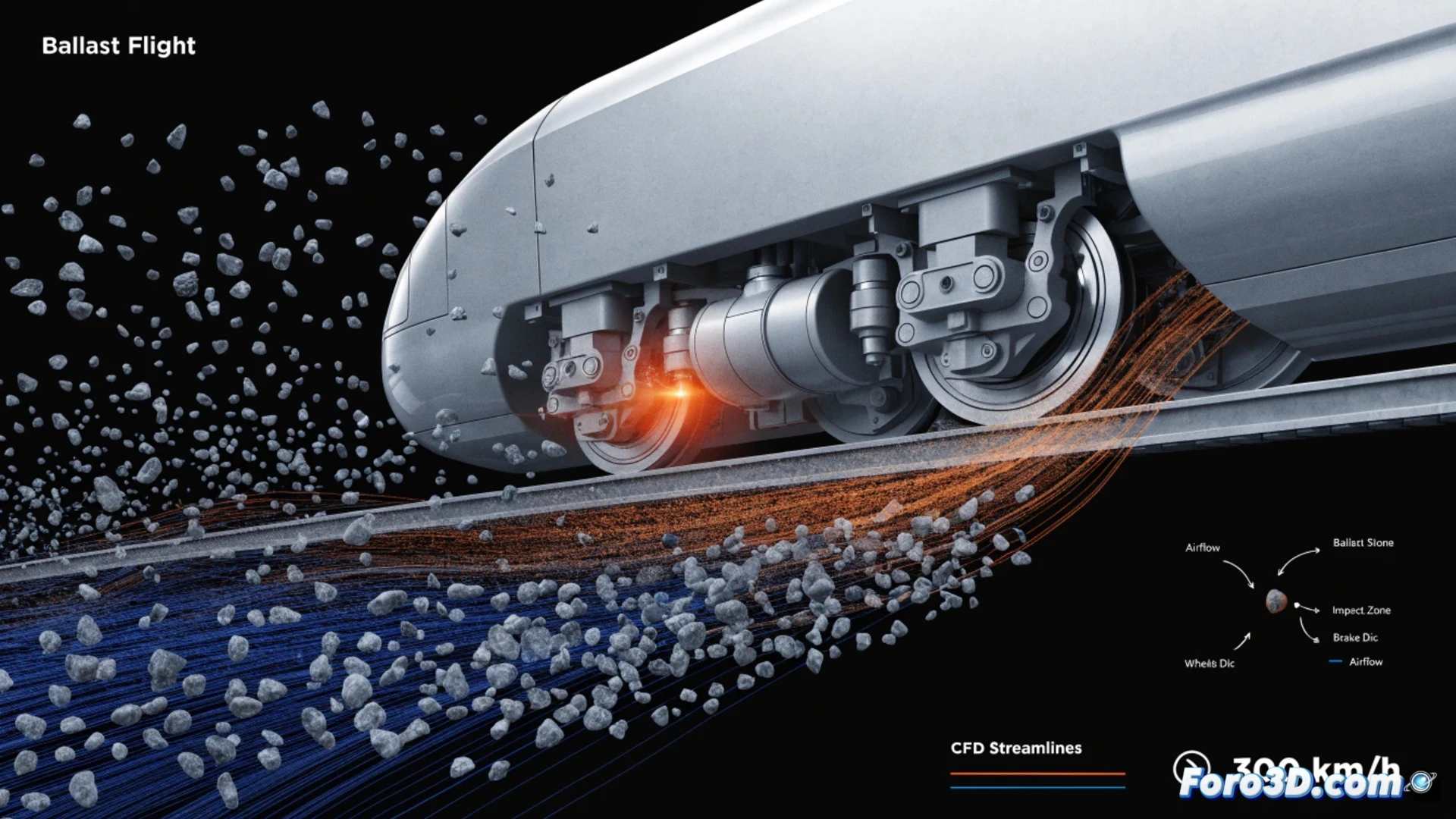
The phenomenon of ballast flight is a critical challenge in high-speed railway engineering. When a train travels at 300 km/h, aerodynamic turbulence under the chassis sucks stones from the track, throwing them against vital components such as braking systems. This technical article details the simulation and 3D visualization pipeline used to analyze these trajectories, map damage, and redesign protective deflectors, using tools like Siemens Star-CCM+, SolidWorks, and Blender.
Technical pipeline: from fluid dynamics to mechanical redesign 🚄
The process begins in Siemens Star-CCM+, where the airflow under the train is modeled using CFD. The orange and blue streamlines represent the trajectories of the ballast particles, highlighting areas of high turbulence. GOM Inspect is used to perform a three-dimensional mapping of impact damage on the underbody, identifying critical points in the braking systems. In SolidWorks, the aerodynamic deflectors are redesigned, optimizing their geometry to redirect the flow. Finally, Blender generates a photorealistic visualization with metallic materials on a dark background, imitating the industrial rendering style of Siemens, to validate the aesthetic and functional behavior of the new design.
Reflection: visualization as a prevention tool in railway automotive engineering 🛠️
Beyond CAD aesthetics, this pipeline demonstrates how advanced 3D simulation allows preventing catastrophic failures in critical systems. By digitally reconstructing the trajectory of each particle and its impact, engineers can anticipate failure points in the brakes and redesign protections before building physical prototypes. For the automotive and 3D systems sector, this integrated approach between CFD, CAD, and rendering is consolidating as a standard for safety validation in high-speed environments.
As a 3D design engineer, what CFD software do you recommend for simulating airflow under a chassis at 300 km/h, and what geometric modifications to the underbody have proven to reduce ballast lifting without compromising the overall aerodynamics of the vehicle?
(PS: car electronics are like family: there is always a fuse that blows)