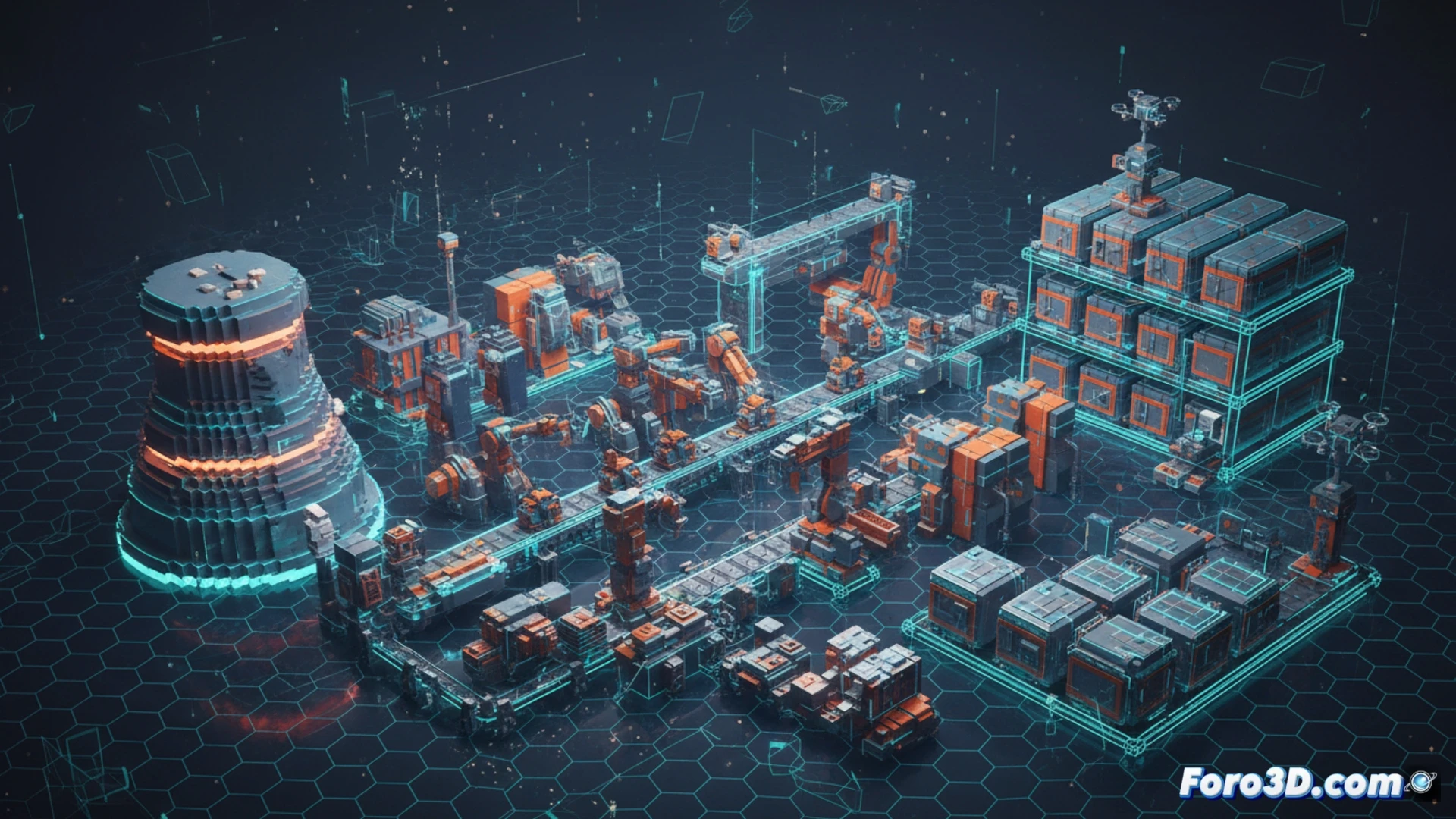
The visualization of industrial plants has found a new ally in the combination of voxelized worlds and functional shaders. By building the environment entirely with 3D voxels, extreme modularity is achieved, facilitating the representation of massive production chains. Using Unity as the main engine allows performance optimization even with millions of blocks, while shaders apply a clean, technical finish to the machinery, moving away from the cartoon style to adopt an aesthetic closer to engineering blueprints.
Blender and Unity: the workflow for modular machinery 🏭
The modeling of each machine in Blender is carried out under a criterion of interchangeable parts, designed to fit perfectly into the voxelized grid. This allows conveyor belts, robotic arms, and assemblers to align seamlessly in Unity's three-dimensional space. Custom shaders apply procedural textures that simulate brushed metal surfaces and control panels, prioritizing visual legibility over superfluous detail. The result is a system where each voxel block represents a unit of usable space, ideal for planning logistics flows and detecting bottlenecks in real time.
Real applications beyond video games 🔧
This technical approach is not only useful for video game prototypes but becomes a valuable tool for industrial simulation. By being able to modify the arrangement of voxels on the fly, engineers can test plant configurations without the need for costly physical prototypes. The visual clarity of functional shaders helps operators understand complex production routes, reducing training errors. Foundry demonstrates that voxelized aesthetics, when combined with technical rendering, can be as serious and precise as any CAD software, but much more agile for iterating.
How a system of voxelized shaders can be implemented in Unity to simulate the logistics flow of an industrial plant in real time without compromising the graphics engine's performance
(PS: bottlenecks in 3D are like traffic jams: you see them coming but you can't avoid them)