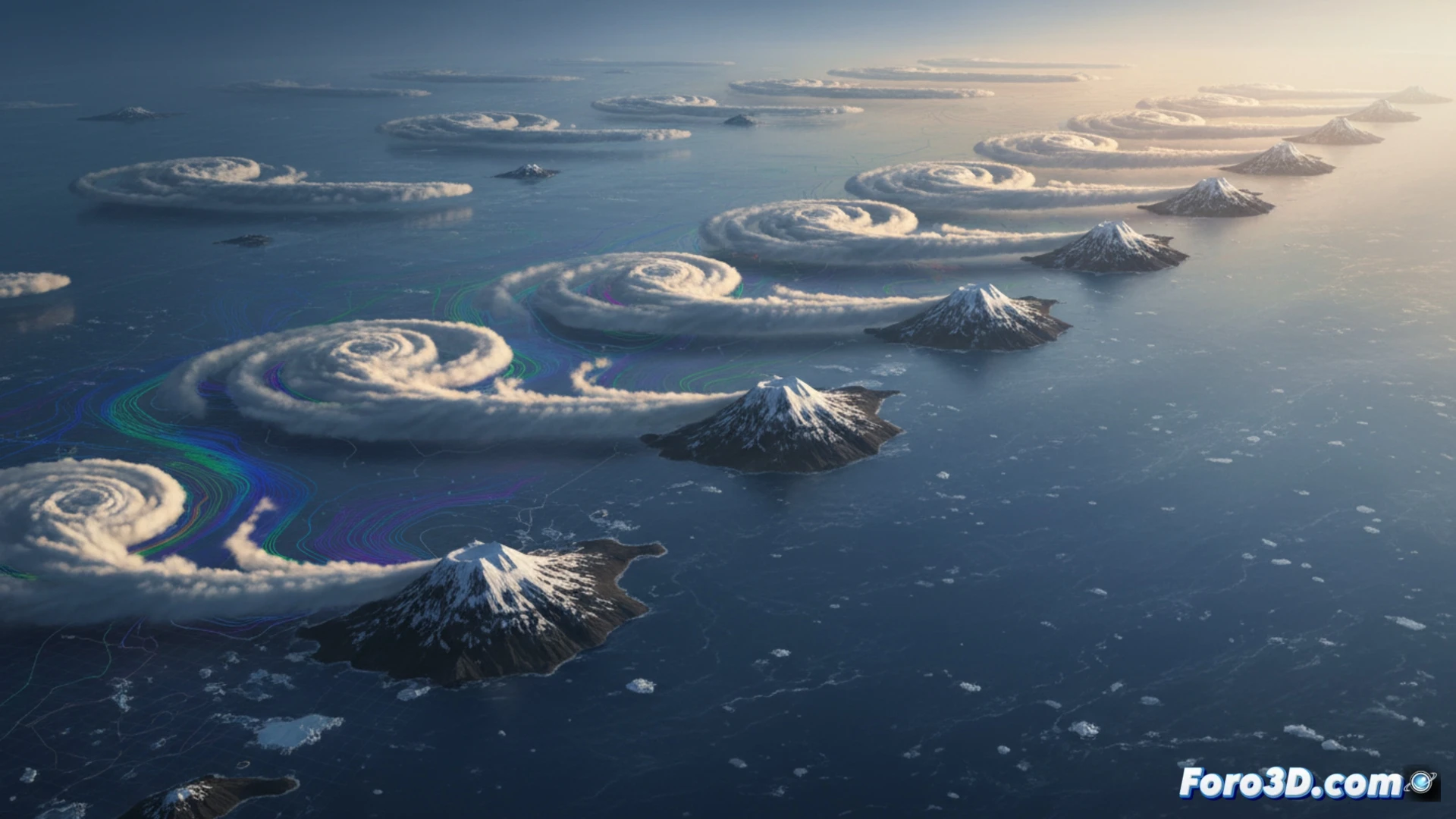
Over the Bering Sea, the volcanic peaks of the Aleutian Islands sculpt the wind into perfect spirals that stretch for hundreds of kilometers. This phenomenon, known as Von Kármán Vortices, not only mesmerizes from a satellite but also represents a fascinating technical challenge for scientific visualization and computational simulation.
CFD Modeling with ANSYS Fluent and Vortex Shedding 🌪️
The physics behind these spiral clouds is pure fluid dynamics. When stratified airflow encounters an abrupt obstacle, such as an island peak, alternating vortices are shed in a pattern known as vortex shedding. In ANSYS Fluent, we can replicate this behavior by adjusting the Reynolds number and fluid viscosity. The key lies in precisely meshing the volcanic peak geometry and configuring a transient solver. The CFD simulation results generate vorticity fields that, visualized as isosurfaces, mathematically replicate the spirals observed in NASA satellite imagery.
From Satellite Data to Volumetric Render 🎨
The beauty of these vortices lies in their duality: they are mathematically precise and aesthetically mesmerizing. In Houdini, we import the vorticity data from Fluent as a VDB volume to sculpt the clouds. Blender completes the workflow with lighting and volumetric shadows that mimic the low-angle light of the Arctic dawn. The final comparison between the render and the actual photograph from the Terra satellite demonstrates that simulation not only educates but also allows exploring angles and atmospheric conditions impossible to capture from orbit.
As a 3D technical artist, what was the greatest challenge in translating the fluid dynamics of the Von Kármán vortices in the Aleutians into a visually accurate and artistic simulation, maintaining scientific rigor without sacrificing aesthetics?
(PS: fluid physics for simulating the ocean is like the sea: unpredictable and you always run out of RAM)