The boundary between quantum mechanics and biology is blurring. Recent experiments suggest that phenomena such as superposition, entanglement, and quantum tunneling are not exclusive to the physics laboratory but operate within our cells. From accelerating enzymatic reactions to the near-perfect efficiency of photosynthesis, these effects open a new understanding of life, although research is still in its early stages.
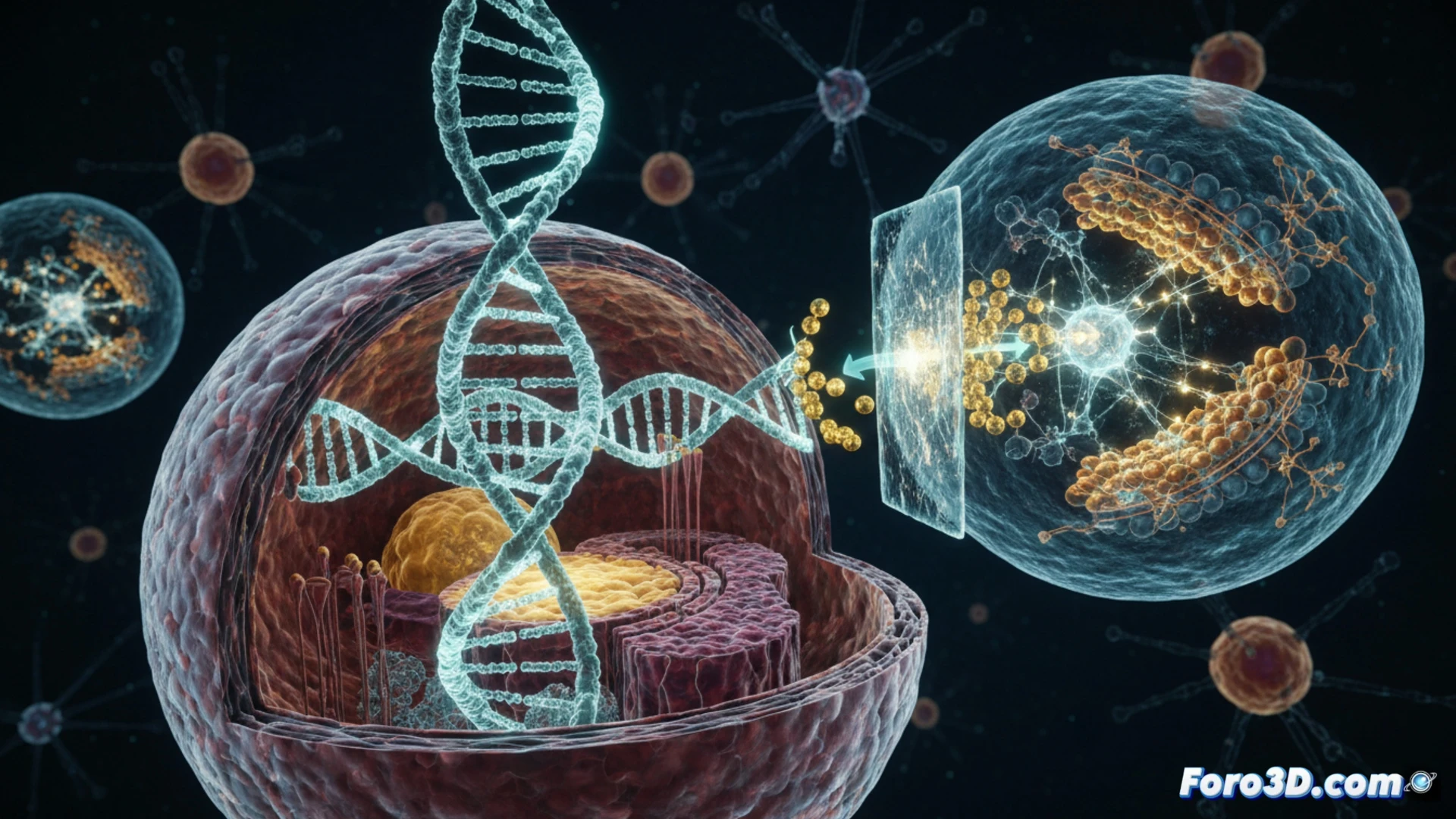
Molecular modeling: quantum tunneling in enzymatic catalysis 🧬
3D scientific visualization has become an indispensable tool for exploring these processes. Through molecular quantum dynamics simulations, researchers can model how protons or electrons cross energy barriers that, according to classical physics, would be insurmountable. In an enzyme, quantum tunneling allows a hydrogen atom to appear on the other side of the barrier without crossing the intermediate space. Volumetric representations and probability density animations allow biochemists to observe this near-instantaneous transfer, accelerating the design of drugs that mimic or inhibit this natural efficiency.
Quantum coherence: photosynthesis as technological inspiration 🌿
In photosynthesis, sunlight is converted into chemical energy with an efficiency close to 100%. 3D simulations reveal that light-harvesting complexes exploit quantum coherence, exploring multiple energy pathways simultaneously to choose the most efficient one. Visualizing these state superpositions in a three-dimensional model allows scientists to understand how nature preserves quantum information in a warm and noisy environment. This knowledge not only redefines our understanding of life but also lays the groundwork for innovative therapies that correct quantum failures in metabolic diseases.
As a 3D modeler, what is the greatest technical challenge in representing quantum phenomena such as superposition or tunneling in biological structures without losing scientific rigor?
(PS: at Foro3D we know that even manta rays have better social bonds than our polygons)