The Swiss student team Aris, from ETH, has achieved a milestone by testing a Rotating Detonation Rocket Engine (RDRE) with liquid fuel. This engine, the size of a plate, generates supersonic detonation waves that spin inside a hexagonal copper chamber. To understand how it works, 3D scientific visualization becomes a key tool, allowing the breakdown of high-pressure and high-temperature phenomena that are impossible to observe directly during the test in Dübendorf.
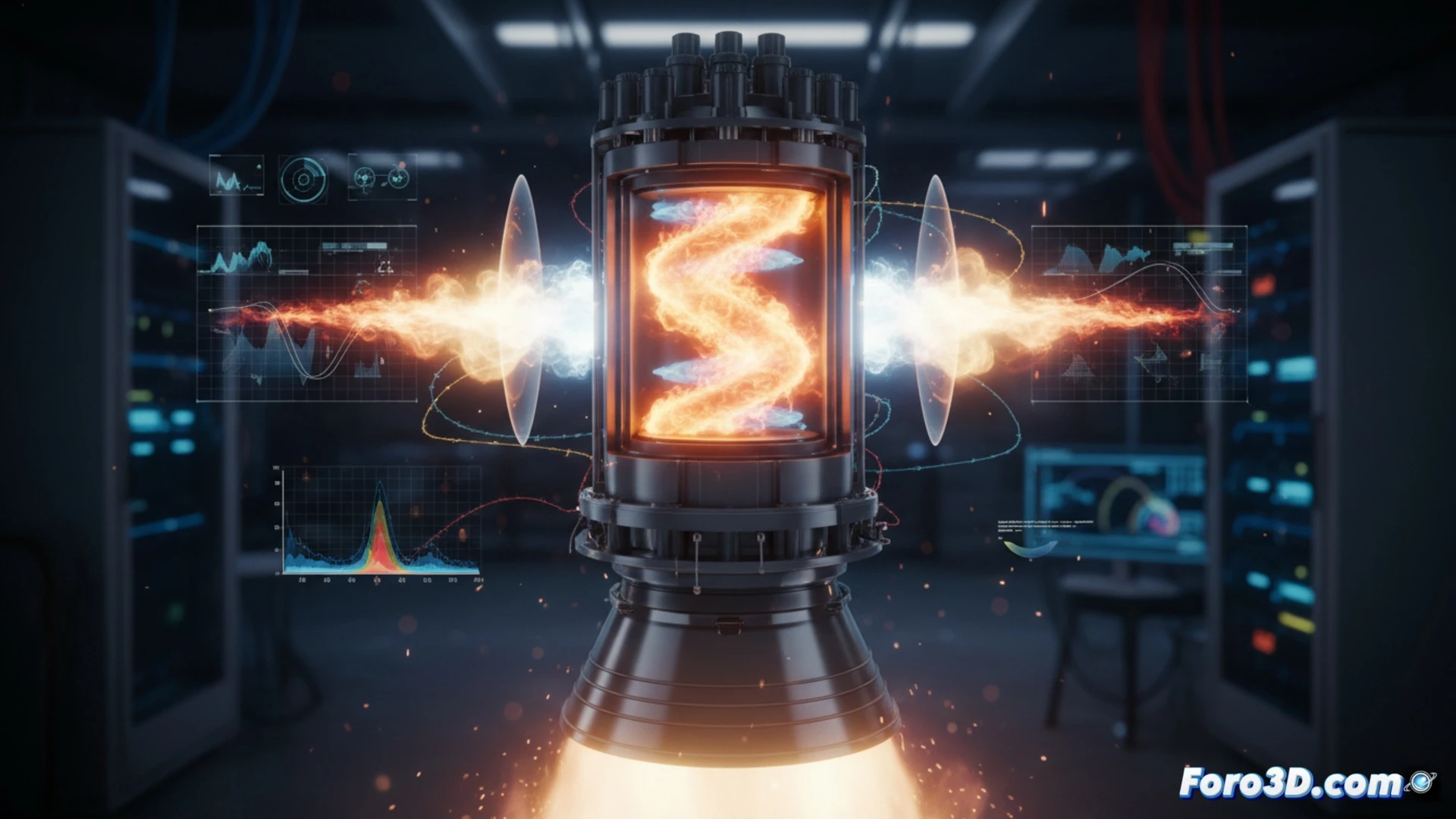
3D Modeling of Rotating Detonation Waves 🚀
In the niche of scientific visualization, the RDRE presents a fascinating challenge. Through 3D simulations, we can represent the detonation front traveling at several kilometers per second around the engine's annular channel. Animated diagrams allow us to see how liquid oxygen evaporates and mixes with the fuel, creating a self-sustaining pressure gradient. A rendered cross-section of the engine reveals the zones of instantaneous combustion, where temperatures exceed 3000 degrees Celsius. Compared to a conventional engine, the animation shows how detonation, instead of slow deflagration, compresses the gas in a more efficient cycle, explaining why this design promises 25% more performance.
The Tension of the Test in a Virtual Environment 🔥
While Barbara Parys gave the immobilization order, the team monitored sensors and high-speed cameras. For the scientific visualizer, this data is the perfect input. Rendering pressure readings as 3D heat maps onto the engine geometry allows us to appreciate the wave's instability. Aris's goal was to achieve stable detonation, an achievement only a dozen countries have accomplished. By virtually reconstructing the test, we can show how copper pre-cooling and the hexagonal geometry are critical for taming the explosion, bringing to life a breakthrough that few student teams have reached.
As a student, what was the greatest technical challenge in 3D modeling the rotating detonation waves of an RDRE with liquid fuel to make it understandable to the scientific community?
(PS: at Foro3D we know that even manta rays have better social bonds than our polygons)