The book Animate by Michael Bond dismantles the myth of human superiority, a belief that has shaped our psychology and culture. For scientific visualization, this concept is a fascinating technical challenge. We propose an interactive 3D infographic that not only compares anatomies but also visualizes cognitive and emotional data, breaking down the artificial barrier that separates our species from the animal kingdom.
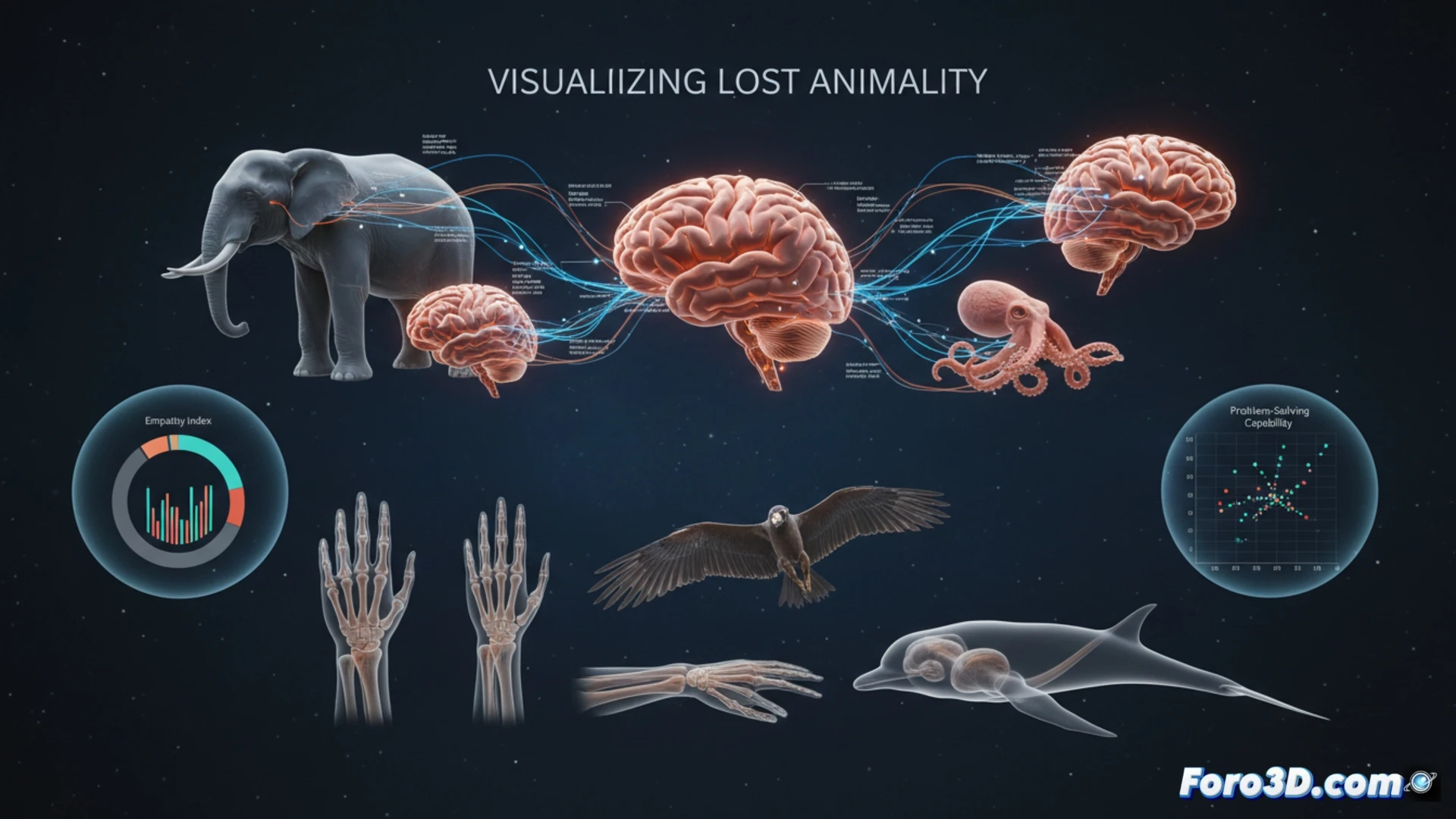
Comparative Modeling and Behavior Simulation 🧠
The technical project would focus on a 3D viewer that allows toggling between volumetric models of a human, a chimpanzee, a dolphin, and a crow. The key lies in overlaying brain heat maps generated from neuroimaging data, showing activity in areas related to empathy and problem-solving. Accompanying the models, real-time behavior simulations (such as tool use in birds or mirror recognition in cetaceans) would activate when selecting hot spots on the anatomy, directly contrasting with the book's quotes that question our uniqueness.
Rebuilding the Evolutionary Bridge in Real Time 🌿
Beyond aesthetics, this visualization aims to generate an immersive experience that provokes reflection. By displaying intelligence and emotion statistics overlaid on the 3D skeletons, the user confronts the fragility of exceptionalism. The final proposal is a virtual tour where the observer, moving between species, discovers that the differences are of degree, not essence, suggesting that recognizing our shared animality is the first step towards a more harmonious future.
How can 3D infographics represent the cognitive and emotional complexity of non-human animal species to challenge the visual foundations of human exceptionalism in scientific communication?
(PS: if your manta ray animation doesn't move you, you can always add some documentary-style music from channel 2)