The concept of the field has evolved from Faraday's lines of force to quantum field theory, where each elementary particle is an excitation of its corresponding field. To visualize these abstract entities that fill space, 3D technologies offer a powerful tool. Interactive simulations allow the representation of dynamic electromagnetic fields and the vibrations that generate electrons and quarks, making the intangible tangible for research and scientific outreach.
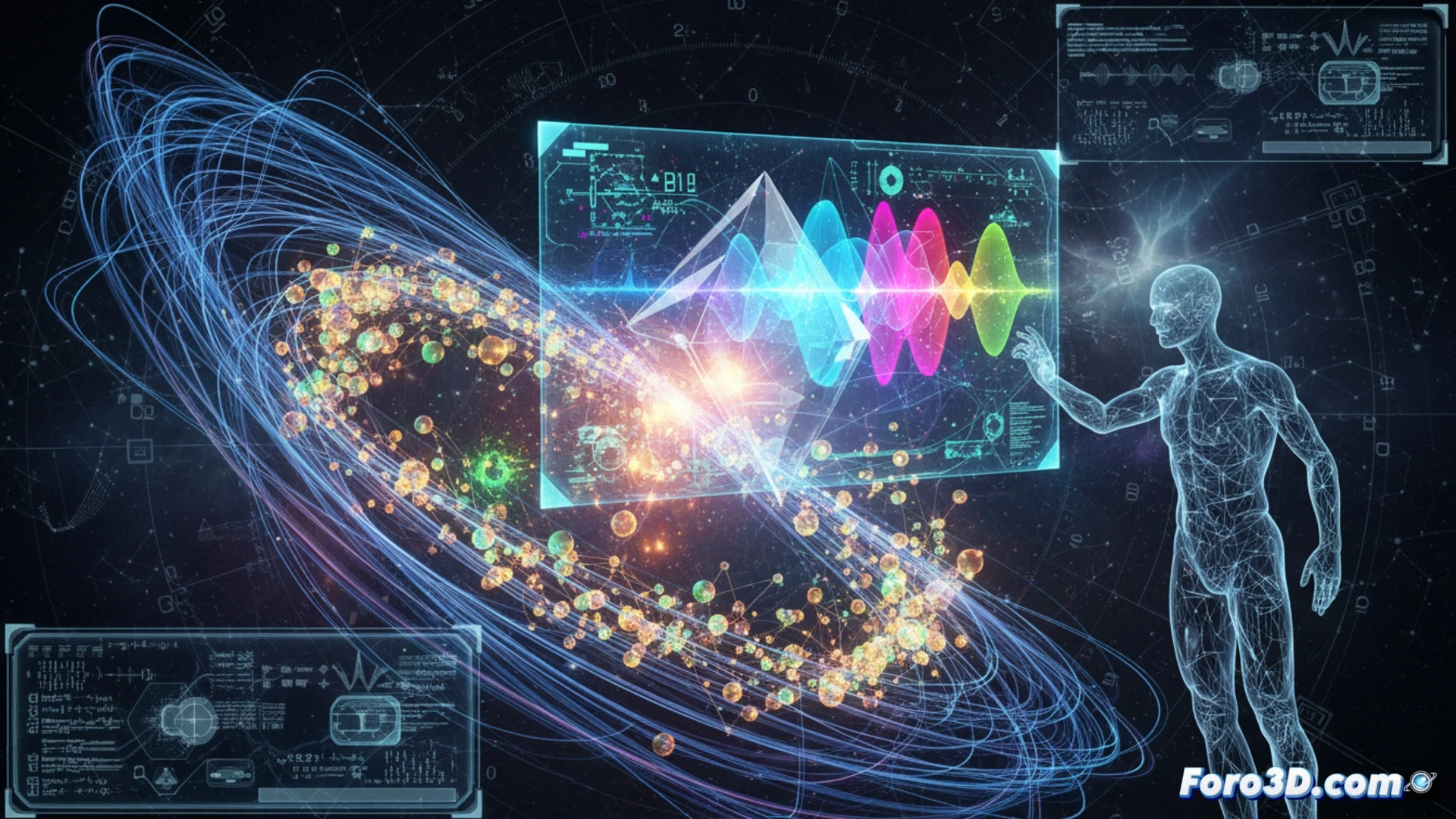
Modeling excitations and lines of force in 3D environments 🧲
3D scientific visualization tools allow recreating the mathematical structure of quantum fields. For example, an electron field can be represented as a volumetric mesh that permeates space, where areas of higher density indicate an excitation or particle. Graphic engineers model electromagnetic lines of force as dynamic curves connecting charges, showing how the field mediates interactions. These simulations, based on Maxwell's equations and quantum mechanics, allow physicists to observe in real time how perturbations travel through the field, offering a visual window into the fundamental dance of matter.
Towards a visual understanding of fundamental reality 🔬
Visualizing quantum fields not only helps researchers detect complex patterns but also transforms physics education. By seeing how an electromagnetic field curves around a charge or how an electron emerges as a localized vibration, students and the general public can connect with the idea that the universe is a dynamic and interconnected fabric. This 3D representation demystifies mathematical abstraction, showing that reality, from the smallest to the cosmic scale, is a landscape of fields in constant interaction.
What 3D visualization techniques effectively represent the probabilistic nature and superposition of states in quantum fields, overcoming the limitations of Faraday's classical field lines?
(PS: if your manta ray animation doesn't excite, you can always add documentary music from channel 2)