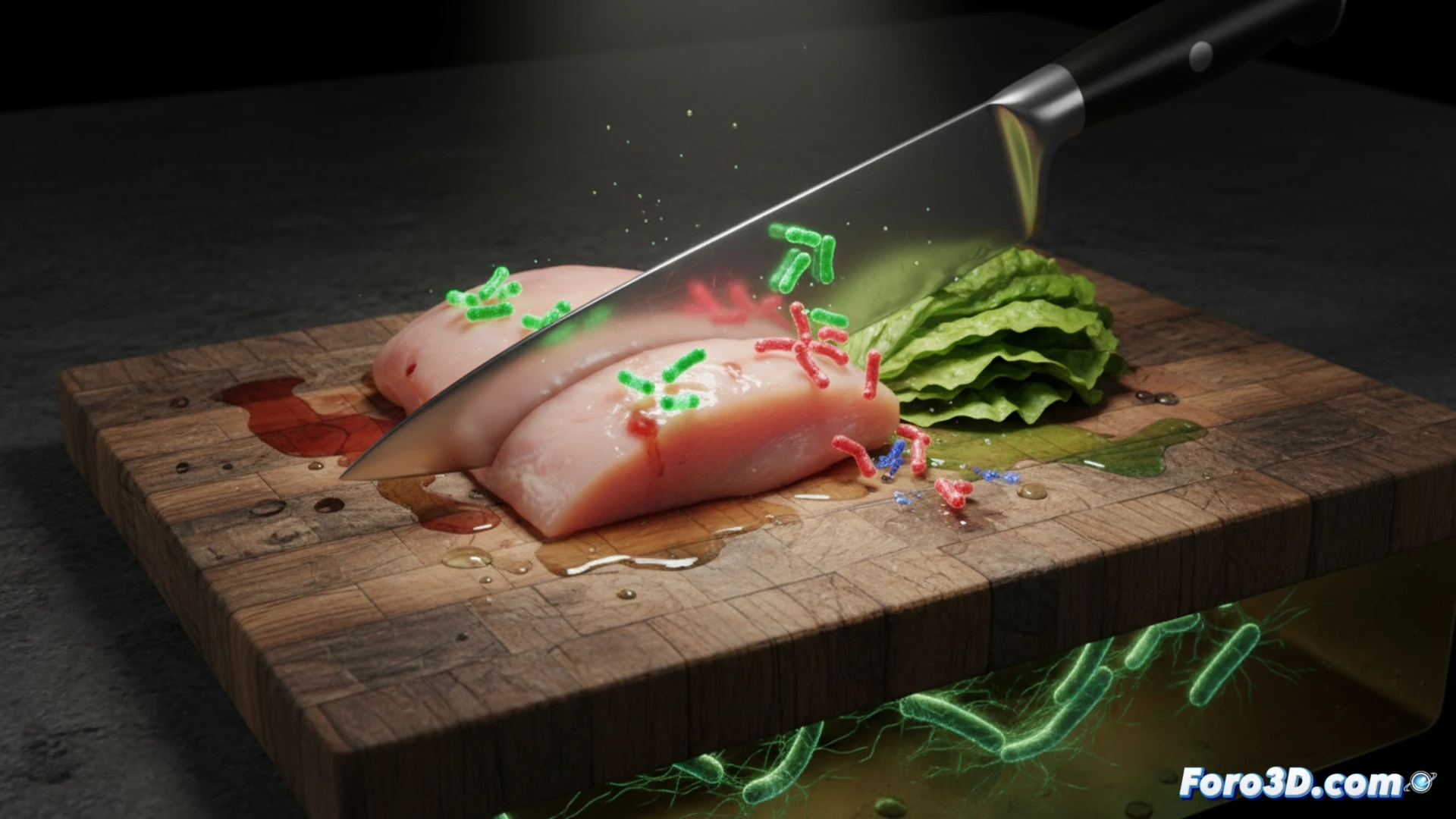
Cross-contamination in the kitchen is one of the most common routes for the transmission of foodborne pathogens. A simple cut with a contaminated utensil can transfer bacteria such as Salmonella or E. coli from surfaces or raw foods to ready-to-eat products. This often invisible phenomenon is a critical point in the epidemiology of food poisoning. Modeling this process in three dimensions allows us to understand the mechanics of bacterial adhesion and shear transfer during cutting, offering a visual tool for health prevention.
Technical Modeling of Shear Cross-Contamination 🔬
To recreate this scenario, the 3D model must capture three main vectors. First, the texture of the knife edge, which serves as a fomite, where bacteria lodge in micro-cracks. Second, the fluid dynamics when cutting a moist food, which facilitates bacterial drag. Third, the surface of the receiving food, where roughness determines the adhesion rate. Using particle simulations and UV surface mapping, the transferred bacterial load can be visually quantified. This allows for generating risk heat maps on the countertop, identifying cleaning blind spots. The result is a digital twin of the kitchen that anticipates spread.
The Educational Value of Visualizing the Invisible 🧠
The strength of this representation lies in its ability to transform an abstract concept into a tangible experience. By observing in 3D how a bacterial colony detaches from the steel and colonizes a vegetable, the viewer internalizes the risk immediately. This approach not only illustrates the origin of the bacteria but also demystifies cross-contamination. For the general public, seeing the journey from the utensil to the digestive system in an anatomical animation reinforces the need for hygiene, turning epidemiological data into a visual guide for active prevention.
How can 3D visualization of the cutting process of a contaminated food help identify critical points of bacterial transmission in the domestic kitchen?
(PS: at Foro3D we know that the only epidemic affecting us is the lack of polygons) 🎮