The discovery of the polychaete Lepidonotopodium sp., known as the electric blue scale worm, has revolutionized extremophile marine biology. Its habitat, the black smokers of the ocean floor, presents conditions of extreme pressure, total darkness, and lethal temperatures. The peculiarity of this annelid lies in its dorsal scales, which under artificial light emit a vibrant neon color, a phenomenon that scientists suspect is related to defensive biophotonics or intraspecific communication.
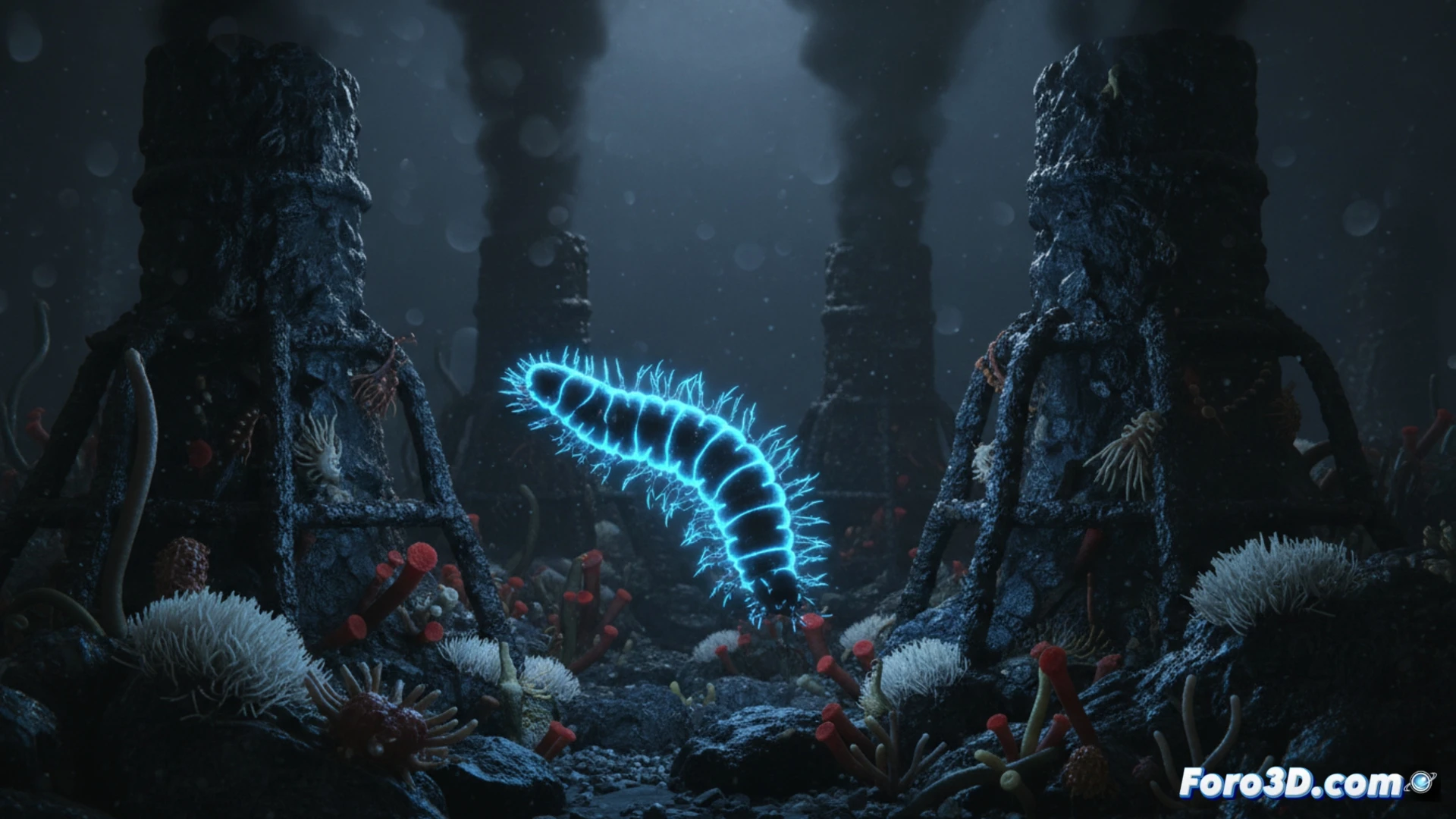
Anatomical modeling and simulation of the extreme environment 🐛
To approach the study of this species, the 3D workflow must integrate micro-CT tomography data to reconstruct the segmented body morphology and chitinous scales. The technical challenge lies in recreating the translucent material of the scales, using subsurface scattering shaders in engines like Cycles or Arnold to simulate the blue fluorescence. In parallel, the habitat scene requires modeling hydrothermal vents with procedural textures of metal sulfides and black smoke particles. Animating the worm's movement across the rocky seabed, with a peristaltic undulating motion, is crucial to validate hypotheses about its locomotion in convective currents.
The bridge between render and biological hypothesis 🔬
Scientific visualization not only beautifies but acts as a virtual laboratory. By rendering Lepidonotopodium sp. in its context, biologists can measure the reflectance of the scales or simulate how bioluminescence attenuates in water at 2000 meters depth. This approach allows testing theories about camouflage or sexual signaling without the need for costly expeditions. At Foro3D, we believe that every well-placed polygon brings the scientific community closer to understanding how life challenges the limits of habitability on Earth.
As a 3D modeler, what is the main technical difficulty in recreating the bioluminescence of the electric blue worm and its interaction with the extreme environment of black smokers to achieve an accurate scientific visualization?
(PS: fluid physics for simulating the ocean is like the sea: unpredictable and you always run out of RAM)