The profession of livestock breeder shares multiple dangers with extensive livestock farming, from injuries caused by kicks and horn thrusts to exposure to zoonoses such as brucellosis and tuberculosis. However, the visual representation of these risks is often limited to static technical manuals. Scientific visualization offers a unique opportunity to transform this data into interactive three-dimensional models that facilitate understanding of the dynamics between the animal, the environment, and the worker.
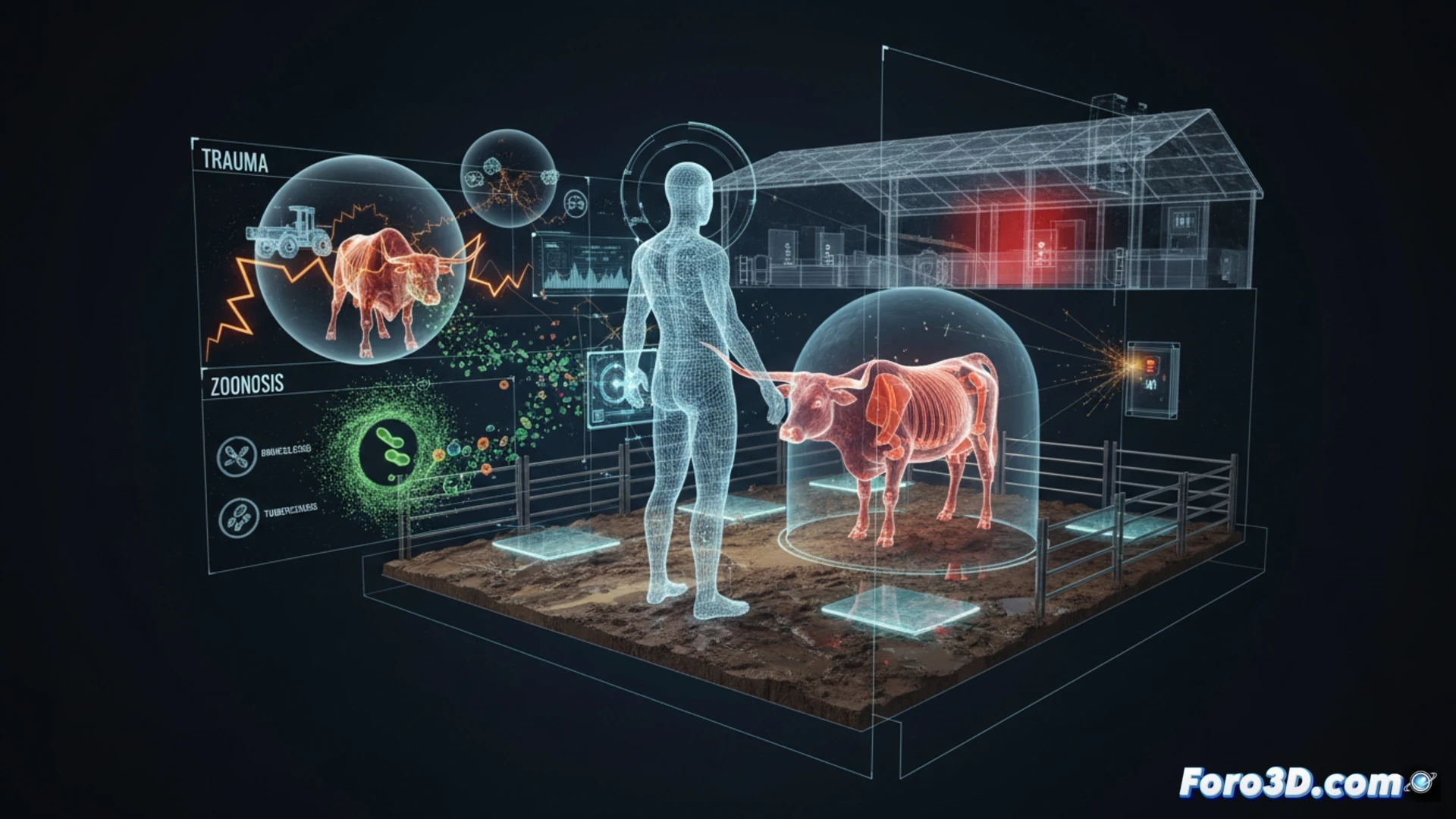
Modeling physical and biological risks in a virtual farm 🐄
To address this need, we propose the development of a 3D infographic that simulates a livestock farm. The model would include an accurate anatomical representation of a bovine and a human, allowing the illustration of the kinematic trajectories of a kick or a horn thrust using animated force vectors. Simultaneously, the transmission routes of brucellosis and tuberculosis would be modeled, highlighting the inhalation of aerosols and contact with fluids through dynamic particles. Statistical incidence data, such as the infection rate from handling placentas or the percentage of fractures from falls in pens, would be superimposed in real time onto the risk zones of the anatomical model.
From prevention to knowledge: the educational value of scientific 3D 🧬
This representation aims not only to catalog hazards but to change the perception of risk. By visualizing the inside of a lung contaminated with Mycobacterium bovis or the impact zone of a kick on the rib cage, the viewer internalizes the severity of the profession. Interactivity allows the user to deactivate machinery layers or modify climatic conditions to observe how exposure varies. Ultimately, turning cold statistics into an immersive experience is the key to effective dissemination in occupational health and veterinary science.
How the dynamics of a stampeding animal can be modeled in 3D to predict risk zones and improve evacuation protocols on livestock farms.
(PS: fluid physics for simulating the ocean is like the sea: unpredictable and you always run out of RAM)