Landscaping, an essential trade in environmental architecture, exposes workers to a unique combination of physical and environmental hazards. From handling organic loads to prolonged exposure to ultraviolet radiation, each task presents an ergonomic challenge. This article proposes a 3D scientific visualization model that integrates biomechanics, thermography, and stress analysis data to map the specific risks faced by landscapers, offering a didactic tool for preventing musculoskeletal injuries and skin pathologies. 🧑🌾
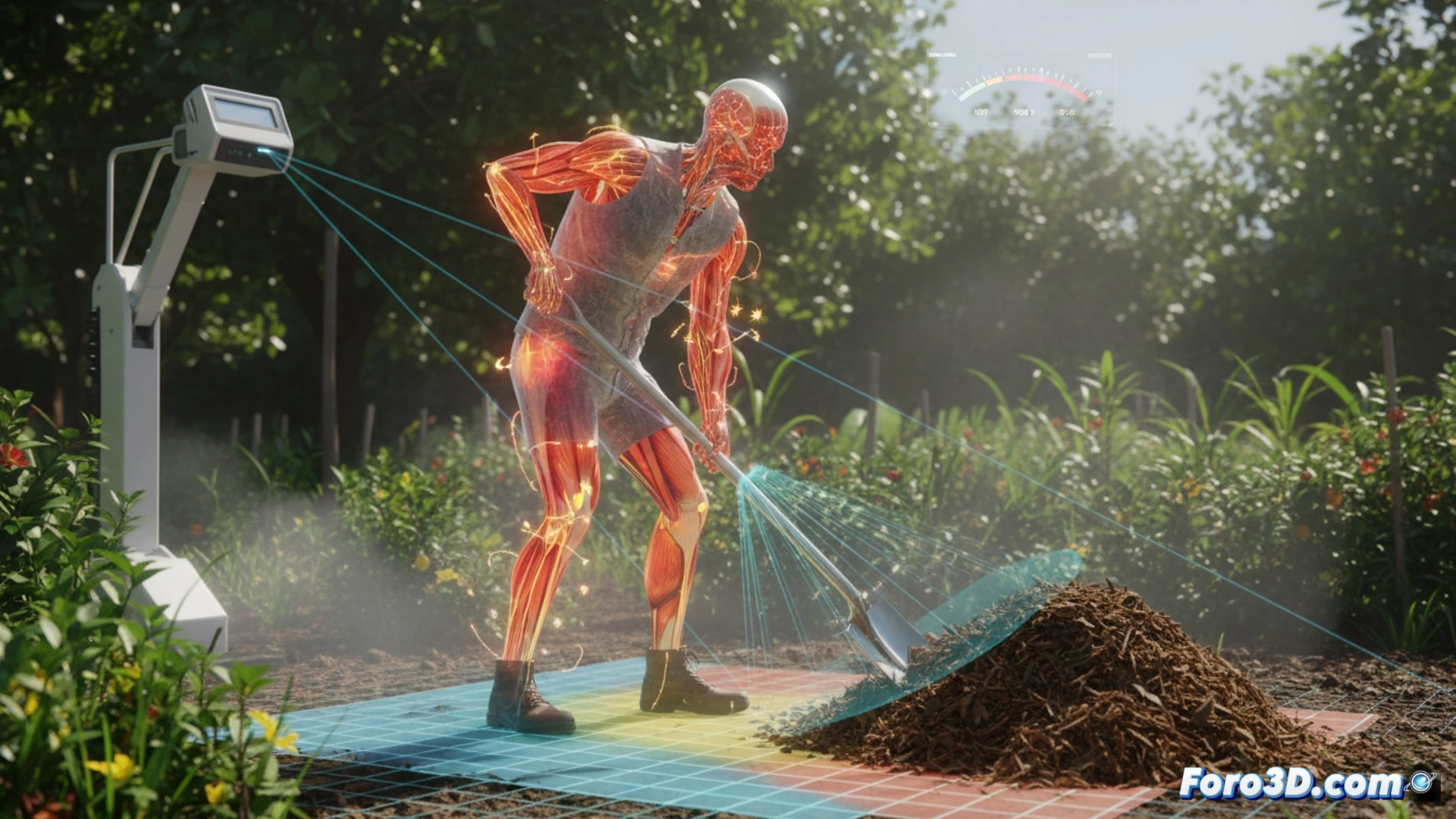
Simulation of Spinal Load and Forced Postures on Uneven Terrain 🦴
The conceptualized tool uses a finite element model of the musculoskeletal system to simulate lifting a 20 kg root ball from a squatting position. The interactive 3D infographic allows rotating the perspective and isolating the lumbar spine, showing in real-time the disc compression at L4-L5, which can exceed 3,500 Newtons at a 60-degree bend. Simultaneously, a dynamic heat map is integrated over the uneven terrain, using accelerometry data to predict the risk of ankle sprain. Muscle tension zones in the trapezius and erector spinae are represented with a chromatic scale ranging from blue (relaxation) to intense red (overload), allowing the trainer to identify the exact moment of biomechanical failure in the lifting technique.
Solar Exposure as a Critical Variable in Occupational Safety ☀️
Beyond body mechanics, the visualization incorporates a UV radiation simulator based on the time of day and latitude. On the landscaper's silhouette, an exposure gradient is projected, revealing the accumulation of erythemal dose on the nape, ears, and forearms during an eight-hour workday. This data layer, superimposed on the working posture, allows directly correlating the neck tilt angle with the skin surface exposed to the sun. The resulting infographic not only educates about the risk of skin cancer but also quantifies the effectiveness of a visor cap or a long-sleeved shirt, transforming a generic piece of advice into a personalized recommendation based on metric data.
How can the interaction between accumulated muscle fatigue from forced postures in landscaping and exposure to thermal stress be modeled in 3D to predict chronic injuries in the worker?
(PS: if your manta ray animation doesn't excite, you can always add documentary music from channel 2)