Red sprites, or elves, are transient luminous events occurring at 100 km altitude, right at the edge of the ionosphere. They manifest as massive rings of red light expanding at near-light speeds, vanishing in less than a millisecond. Their origin lies in the electromagnetic pulse (EMP) generated by an extremely powerful lightning strike on the Earth's surface. Modeling this plasma physics in 3D requires a multidisciplinary workflow combining tomography, electromagnetic simulation, and data segmentation.
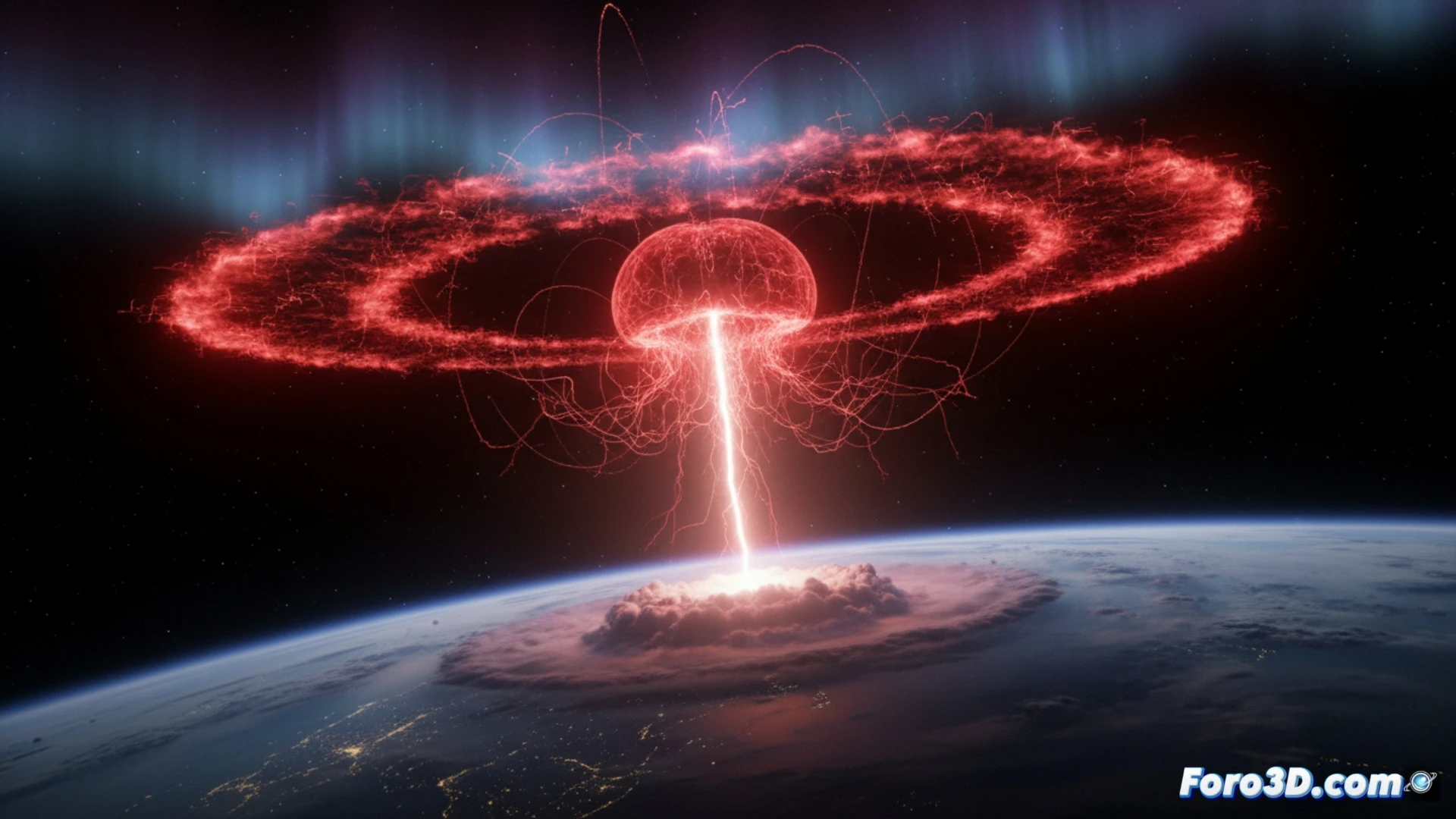
Modeling the EMP pulse with COMSOL and segmentation in Mimics 🌩️
To capture the ring dynamics, we start with COMSOL Multiphysics in its Bio-electromagnetism module, adapting Maxwell's equations to simulate the pulse propagation from the ground to the ionosphere. This model solves the interaction of the electric field with charged particles in the upper atmosphere, calculating the nitrogen excitation rate that produces the characteristic red glow. The resulting plasma density data is exported as meshes or scalar volumes. Here, Materialise Mimics comes into play, not for medical data, but to segment the expanding ring, isolating the regions of highest light intensity from the ionospheric background. This segmentation allows generating a precise 3D mask of the event at each femtosecond of the simulation.
Volumetric reconstruction in VGSTUDIO MAX for analysis 🔬
The final step is scientific visualization in VGSTUDIO MAX. The segmented masks from Mimics and the fields from COMSOL are imported to create a volumetric reconstruction of the sprite. The software allows mapping the ring expansion over time, applying transfer functions that highlight the plasma density gradient. Through cross-sections and animations, we can observe how the red ring propagates at 100 km altitude in less than a millisecond, validating the physical theory and offering a tangible 3D representation of a phenomenon that lasts less than a human blink.
To accurately simulate the dynamics of red sprites in 3D, what fluid and particle modeling techniques allow replicating the annular expansion and filamentary structure of these ionospheric plasmas in real-time or near real-time?
(PS: fluid physics for simulating the ocean is like the sea: unpredictable and you always run out of RAM)