In gravitational wave detection, precision is absolute. However, a recent incident in the laser interferometer revealed how a spurious signal almost got mistaken for a real cosmic event. The origin was not a distant earthquake, but a local seismic micro-vibration combined with thermal noise, which generated a parasitic resonance in the mirror suspension system. This alignment error forced a comprehensive 3D analysis to discern the real source of the disturbance.
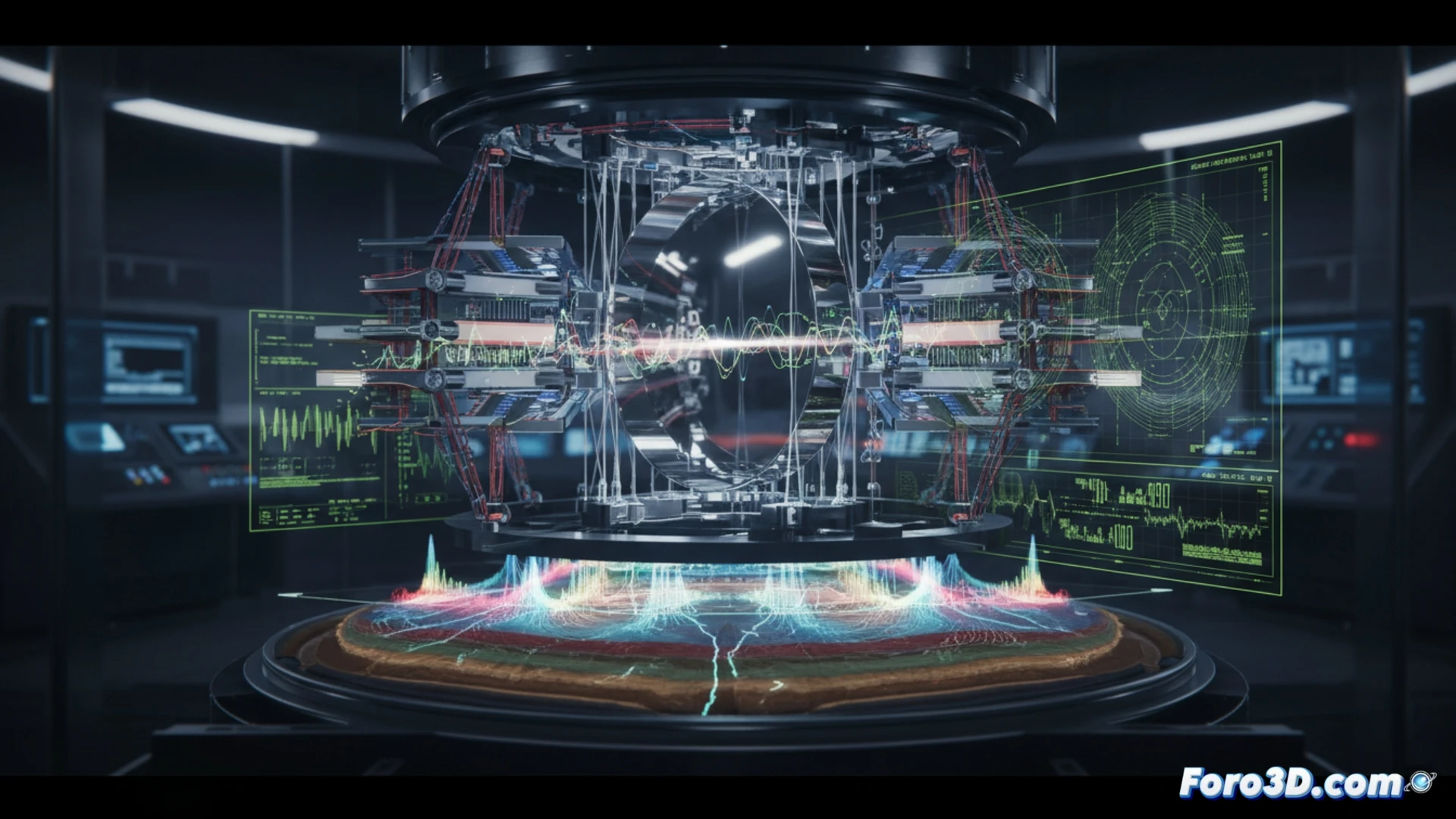
Finite Element Analysis of Parasitic Resonance 🛰️
To solve the mystery, SolidWorks Simulation was used in conjunction with MATLAB for signal processing. The 3D model of the mirror suspension was subjected to modal and fatigue analysis. It was identified that the mass isolation system, designed to filter external vibrations, exhibited an undocumented vibration mode at critical frequencies. Thermal noise, combined with low-amplitude micro-seisms, excited this resonance. The simulation software allowed visualizing the accumulated deformation and incipient fatigue at the anchor points, demonstrating that the material was being subjected to unforeseen cyclic stress.
Lessons for Fatigue Simulation in Critical Systems 🔧
This case underscores that material fatigue not only affects rotating mechanical or structural components. In high-precision systems like LIGO, thermal fatigue and micro-seismic vibrations can generate elastic deformations that translate into catastrophic measurement errors. 3D simulation, supported by tools like Leica Cyclone for precise geometric scanning, becomes indispensable for predicting parasitic resonances before a spurious signal is mistaken for a revolutionary scientific finding.
What advanced modeling techniques allow for more accurate prediction of fatigue induced by parasitic vibrations in the multi-stage seismic isolation systems used in LIGO, and how do they compare to traditional modal analysis methods?
(PS: Material fatigue is like yours after 10 hours of simulation.)