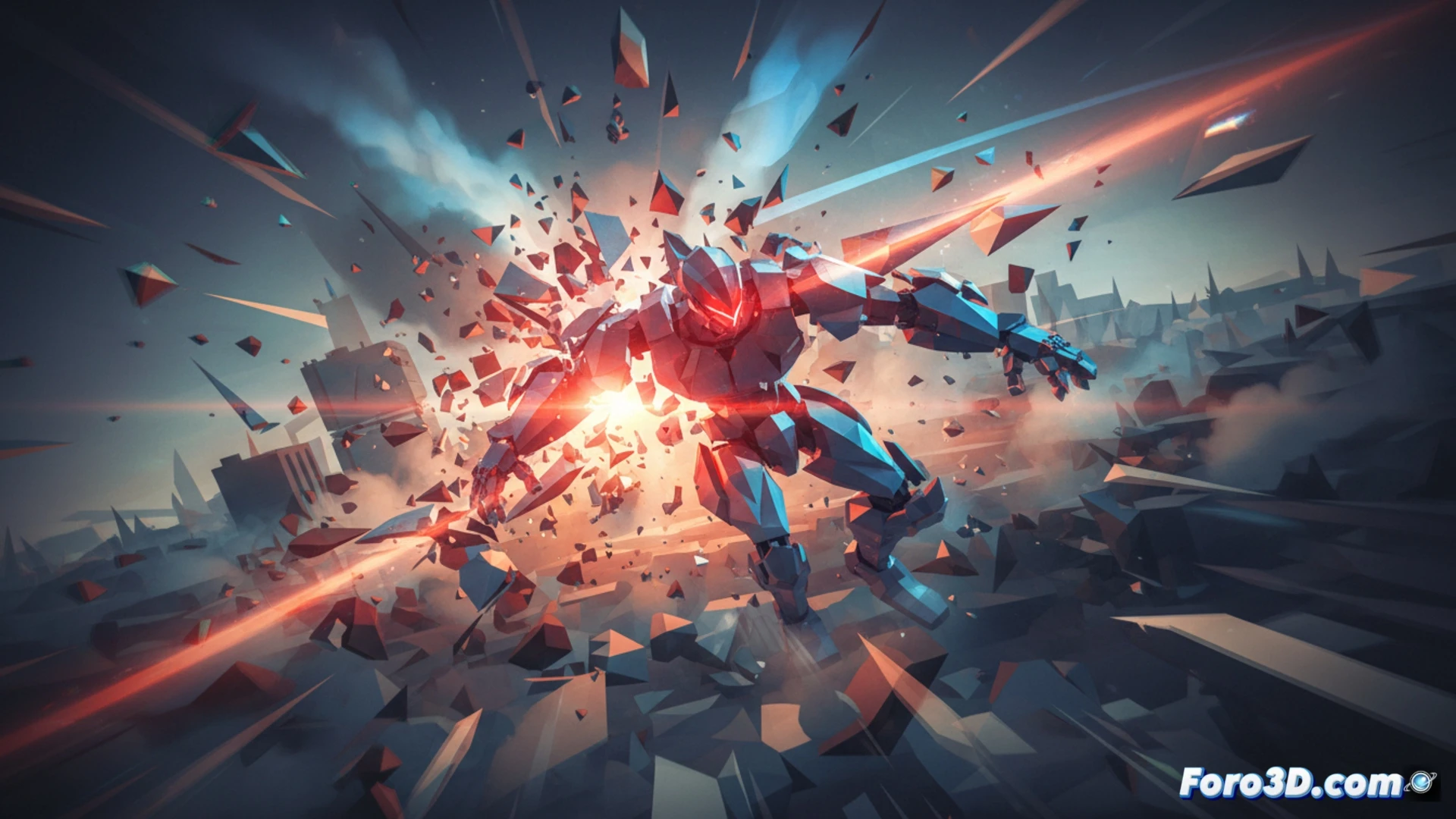
The V.A. Proxy project demonstrates how low-poly aesthetics, far from being a technical limitation, become a narrative tool to represent frenetic action. The key lies in the juxtaposition of minimalist models with aggressive post-processing effects in Unity. While the characters maintain a clean, legible silhouette, the camera is saturated with motion blur, chromatic aberration, and light flares, generating a sense of speed that the human eye interprets as imminent mechanical chaos.
Fast production pipeline: Blender to Unity 🚀
To achieve this fluidity in high-intensity scenes, the pipeline relies on Blender for rapid structural modeling. Optimization starts from the mesh: geometries with a low polygon count are prioritized, and aggressive LODs (Level of Detail) are used to reduce visual complexity as objects move away from the camera. In Unity, the key is using GPU Instancing to render multiple copies of the same object, such as debris or projectiles, without penalizing performance. Post-processing effects are applied using a layer system, activating motion blur only during moments of maximum acceleration to avoid overloading the GPU at rest.
Less geometry, more visual impact 💥
The real lesson of V.A. Proxy is that the perception of graphical quality does not depend on the amount of detail, but on how it is managed. By reducing geometric complexity, the engine frees up resources that are redirected to volumetric effects and particles. The result is a style that, although minimalist, feels denser and more violent than many hyper-realistic titles. For the independent developer, this is a viable strategy: sacrifice polygons to gain personality and performance in the most unrestrained action.
As a developer, what specific criteria did you consider to balance the mechanical chaos of post-processing effects in Unity with the visual clarity necessary in a low-poly environment like V.A. Proxy?
(PS: optimizing for mobile is like trying to fit an elephant into a Mini Cooper)