The dream of photonic propulsion came to an abrupt halt when a space probe failed to deploy its 100 m² solar sail. The 3D reconstruction of the incident, based on telemetry and membrane dynamics models, identified the culprit: the electrostatic charge of deep space caused the thin Mylar layers to stick together, preventing their deployment. This real-world case demonstrates how material fatigue simulation is crucial for validating deployable structures under extreme conditions.
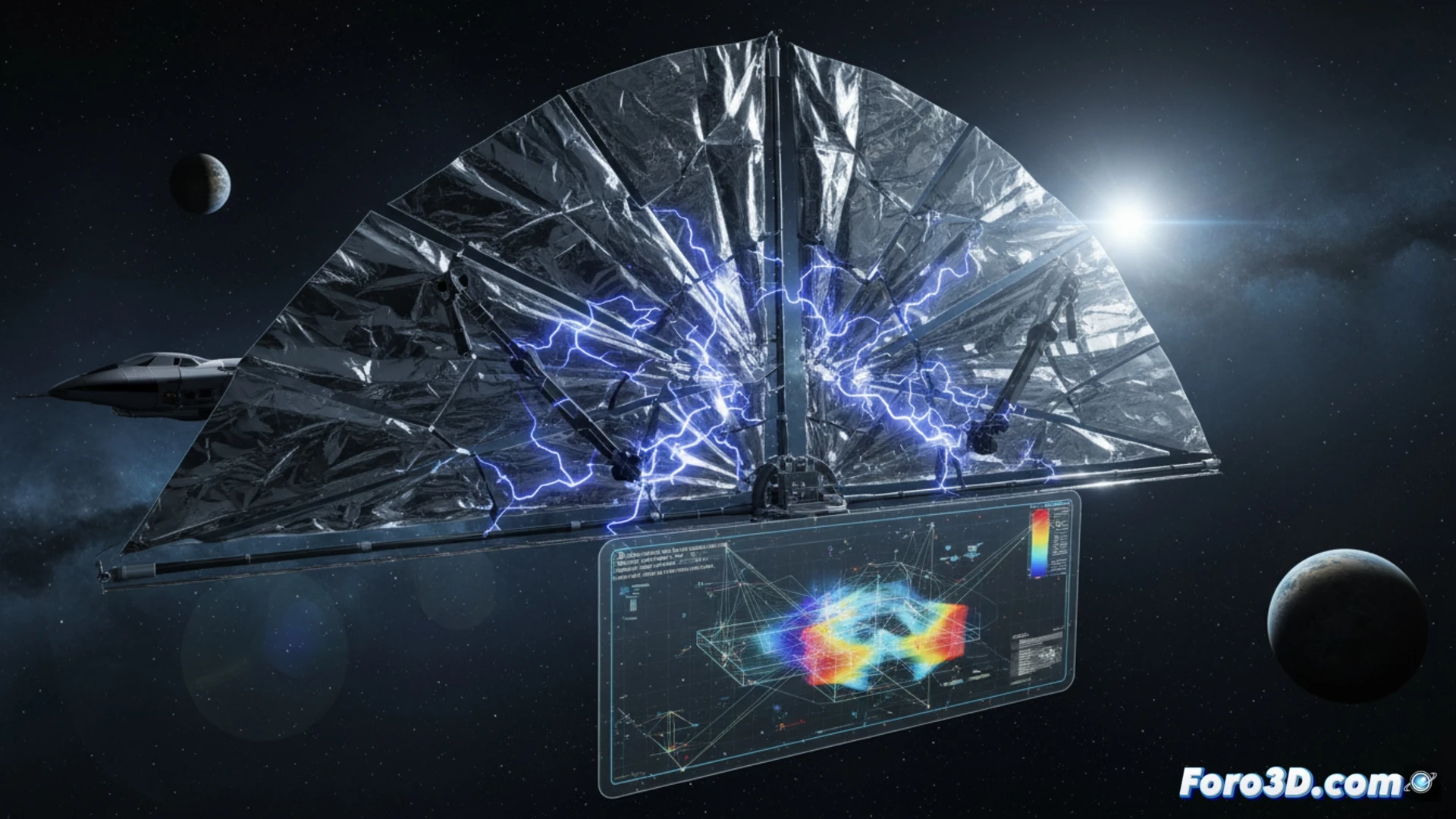
Technical Workflow: Membrane Dynamics with MSC Adams and Visualization in Cinema 4D 🚀
The analysis began in MSC Adams, where the sail was modeled as a flexible membrane subjected to electrostatic adhesion forces. Engineers simulated layer-to-layer contact, adjusting friction coefficients and dielectric stiffness of the Mylar to replicate the vacuum. The results showed that, without a charge dissipation path, the sheets behaved like a monolithic block, blocking the deployment mechanism. Subsequently, deformation data was exported to Cinema 4D and Maya to generate a photorealistic visualization of the failure, allowing the team to observe how stresses concentrated at the folds, revealing critical fatigue points that telemetry alone could not show.
Lessons for the Design of Deployable Structures in Space 🛰️
This incident underscores that material fatigue depends not only on mechanical loads but also on electromagnetic interactions in the mission environment. For future designs, simulation must integrate the electrostatic properties of polymers and incorporate conductive coatings to dissipate charge. The workflow with Adams and Cinema 4D demonstrates that visualizing the failure in 3D not only aids diagnosis but also helps redesign folds and separators to prevent vacuum adhesion, ensuring that tomorrow's solar sails do not remain folded.
What mesh parameters and boundary conditions were critical in the 3D simulation to predict the exact crack initiation point on the solar sail under static load, and how were these validated against the actual failure data?
(PS: Material fatigue is like yours after 10 hours of simulation.)