A recently launched CubeSat suffered a catastrophic structural collapse minutes after reaching orbit. The cause was not an impact or extreme vibration, but a microscopic phenomenon: outgassing from a non-certified commercial adhesive. 3D forensic analysis revealed that trapped gas bubbles in the glue, called vacuoles, expanded in the vacuum until they fractured the carbon joints from within.
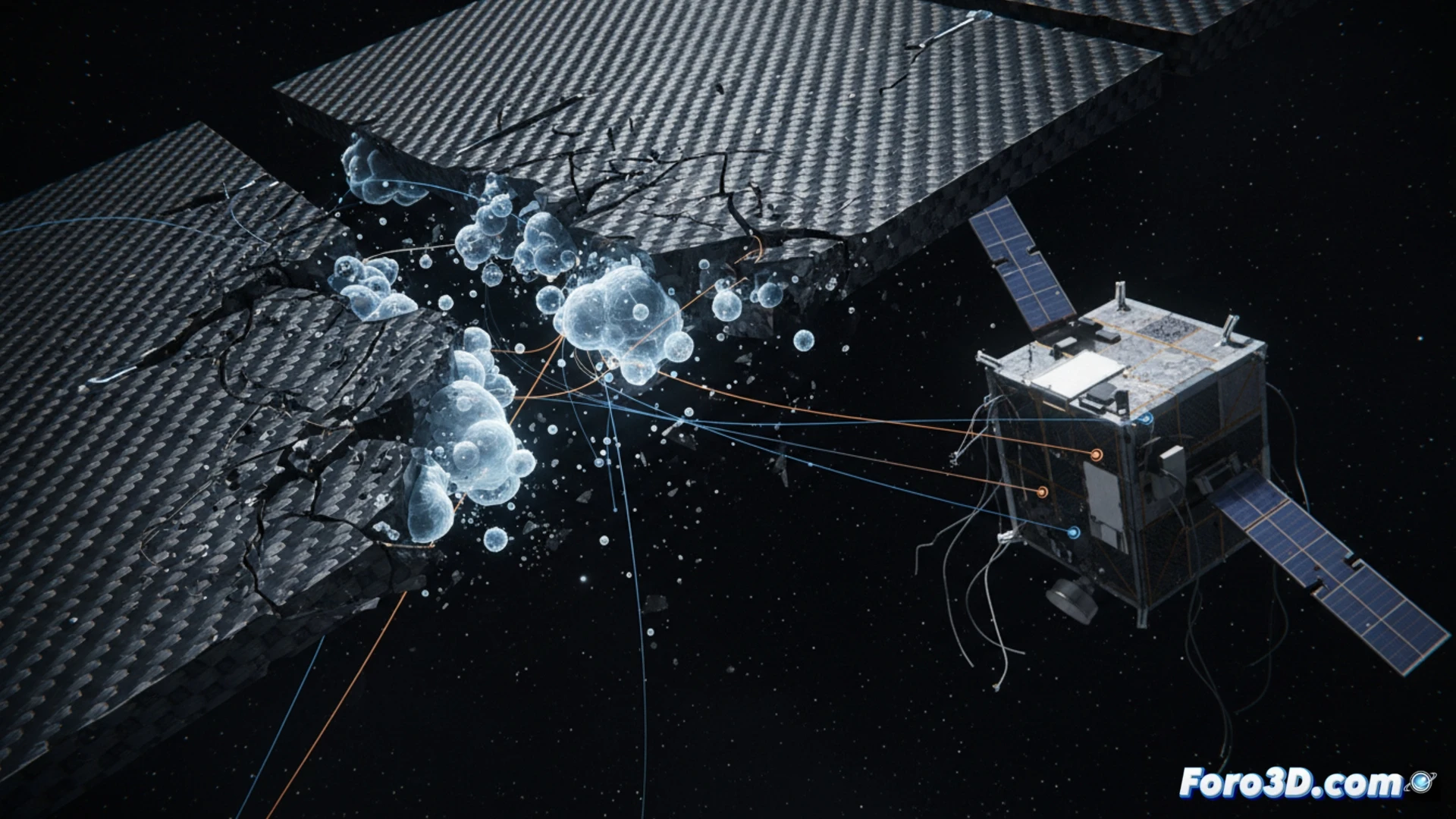
Modeling vacuole expansion with Siemens NX and Ansys Mechanical 🛰️
The engineering team used Siemens NX to reconstruct the carbon fiber chassis and adhesive joints. High-resolution computed tomography data processed with Volume Graphics software was imported, identifying micropores between 10 and 50 microns in the adhesive. This data was transferred to Ansys Mechanical to simulate the behavior of vacuoles during the transition to vacuum. The model coupled the gas equation of state (Boyle's Law) with the fracture mechanics of the joint. Results showed that the internal pressure of the vacuoles increased up to 1.2 MPa upon expansion, generating local stresses exceeding the ultimate strength of the epoxy resin. This hydraulic wedge effect propagated cracks along the carbon-adhesive interface, disintegrating the structure in seconds.
Material certification as a barrier against outgassing 🔬
This case demonstrates that a single non-aerospace component can nullify decades of structural design. Vacuum-certified adhesives (such as those from the EC-2216 or Hysol EA-9394 series) have a volatile content below 0.1%, virtually eliminating the risk of vacuoles. Comparative simulation with Ansys Mechanical showed that, using the certified adhesive, residual stresses remained below 15% of the fatigue limit. The lesson is clear: in space, what you don't see can indeed kill you. Structural integrity begins with the chemistry of the glue.
What numerical simulation techniques allow for more accurate prediction of vacuole nucleation and propagation in aluminum alloys under vacuum and cyclic loading conditions, to prevent catastrophic failures in space structures like CubeSat chassis?
(PS: Material fatigue is like yours after 10 hours of simulation.)