The development of massive open worlds with anime aesthetics presents a unique technical challenge: maintaining stylized shading fidelity while managing dynamic lighting cycles. The Seven Deadly Sins: Origin addresses this dichotomy by using Unreal Engine 5 as its backbone, relying on Lumen to achieve global illumination that respects the rules of cel-shading without falling into visual inconsistencies during day-to-night transitions. 🎮
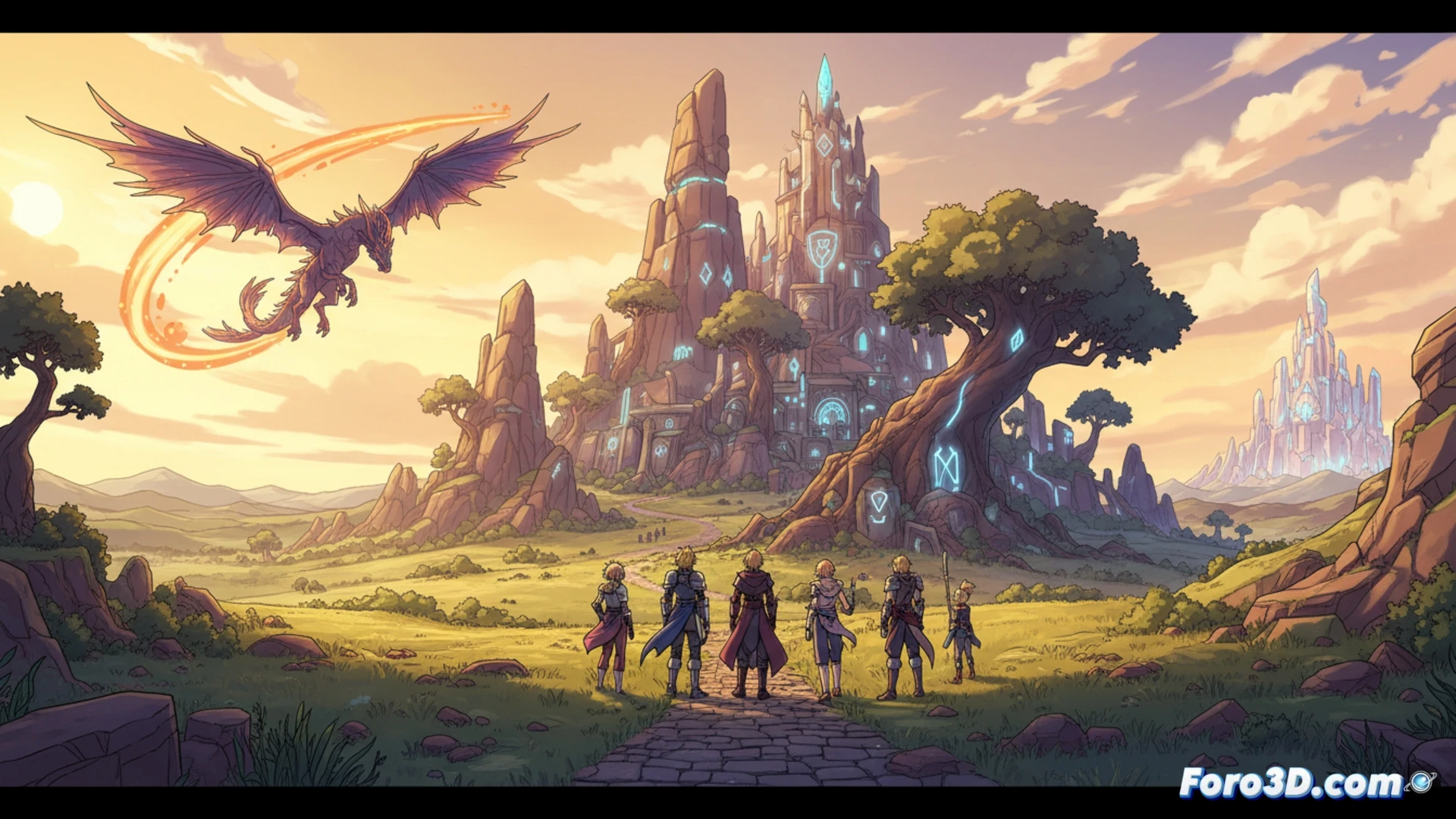
Artistic pipeline: integrating Maya and Houdini into the engine 🛠️
The workflow for this title begins in Maya, where characters are modeled and rigged with clean geometry and low polygon density, crucial for flat shading (toon shading) to work without artifacts. Subsequently, Houdini comes into play for procedural terrain generation and asset scattering in the open world, such as trees and rock formations. The technical key lies in how Unreal Engine 5 processes this data: upon importing the models, the engine applies a master material that combines a cel-shaded shader with Lumen parameters, allowing bounced light from sunsets or nighttime shadows to modify the base shading color without breaking the characteristic black outline of anime. To optimize performance, LODs (levels of detail) automatically generated in Houdini are used to reduce geometry at a distance, while Lumen is configured with low reflection resolution for distant objects, prioritizing resources in areas near the player.
Lessons for developing stylized worlds 💡
This approach demonstrates that realistic lighting is not an enemy of cartoon aesthetics, but rather a tool that, when well-calibrated, enriches immersion. The biggest takeaway for developers is the need to customize Lumen parameters for each scene: a day/night cycle in a cel-shaded world should not replicate the exact physics of light, but rather imitate its emotional behavior. Integrating Houdini as a bridge between Maya and Unreal Engine 5 allows scaling the production of a massive world without saturating memory, a reminder that optimization begins in the pipeline, not in the engine.
How does Unreal Engine 5 optimize cel-shading to render a massive open world without sacrificing visual fluidity or anime aesthetics in Seven Deadly Sins Origin?
(PS: 90% of development time is polishing, the other 90% is fixing bugs)