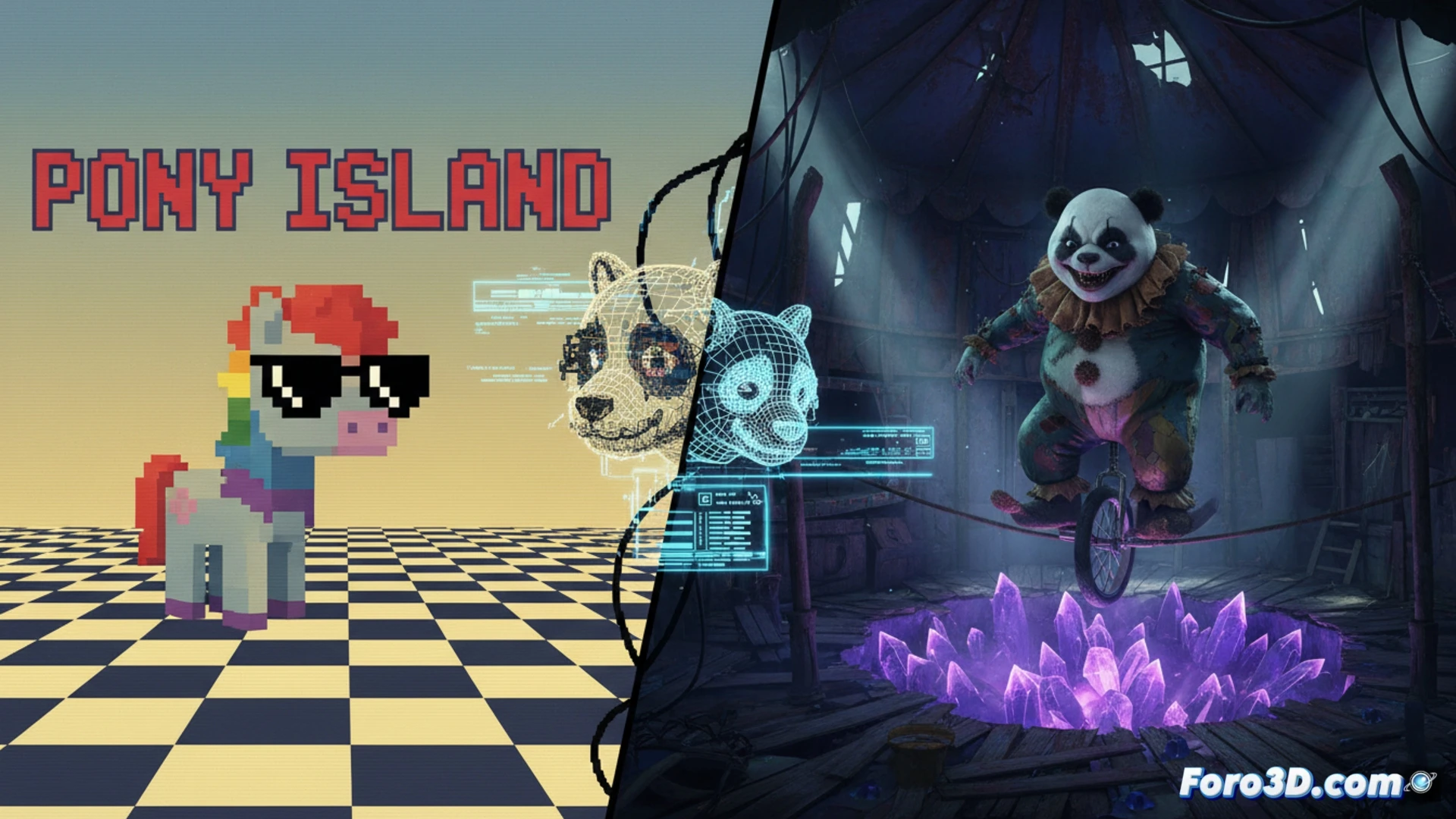
The announcement of Pony Island 2: Panda Circus has shaken the indie scene not only for its narrative proposal but also for its aggressive art direction. The game, developed in Unity, promises an experience where 8-bit pixel art clashes head-on with surreal 3D environments. For a developer, this is not just an aesthetic decision; it is a technical challenge on how to manage multiple rendering pipelines and maintain coherence within the same graphics engine.
Technical Pipeline: From Photoshop to Blender and the Magic of Unity 🛠️
The workflow to achieve these abrupt transitions requires meticulous control of assets. 2D sprites are created in Photoshop using limited palettes and manual dithering to emulate old hardware. On the other hand, surreal 3D models are sculpted in Blender, applying non-photorealistic (NPR) materials and geometric distortions. The technical trick lies in Unity: you must use Sorting Layers and custom events to swap the camera between orthographic (for 8-bit) and perspective (for 3D) modes. To avoid flickering during transitions, it is recommended to preload scenes in Additive Mode and use a global Canvas for fourth-wall-breaking effects.
Breaking the Fourth Wall Without Breaking Performance 🎭
Breaking the fourth wall in Pony Island 2 is not a simple graphical joke; it is a narrative device that forces the engine to change its visual state in real-time. For indie developers, the key advice is not to overuse coroutines for these changes, as they can cause frame time spikes. Instead, a State Machine Behavior in Unity's Animator should be used to manage style transitions (from 2D to 3D) via Shader Graph interpolations. This allows the visual jump to be jarring for the player but smooth for the engine, maintaining a stable technical experience.
How does Unity manage the technical complexity of such aggressive visual chaos as in Pony Island 2 without compromising performance on modest hardware?
(PS: optimizing for mobile is like trying to fit an elephant into a Mini Cooper)