Arizona Sunshine 2 has established itself as a technical benchmark in virtual reality development, demonstrating that Unity can handle complex physics systems and advanced dismemberment without sacrificing performance. The game, set in a post-apocalyptic desert, uses an artistic pipeline that combines Blender for organic modeling and Substance Painter for PBR texturing, achieving dynamic lighting that enhances immersion in VR. For indie developers, this title offers key lessons on how to optimize real-time interactions. 🎮
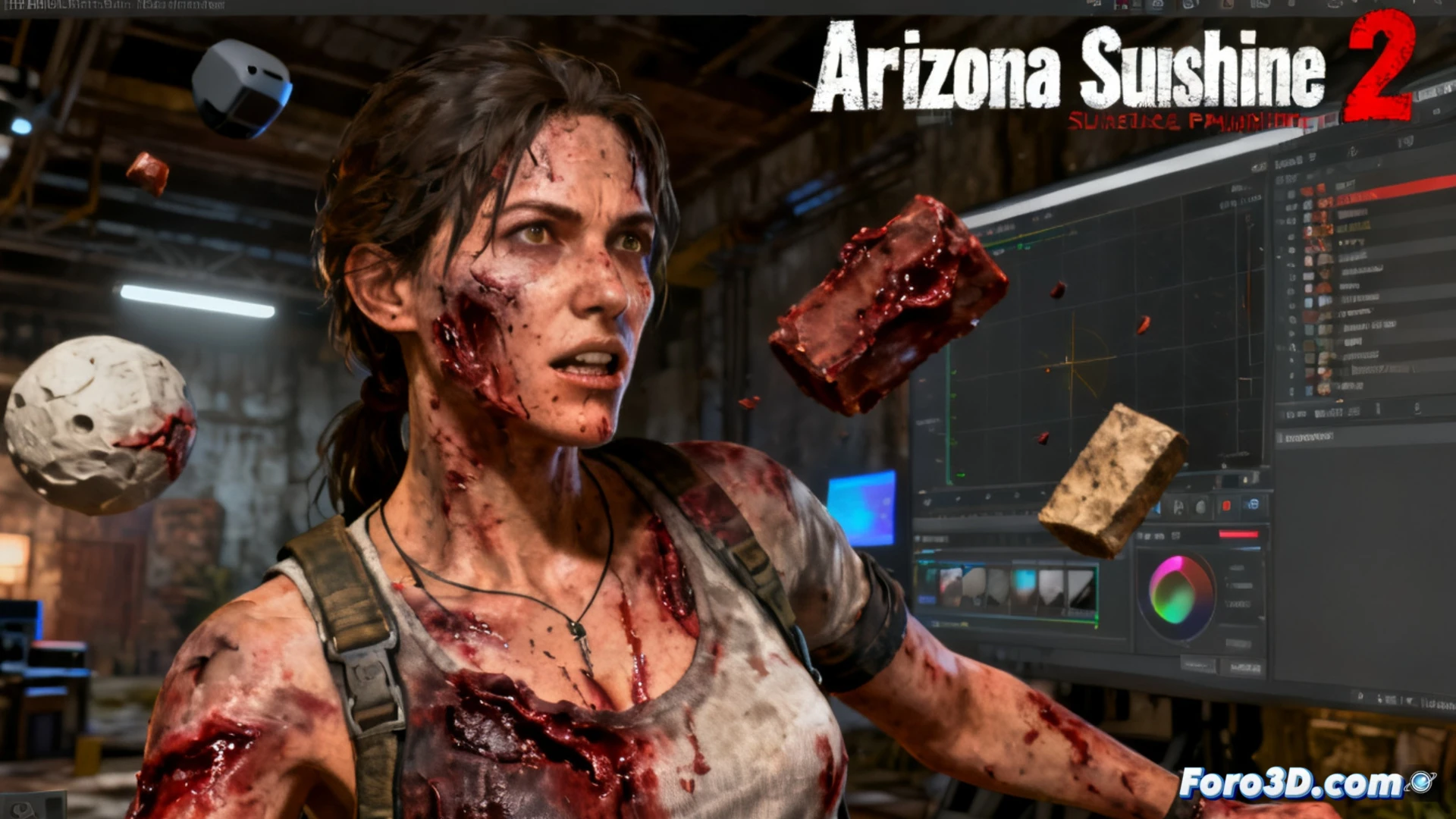
Technical Pipeline: From Blender to Unity with Substance Painter 🛠️
The asset workflow in Arizona Sunshine 2 begins in Blender, where zombies and the desert environment are modeled with topology optimized for deformations. Then, Substance Painter applies physically based (PBR) textures that react to the desert sunlight, a critical factor in VR where the human eye detects lighting inconsistencies. In Unity, the dismemberment system is implemented using pre-cut meshes and a particle system that simulates blood and tissue, all managed by the native physics engine. The key lies in using convex colliders and joints configured to support the high framerate required in VR (minimum 90 FPS). Developers must prioritize dynamic LOD and occlusion culling to avoid performance drops.
Tips for Implementing Damage and Interactive Physics in VR 💡
Advanced dismemberment does not require expensive plugins. In Unity, you can use the Skinned Mesh Renderer system with blendshapes for smooth deformations, combined with a script that instantiates prefabs of severed limbs. For realistic physics, avoid excessive use of Rigidbody; instead, use CharacterJoint to simulate tissue resistance. A practical tip: test your mechanics in a VR headset from the early stages, as the perception of weight and gravity changes drastically compared to flat screen. Arizona Sunshine 2 demonstrates that a small team can achieve AAA results if they optimize every asset from modeling to the desert's time-of-day lighting.
How did the Vertigo Games team manage to implement the realistic physics system and dismemberment mechanics in Arizona Sunshine 2 using Unity without sacrificing performance on virtual reality devices?
(PS: shaders are like mayonnaise: if they break, you start all over again)