The release of The Legend of Zelda: Tears of the Kingdom has redefined the limits of physics simulation on limited hardware. Nintendo, using its proprietary KingSystem engine and a highly modified version of Havok Physics, implemented the Ultrahand system. This allows players to join disparate objects in real-time, creating complex vehicles and structures with barely any latency. For developers, the achievement is not just playable, but technically astonishing, as it manages hundreds of rigid bodies interacting simultaneously on a console with very constrained memory and CPU resources.
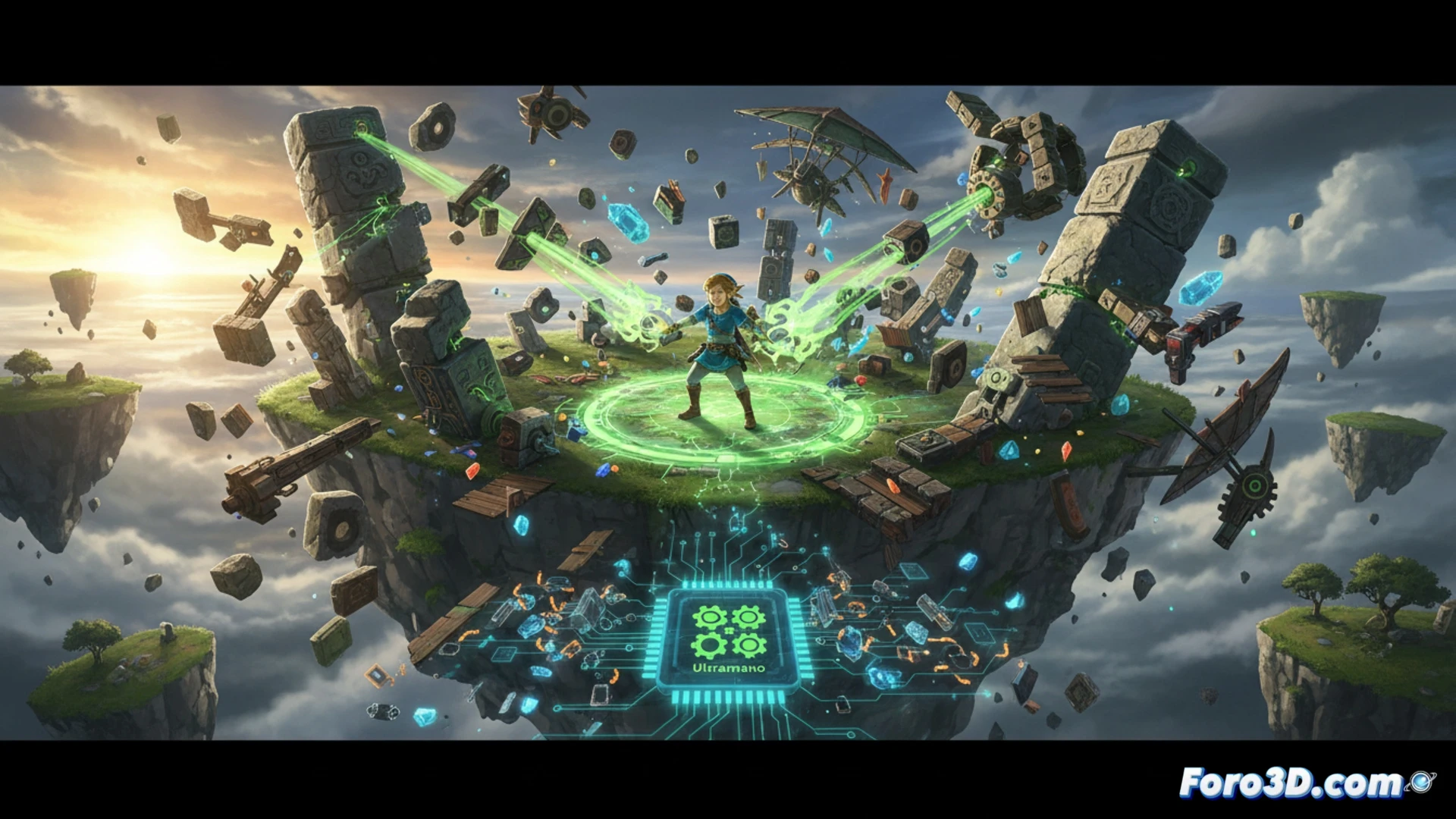
Deep modification of Havok and constraint management 🛠️
The technical key lies in how Nintendo modified the Havok Physics middleware. Instead of using the standard joint or constraint system, they created a system of temporary and hierarchical constraints. When a player uses Ultrahand, the engine does not brute-force calculate all collisions between every pair of objects. Instead, it groups the joined objects into a single constraint tree, simplifying contact resolution. Additionally, they implemented aggressive physics culling: objects far away or out of the player's view drastically reduce their update frequency. This technique, known as Level of Detail (LOD) for physics, allows maintaining stable 60 FPS even with massive constructions. Compared to Unreal Engine, which uses Chaos Physics with a more generic approach, Nintendo's solution is extremely specific to its use case, sacrificing versatility for performance.
Lessons for independent developers 💡
The main lesson for small studios is to prioritize optimization over absolute precision. You don't need a perfect physics engine; you need one that feels realistic within your game's context. Nintendo demonstrated that modifying a mature middleware like Havok is more efficient than building an engine from scratch. For an indie, the recommendation is to limit the number of active physics objects per zone and use simplified constraints (for example, anchor points instead of full torque calculations). Likewise, the spatial partitioning of Hyrule's world is a model to follow: dividing the map into cells that only activate complex physics when the player directly interacts with them.
As a developer, what practical lessons about massive physics optimization and real-time collision handling can we extract from the Ultrahand system to apply in engines like Unity or Unreal Engine without sacrificing performance on modest hardware?
(PS: a game developer is someone who spends 1000 hours making a game that people complete in 2)