The new Turtle Beach Stealth 700 Gen 3 arrive on the market promising a revolution in auditory perception for virtual environments. Originally designed for gaming, their 3D spatial audio system and multiplatform connectivity make them a viable tool for the modeling and simulation professional. We analyze if their low latency and fast charging justify their inclusion in a high-precision technical workflow. 🎧
Key specifications and multi-connection performance ⚡
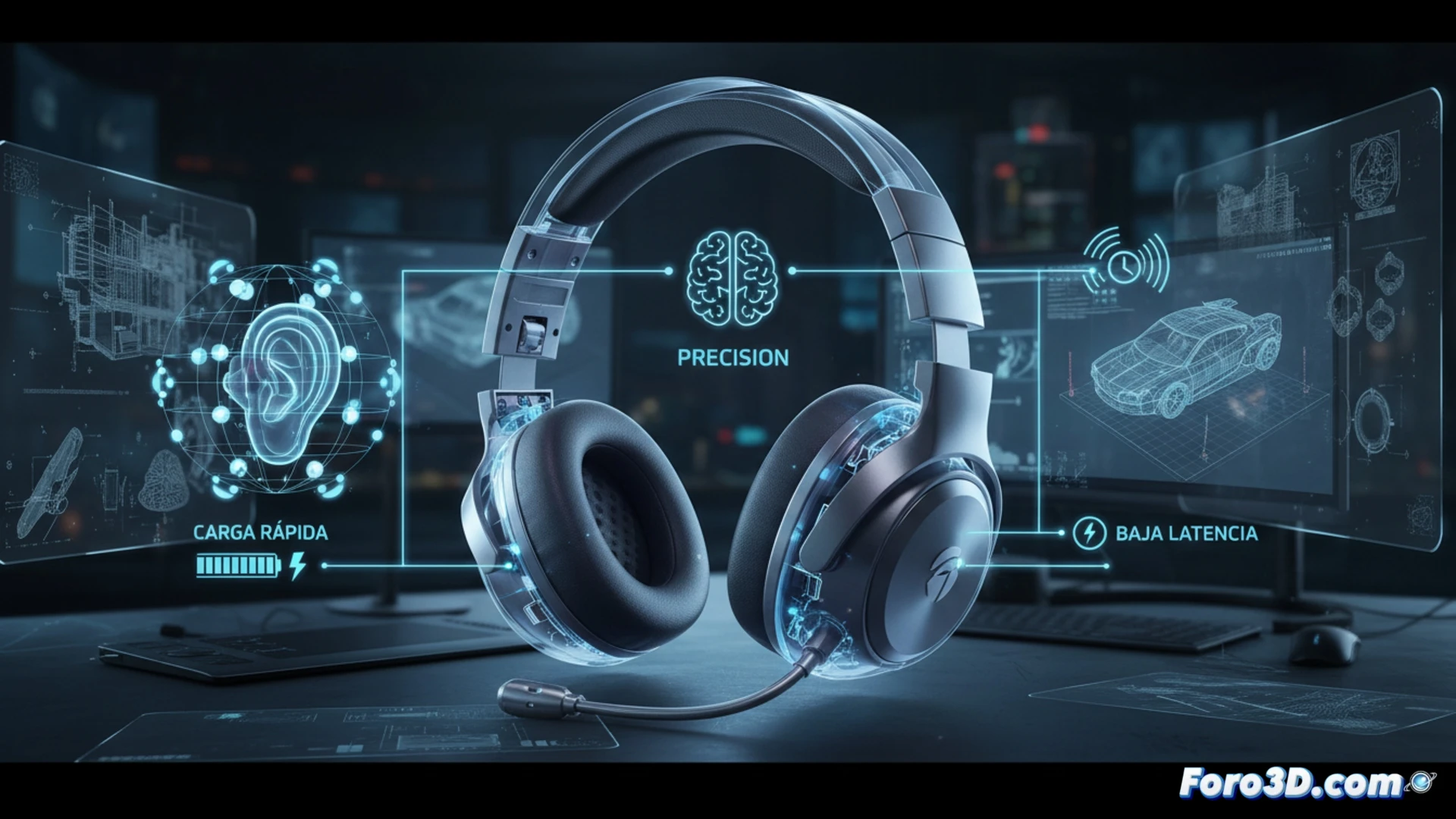
The Stealth 700 Gen 3 incorporates 50mm drivers with neodymium magnets and a frequency response ranging from 20Hz to 22kHz, covering the auditory spectrum needed to detect artifacts in audio tracks synchronized with animations. Its most notable feature is the fast charging system: with just 15 minutes of charging, you get up to 8 hours of continuous use, minimizing downtime during long rendering sessions. Connectivity is managed via Bluetooth 5.2 and a low-latency (less than 20ms) 2.4GHz wireless transmitter, allowing simultaneous connection to two sources. This is vital for the professional who needs to monitor a real-time simulation while receiving instructions via a conference call. Additionally, support for DTS Headphone:X and Windows Sonic spatial audio enables precise localization of sound sources in 3D environments, facilitating the detection of errors in spatial mixes or acoustic simulations.
Are they really useful for the 3D workflow? 🎯
While the main focus of the Turtle Beach Stealth 700 Gen 3 is interactive entertainment, its technical architecture positions it as a competent monitoring peripheral for the design studio. The combination of passive isolation, low latency, and spatial audio allows the modeler to immerse themselves in the soundscape of a scene without external interference. However, the professional should note that the factory equalization is geared towards aggressive frequencies for games. For audio editing or post-production tasks, it will be necessary to adjust the equalizer using the Swarm II application to obtain a flat response. Ultimately, it is a solid option for those seeking versatility between work and testing immersive environments, although it does not replace a professional studio monitor for mastering.
Is the spatial audio system of the Turtle Beach Stealth 700 Gen 3 capable of providing precise localization of sound sources in a 3D modeling environment, surpassing the latency of traditional studio monitors?
(PS: RAM is never enough, like coffees on a Monday morning)