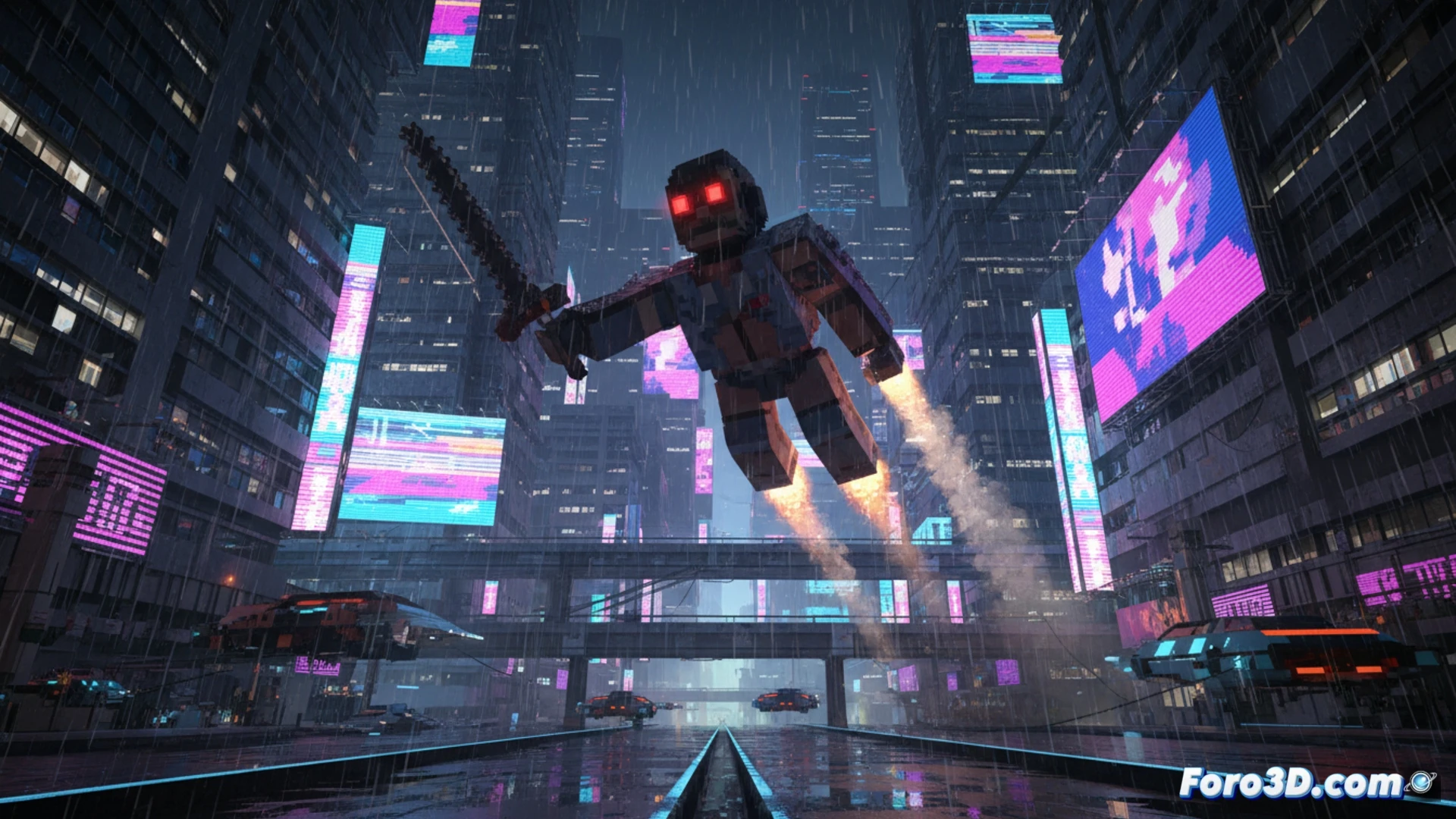
Trigger Happy Interactive has achieved a unique visual balance in Turbo Overkill by combining the rawness of pixel art with the saturation of neon. Using Unity's High Definition Render Pipeline (HDRP), the team achieves a retro-modern look that pays homage to classic shooters without giving up current lighting techniques. The key lies in managing custom shaders and a highly contrasted light palette.
Managing neon lights and shaders in HDRP 🎮
To achieve that saturated glow without sacrificing performance, the studio applies point lights with high intensity values and a fine-tuned attenuation range. The shaders use a simplified specular reflection model that, combined with aggressive post-processing bloom, simulates the glow of neon tubes without the need for complex bounces. Assets modeled in Blender are exported with normal and emissive maps, which Photoshop helps texture with very pure color channels. The trick is to limit the number of dynamic lights per scene and use baked reflection probes so the human eye perceives a vibrant city without overloading the GPU.
The art of retro without losing fluidity 🚀
The most interesting aspect of Trigger Happy Interactive's approach is that it demonstrates that visual style does not depend solely on texture resolution, but on lighting contrast. By prioritizing flat shaders with hard edges and high-impact lights, they make the action at 60 FPS feel faster and more visceral. For independent developers, this lesson is key: real-time optimization is not at odds with a strong graphical identity, as long as you know how to balance the complexity of HDRP and properly integrate external tools like Blender and Photoshop.
What specific Unity HDRP techniques did Trigger Happy Interactive use to achieve the contrast between dynamic lighting and pixel art without losing the retro essence of Turbo Overkill?
(PS: 90% of development time is polishing, the other 90% is fixing bugs)