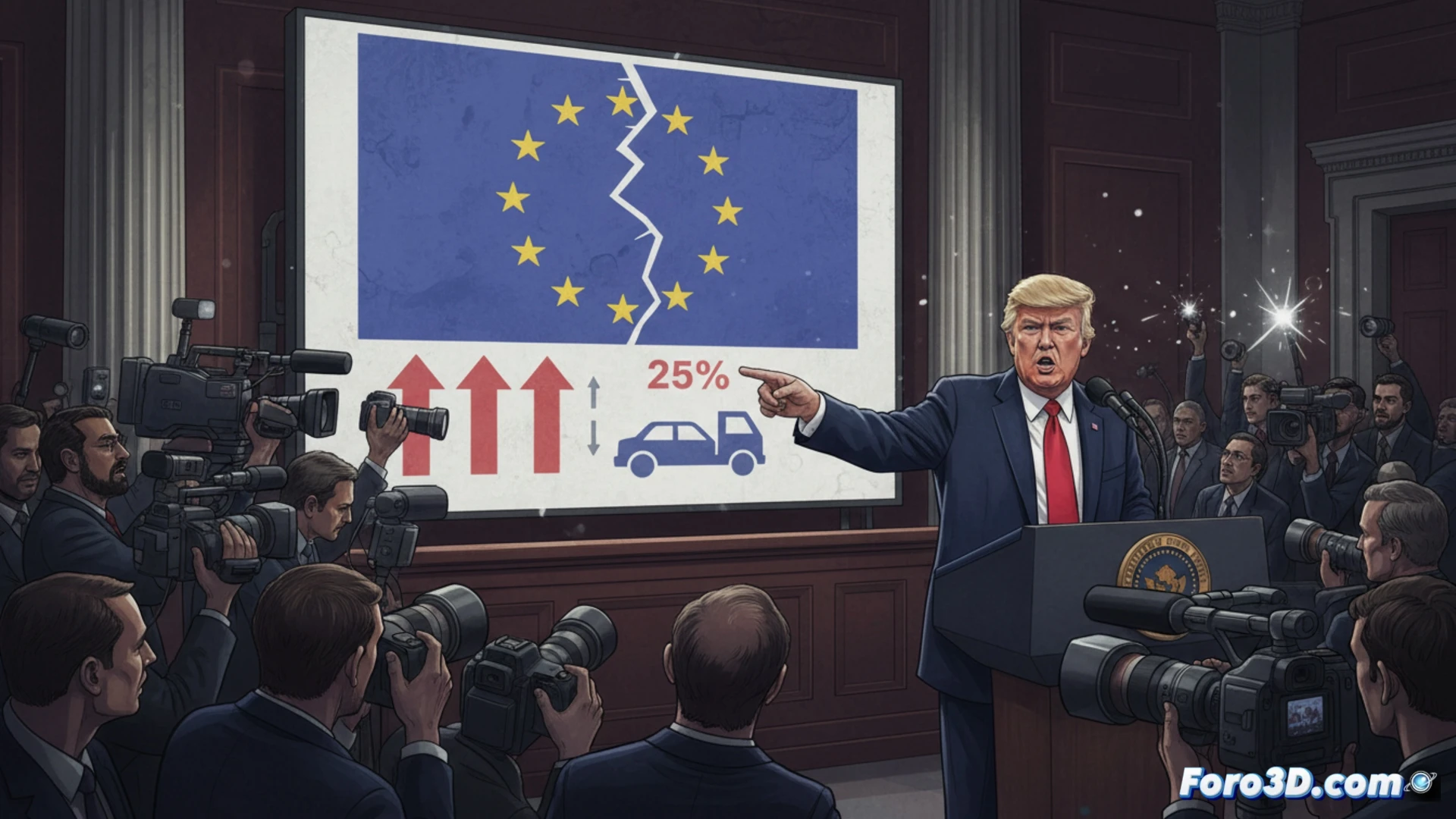
U.S. President Donald Trump has once again attacked the European Union, accusing it of not respecting previous trade agreements. In response, he announced a 25% tariff increase on all automobiles and trucks manufactured in the bloc. The measure directly impacts manufacturers such as Volkswagen, BMW, and Stellantis, which export thousands of vehicles to North America each year. European stock markets reacted with declines, and industry unions are already anticipating possible production cuts.
The technical blow to the global supply chain 🔧
The tariff increase directly affects the just-in-time logistics used by European plants. Each vehicle exported from Germany or Spain now adds an extra cost of between 2,500 and 5,000 euros in customs duties alone. Manufacturers like Audi are already evaluating moving production to their plants in Mexico or China to avoid the tax. The problem is that those countries are also in Washington's crosshairs. Dependence on Asian electronic components further complicates the adjustment, as the tariffs do not differentiate between a complete car and its parts.
The masterstroke to sell more pickups 🚛
The curious thing about this case is that Trump accuses Europe of not complying with agreements while he himself renegotiates everything aggressively. But the fine detail is that the 25% tariffs do not affect American pickup trucks, which are the best-selling vehicles in their market. So, if you are a farmer from Iowa and want a Ford F-150, you won't notice. But if you are an executive from Stuttgart and your Mercedes is stuck at the port of Baltimore, you have to pay. The move is as subtle as a sledgehammer: protect your own and punish others. Europe, meanwhile, wonders whether to respond with tariffs on bourbon or blue cheese.