Delroy Garrett Jr., known as Triathlon, is not your average superhero: he is an Olympic athlete whose physical abilities were tripled by a mystical sect. His time with the Avengers turned him into an icon of superhuman performance, but from a technical perspective, his figure poses a fascinating challenge for 3D modeling and sports simulation. How do you digitally recreate a body that swims, pedals, and runs with an efficiency impossible for a real human? 🏊♂️
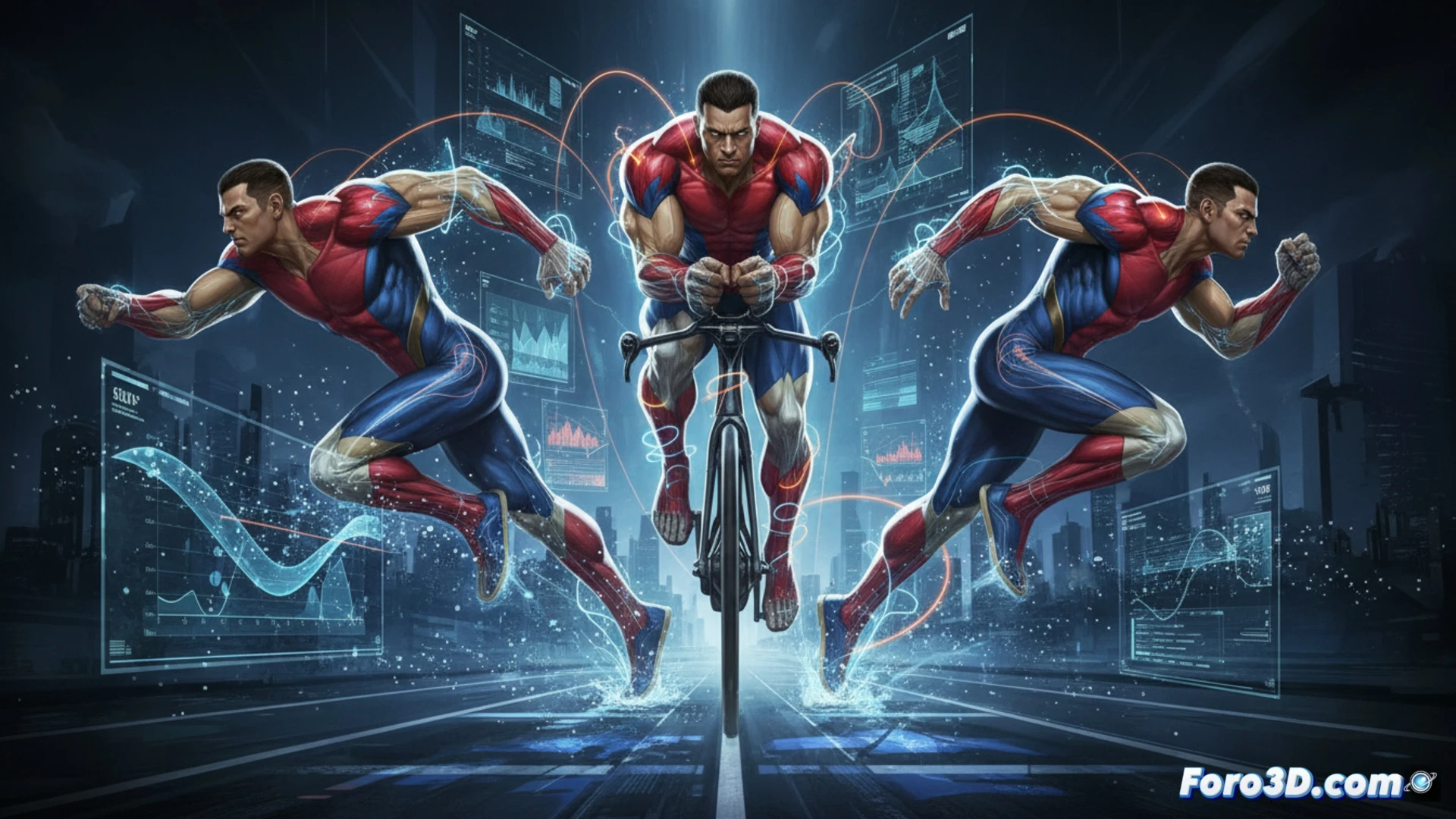
Motion capture and extreme performance simulation 🎯
To analyze Triathlon with technical rigor, we would apply a motion capture (mocap) pipeline with high-frequency optical markers, recording each phase of the triathlon: freestyle stroke swimming, transition to aerodynamic cycling, and elastic stride running. Biomechanical modeling in software like OpenSim or AnyBody would allow scaling muscle power by three, adjusting parameters such as maximum joint torque, theoretical heart rate, and oxygen consumption. The simulation would reveal that an athlete with that capacity could complete an Ironman in under three hours, but with bone stresses exceeding human limits, something only detailed 3D visualization can accurately show.
Human limits and sports fantasy in 3D 🦴
3D technology is not only useful for validating fictions but also for exploring the frontier of real performance. By comparing Triathlon's speed and fatigue curves with those of athletes like Alistair Brownlee, the model shows that a tripled body would require reinforced joints and fictional bone density. These simulations force us to ask: if elite sports already border on the superhuman, where does science end and myth begin? Foro3D breaks down that line with data, meshes, and algorithms.
How could the distribution of bone stress in the limbs of an athlete with tripled strength be modeled in 3D to predict fracture points during a high-intensity triathlon?
(PS: VAR in 3D: now with replays from angles that didn't even exist)