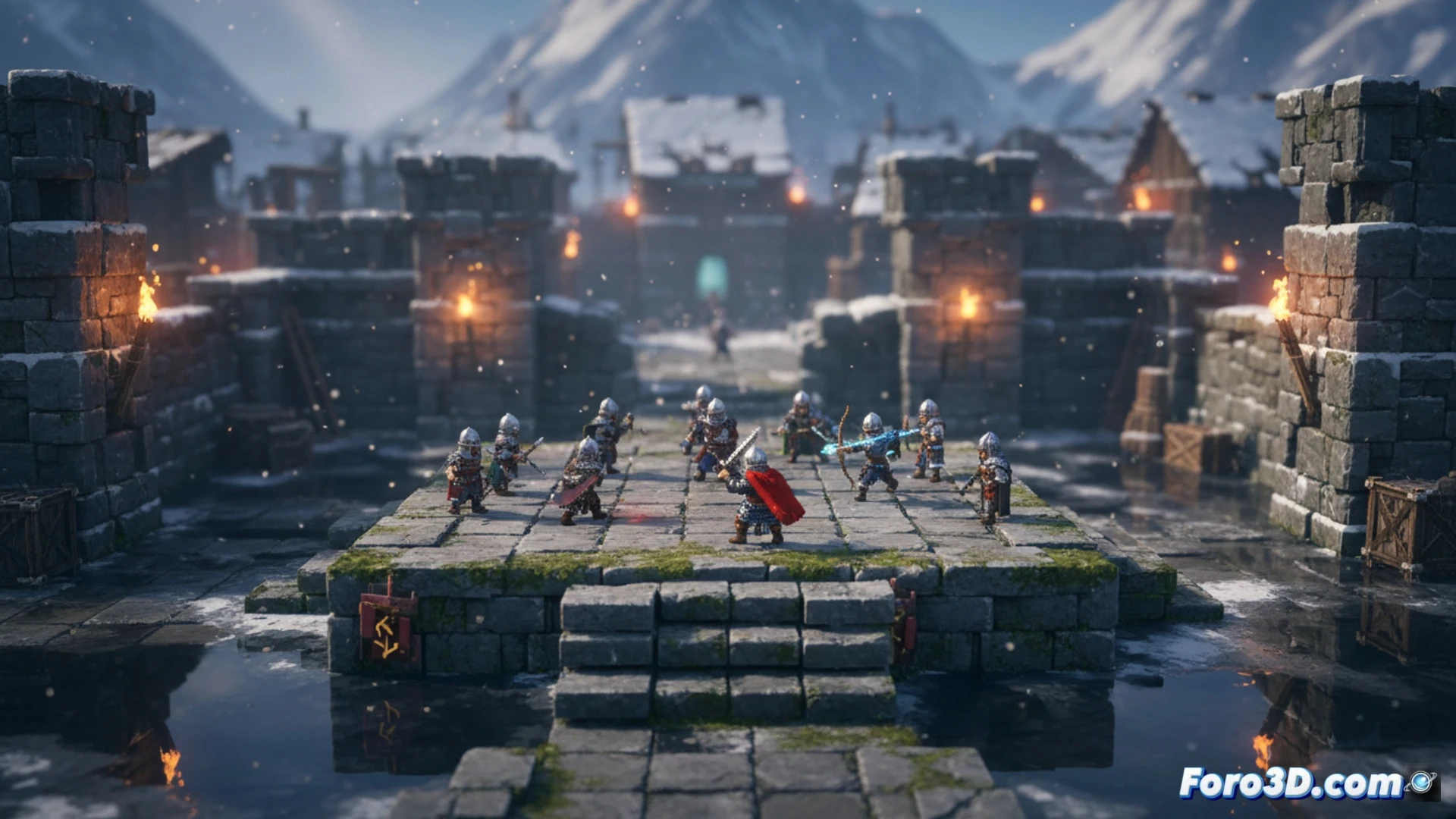
The visual success of Triangle Strategy lies not only in its narrative but in the meticulous technical fusion between the classic and the modern. The game uses Unreal Engine 4 to render complex three-dimensional environments, over which 2D sprites created with Aseprite are superimposed. This combination, known as the HD-2D aesthetic, allows pixel art characters to retain their retro essence while interacting with scenes that possess depth of field, specular reflections, and dynamic lighting that few titles in the genre manage to match.
Technical Pipeline: Sprites, Textures, and Post-Processing 🎨
To replicate this style, the workflow is divided into two main branches. On one hand, character sprites are drawn frame by frame in Aseprite, optimizing color palettes so they contrast correctly with the engine's ambient light. On the other hand, scene textures are designed in Photoshop, prioritizing details that simulate organic and architectural materials. The technical trick lies in Unreal Engine 4's post-processing: a soft depth of field (DOF) effect is applied to blur the background and give scale to the scene, while reflections on water or metal are calculated in real-time. Dynamic lighting, based on directional and point lights, prevents the pixel art from looking flat, casting soft shadows that anchor the sprites to the 3D ground.
Tips for Indies Seeking the HD-2D Style 💡
If you are an indie developer and want to emulate this technique, start by defining a fixed base resolution for your sprites (for example, 24x24 pixels per character unit) and scale everything in the engine without smoothing filters. In Unreal Engine 4, configure your camera with a low FOV (around 35 degrees) to simulate the isometric perspective. Use a post-process material that applies a slight vignette and bloom, but avoid saturating the colors. The key lies in contrast: dynamic lighting should be subtle, prioritizing warm light sources for sprites and cool ones for backgrounds. If you work with Aseprite, export your sprite sheets in PNG format with an alpha channel; Photoshop will serve you to create lighting masks that you can later import as emission textures into the engine.
How Triangle Strategy manages to balance performance in Unreal Engine 4 when rendering its HD-2D scenes with volumetric lighting and pixel art sprites without sacrificing fluidity on low-spec consoles
(PS: 90% of development time is polishing, the other 90% is fixing bugs)