Speleology is a discipline that demands millimeter precision, especially in emergency situations. When an accident occurs inside a cave, evacuation planning becomes a critical challenge. Today, 3D simulation technologies allow for the generation of exact volumetric models of the cavity, tracing virtual trajectories that optimize rescuer movement and minimize risks of collapse or disorientation.
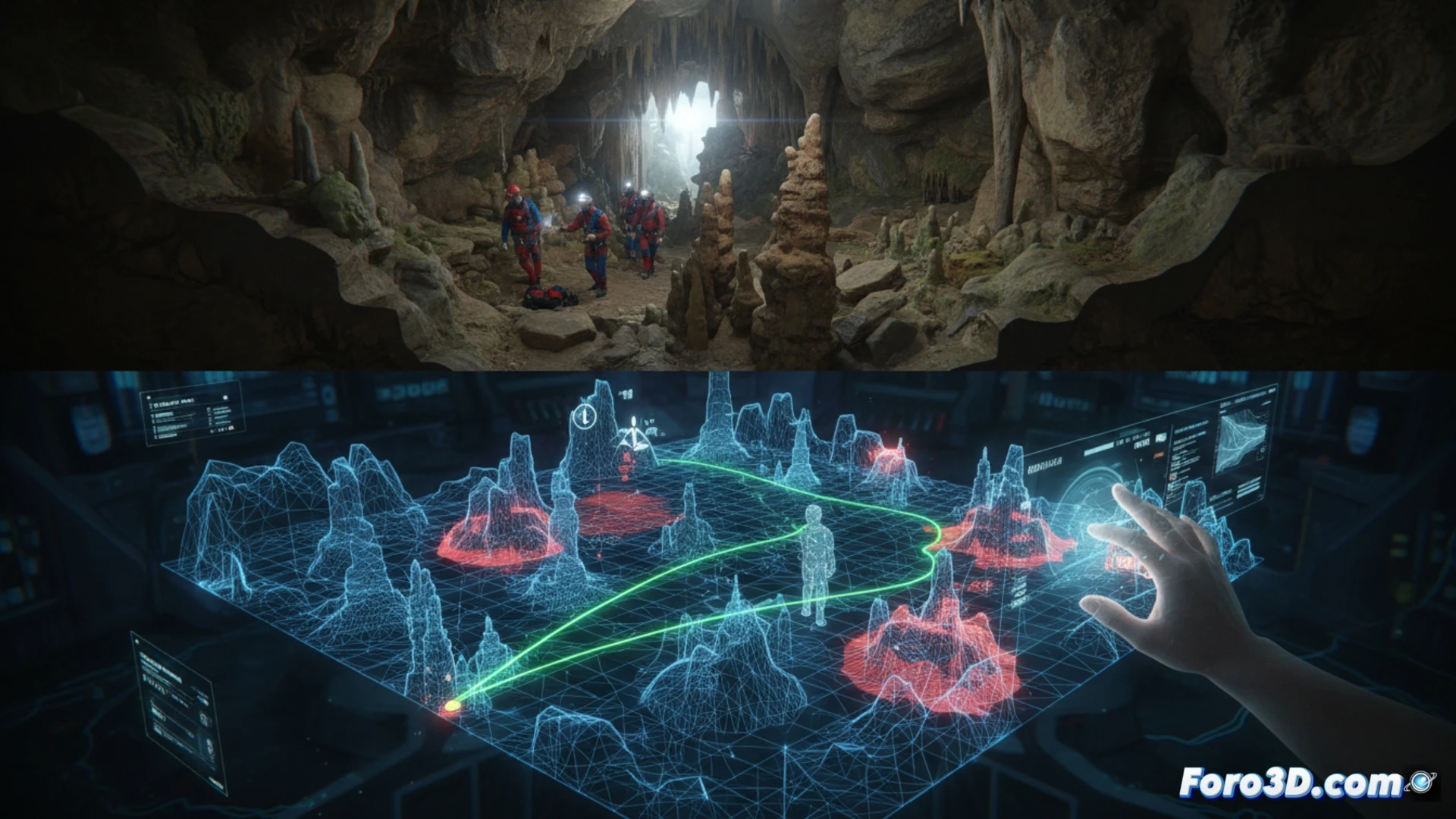
Cavity modeling and evacuation kinematics 🧗
The first technical step involves scanning the cave using LIDAR or photogrammetry, generating a point cloud that is converted into a polygonal mesh. On this model, pathfinding algorithms calculate routes of minimum effort and maximum safety, considering variables such as the angle of inclination, passage width, and the presence of obstacles. The simulation of the rescue team's movement —including rigid stretchers and harnesses— is performed using inverse kinematics, ensuring that each turn or displacement physically fits within the real space of the cave.
The value of anticipating the invisible 🧠
Beyond logistical efficiency, trajectory simulation in underground environments offers a crucial psychological and strategic advantage. By virtually visualizing each step of the rescue, teams can rehearse complex maneuvers without exposing themselves to real danger. This capacity for anticipation transforms the uncertainty of a dark cavity into a controlled scenario, where every meter of progress is backed by precise data rather than improvisation.
How can the millimeter precision of a virtual 3D trajectory generated in real-time during a rescue operation in underground cavities be guaranteed, considering connectivity limitations and scanner distortion in flooded or collapsed spaces?
(PS: Simulating trajectories is like playing billiards, but without having to clean the table afterwards.)