Instant real-time translation headphones have hit the market promising to break down language barriers in seconds. However, a technical analysis reveals that their operation depends on a stable internet connection, they introduce a significant delay in conversation, and they fail spectacularly in the presence of background noise or local idioms. This technology, far from being magical, exposes the harsh limitations of artificial intelligence applied to human communication.
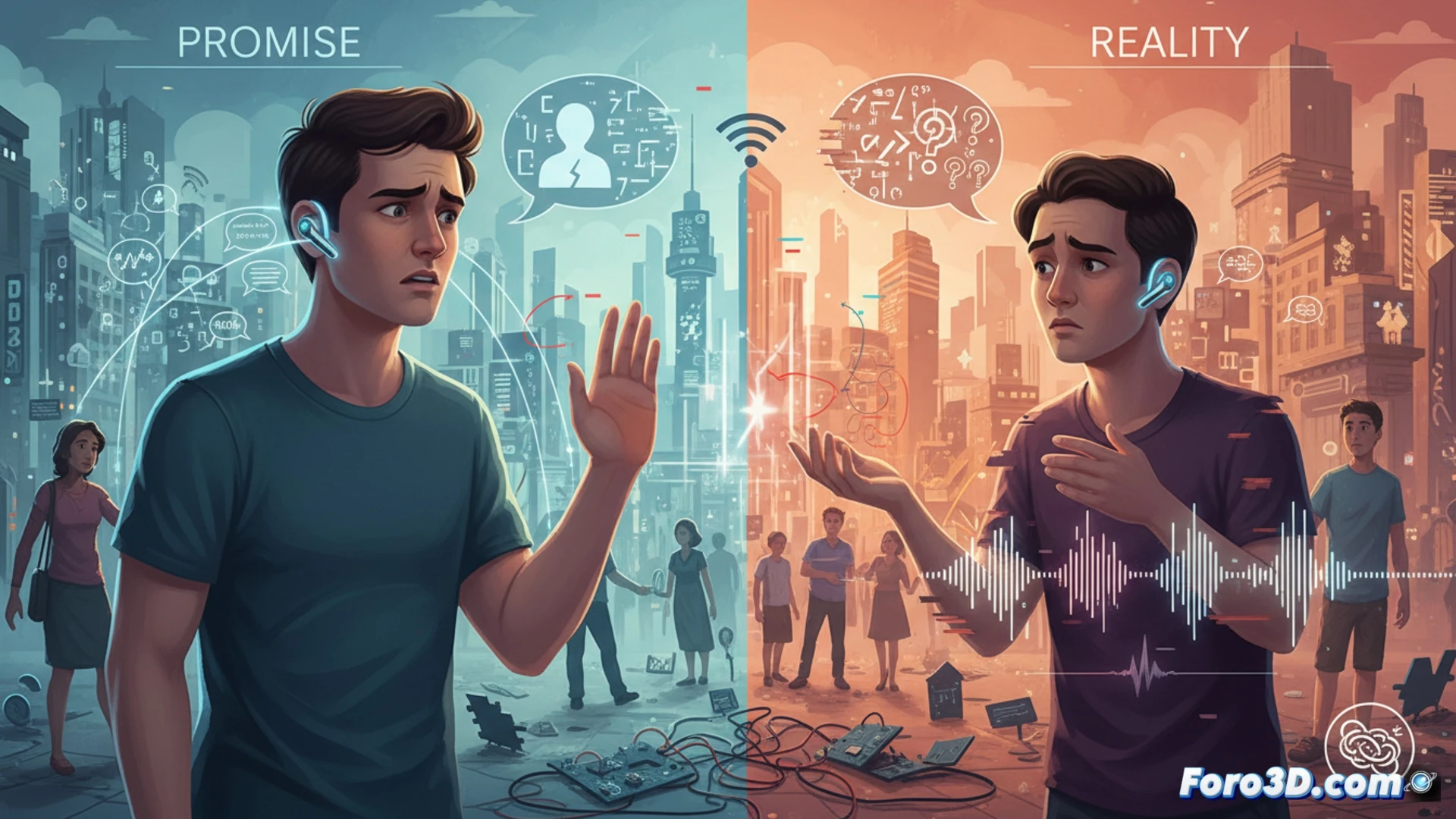
Technical analysis: latency and infrastructure dependency 🛠️
The main bottleneck of these devices lies in the client-server architecture. The captured audio must be sent to the cloud for processing, which introduces a latency of between 2 and 5 seconds. This delay disrupts the natural flow of a conversation, generating awkward pauses. Furthermore, the accuracy of speech recognition plummets in noisy environments or when the speaker has a strong regional accent. Idioms and cultural expressions, lacking a literal equivalent in the model's database, are often translated literally or incorrectly, distorting the original message.
The mirage of immediacy and user trust 🧠
This case is paradigmatic for understanding the gap between expectations and reality in AI. The promise of fluid communication clashes with an experience that requires patience and a controlled environment. When the user faces a poor translation or an annoying delay, trust in the technology erodes quickly. Managing these expectations is key for technology platforms: it is not enough to sell the idea of a future without barriers; one must also educate about the real conditions of use and the inherent limitations of current artificial intelligence.
What is the true social impact of instant translation headphones by removing human mediation in intercultural communication, beyond technical accuracy?
(PS: the Streisand effect in action: the more you ban it, the more people use it, like microslop)