Naval archaeology faces a constant challenge: identifying the origin of a sunken ship without documentation. A new 3D pipeline solves this enigma using computed tomography. By scanning the ship's frames, a volumetric model is generated that allows specialists to map the orientation of fibers and growth rings, comparing these patterns with databases of historical forests from Scandinavia and the Mediterranean.
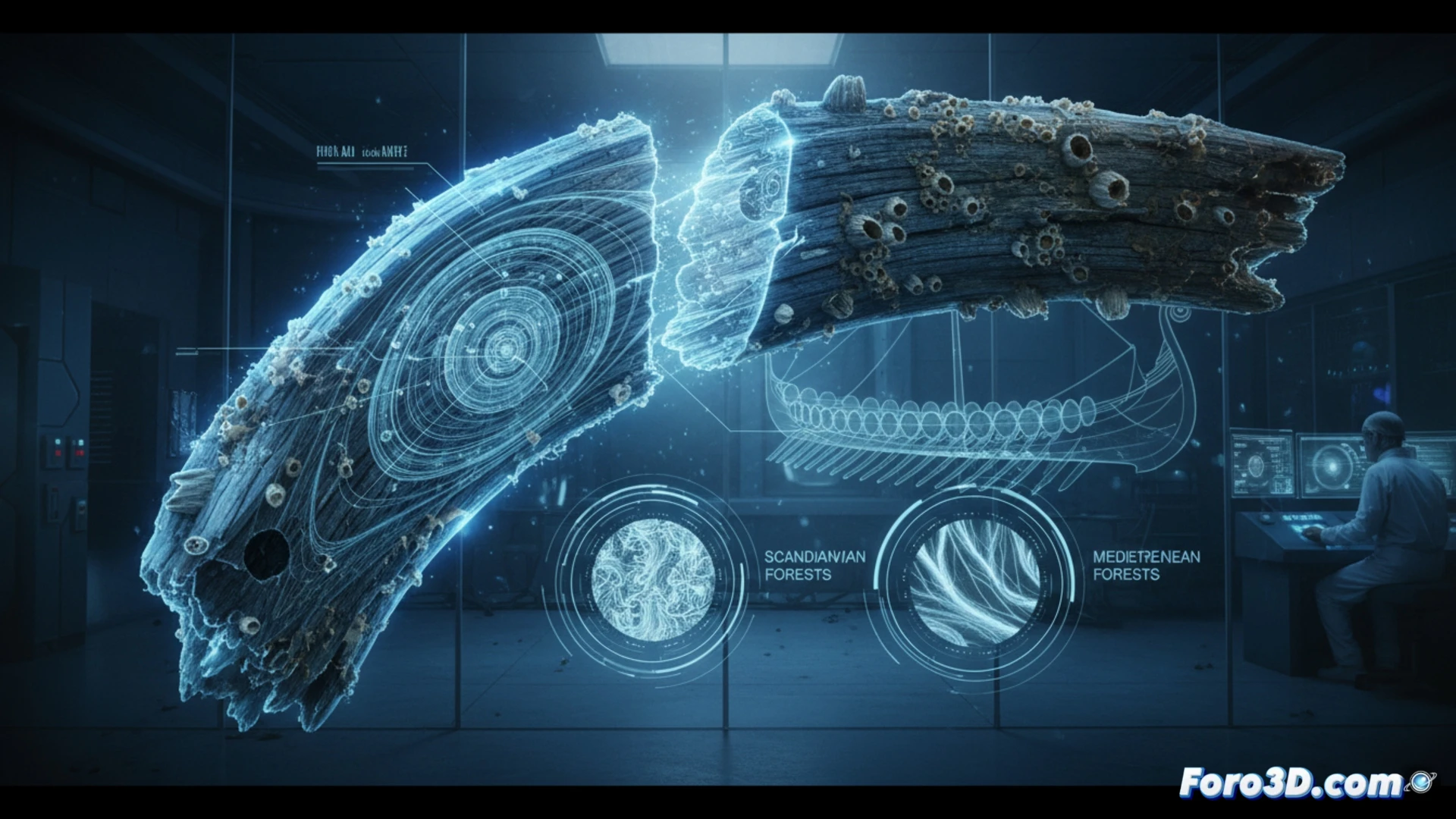
Technical workflow for provenance dating 🛠️
The process begins with an industrial CT scanner that captures the internal density of the wood. The DICOM file is imported into VGSTUDIO MAX, where a porosity and fiber orientation analysis is applied using anisotropy algorithms. This software extracts directional vectors from the wood, identifying the curvature of the rings. Subsequently, the resulting point cloud is cleaned in MeshLab to remove noise and artifacts from decomposition. Finally, Blender is used to visualize the fiber vectors as a three-dimensional line field, allowing archaeologists to compare the geometry of tree growth with regional dendrochronological maps.
Implications for heritage preservation 🏛️
This non-invasive method offers a crucial advantage over destructive sampling techniques. By preserving the physical integrity of the shipwreck, the 3D pipeline allows dating the ship without extracting wood sections. Determining whether the wood comes from a Scandinavian oak or a Mediterranean pine not only reveals the ship's trade route, but also settles historical debates about the naval technology of the era, demonstrating that volumetric analysis software is today an essential tool for digital archaeology.
As 3D tomography reveals the orientation of wood fibers, could this method differentiate local tree species from exotic ones in shipwrecks without historical records?
(PS: and remember: if you can't find a bone, you can always model it yourself)