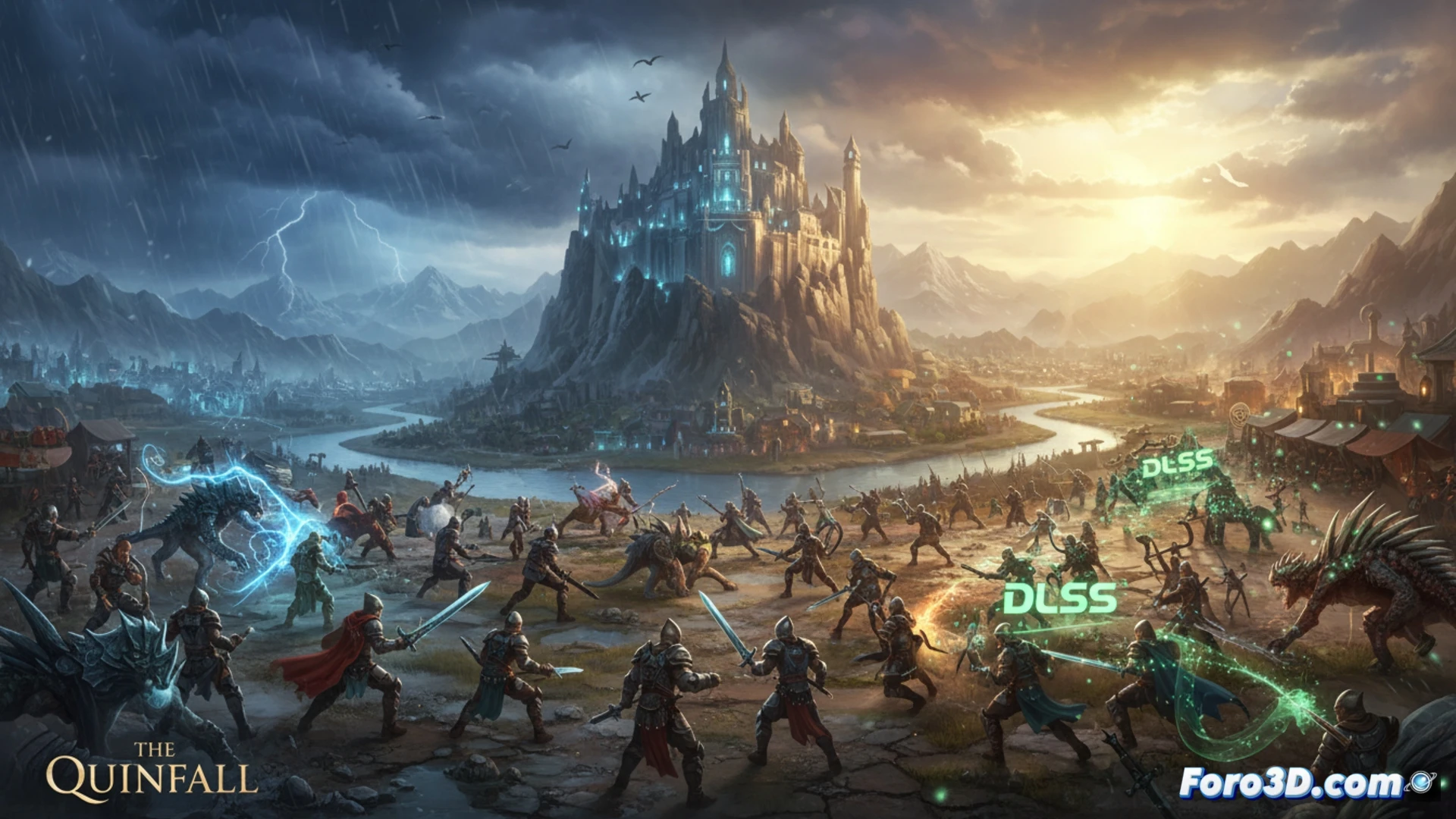
The Quinfall, developed by Vawraek Technology on the Unity Engine, represents an ambitious leap in massive open-world management. The title not only promises a dynamic weather system that affects gameplay but also integrates NVIDIA DLSS to ensure stability in high-density player scenarios. We analyze the technical keys of its engine and the tools that make it possible. 🌍
Unity Engine, procedural terrain, and multiplayer optimization 🛠️
To build a seamless persistent world, the developers have turned to procedural terrain generation tools within Unity, allowing the creation of vast map extensions without the need for manual modeling. The dynamic weather system, likely managed through shaders and real-time particles, modifies visibility and NPC behavior. The biggest technical challenge lies in optimizing performance in massive areas. This is where NVIDIA DLSS support comes in, scaling the image from a lower resolution, freeing up crucial GPU resources during sieges or large-scale events.
The Intel_OID SDK and network architecture 🔗
Beyond the graphical aspect, The Quinfall uses the Intel_OID SDK to manage object identification and tracking in the world. This technology allows the server to prioritize which elements to render at any given moment, reducing latency in the most populated areas. The combination of DLSS for graphical load and the Intel SDK for network logic suggests that Vawraek Technology seeks an intelligent balance between visual fidelity and gameplay smoothness, a critical factor for player retention in an MMORPG.
How does The Quinfall approach performance optimization in Unity with the implementation of dynamic weather and DLSS to maintain a smooth experience in a massive open-world MMORPG?
(PS: optimizing for mobile is like trying to fit an elephant into a Mini Cooper)