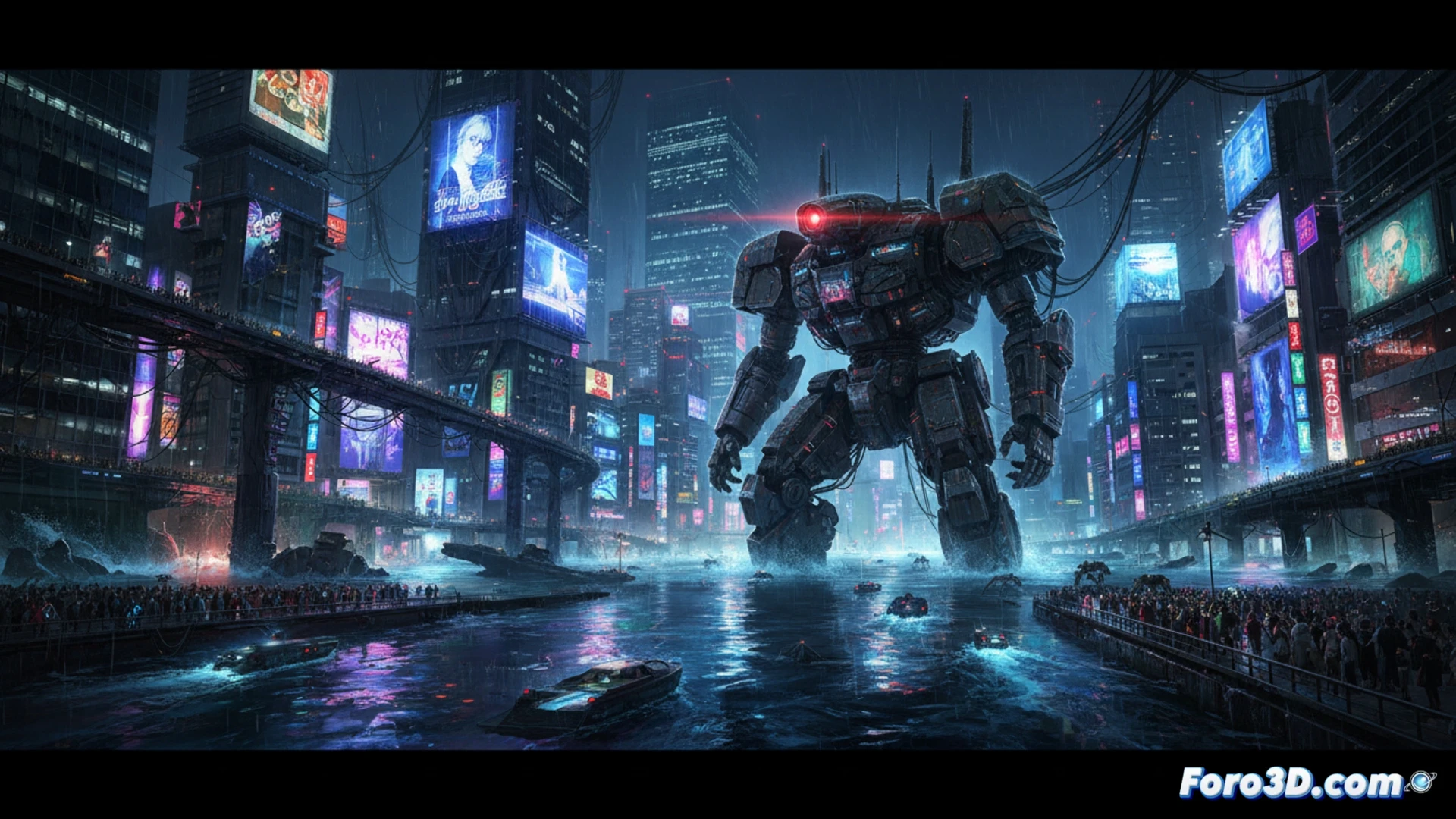
The Last Sentinel is shaping up to be a technical testbed for Unreal Engine 5, featuring a semi-submerged futuristic Tokyo. The project combines photorealism with fluid simulation and massive crowds, pushing the boundaries of the open world. We analyze how its pipeline, integrating Maya, Houdini, ZBrush, and photogrammetry, leverages UE5's tools to achieve this cyberpunk aesthetic. 🌆
Asset Pipeline: From Houdini to Real-Time Water Simulation 🌊
Creating the flooded environment requires a hybrid workflow. Houdini is crucial for generating procedural water geometry and flood patterns, exporting simulation meshes to UE5. Maya handles character rigging and animation, while ZBrush sculpts high-frequency details on tech debris and neon signs. Photogrammetry of real-world Tokyo references provides photorealistic textures for facades. In UE5, Niagara's water system manages dynamic waves and player interaction, while the AI crowd system (Mass Entity) populates the streets with NPCs that react to the environment, optimizing performance through LOD and occlusion.
Lessons for Developers: AI and Photorealism Without Sacrificing Performance 🎮
The Last Sentinel demonstrates that photorealism in an open world is viable if optimization is prioritized. Using Lumen for dynamic global illumination and Nanite for virtual geometry allows ZBrush-level detail without impacting frame rate. The key lies in UE5's AI for crowds: each NPC uses simplified state-based behavior, reducing computational cost. For developers, the project underscores the importance of a non-destructive pipeline from DCCs like Houdini to UE5, and of testing water simulation with simple collision volumes before polishing visual effects.
How is The Last Sentinel optimizing the use of Lumen and Nanite in Unreal Engine 5 to manage dynamic reflections and massive geometry in a flooded Tokyo without sacrificing real-time performance?
(PS: shaders are like mayonnaise: if they break, you start all over again)