The legend of the Lima Treasure, a cargo of gold ingots and jewels stolen by Captain William Thompson in 1820, places its hiding spot on the mythical Cocos Island. This Costa Rican enclave, linked to countless failed expeditions, becomes a perfect candidate for digital archaeology. Applying photogrammetry and 3D modeling techniques to its geography could reveal burial patterns and hidden access points, transforming a myth into a technical case study. 🏝️
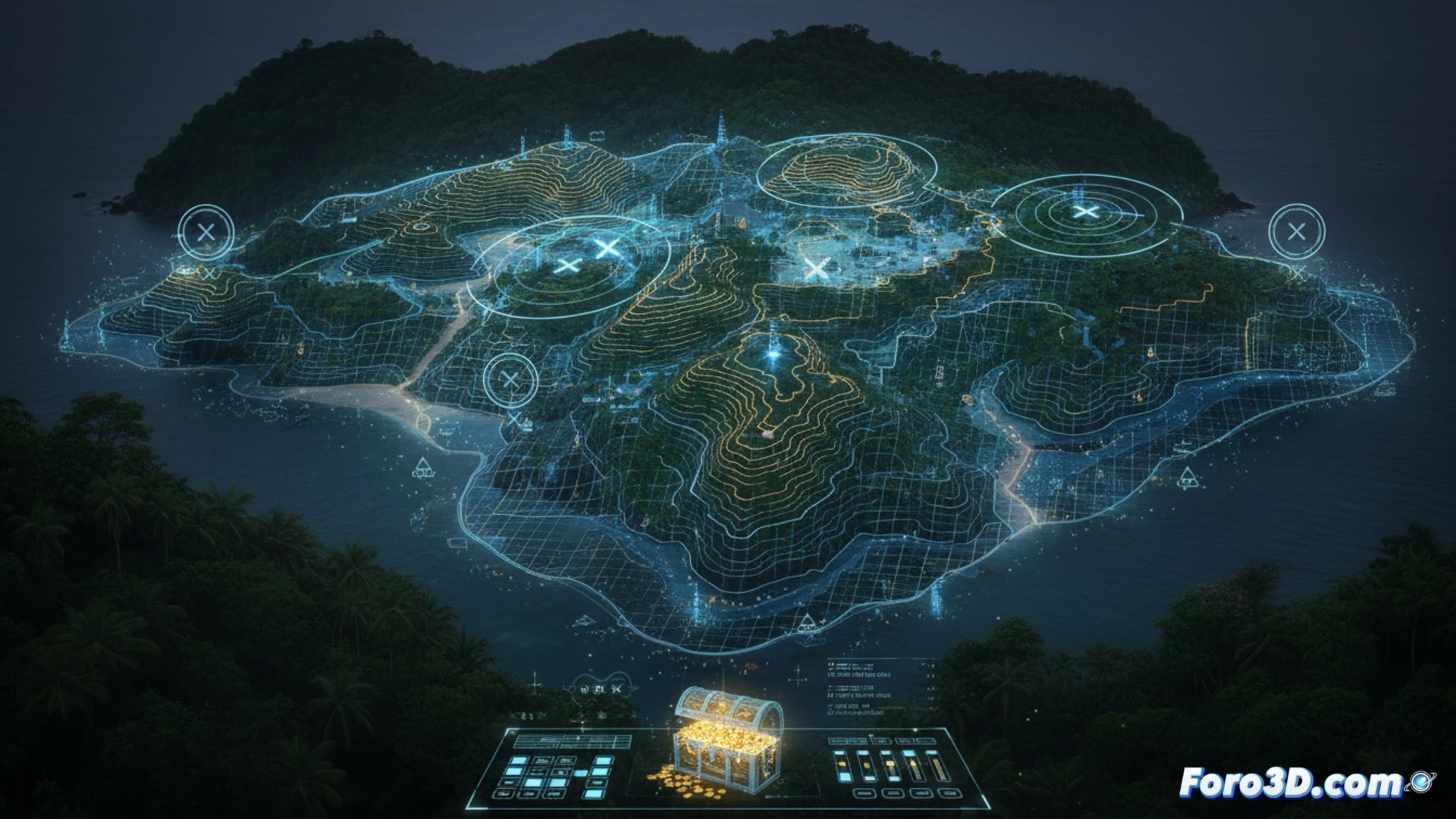
Aerial photogrammetry and cavity modeling 🚁
To address this challenge, a workflow based on high-resolution drone capture is proposed. An orthomosaic of Cocos Island, combined with point clouds generated by photogrammetry, would allow the creation of a digital terrain model (DTM) with centimeter precision. The next step would involve terrestrial LiDAR scanning to document the caves and cliffs where, according to accounts, Thompson hid the treasure. Post-processing in software such as RealityCapture or Agisoft Metashape would facilitate the integration of this data, generating a textured 3D mesh that reveals geological anomalies or possible historical excavations.
Digital heritage facing historical fiction 🏛️
The virtual reconstruction aims not only to validate the legend but also to digitally preserve a natural and archaeological heritage threatened by erosion and looting. Modeling the possible hiding spots of the Lima Treasure in 3D allows archaeologists to simulate search strategies without altering the ecosystem. This approach transforms a pirate story into a digital laboratory, where technology demystifies the past and offers a scientific tool for the conservation of Cocos Island.
How can photogrammetry and LiDAR scanning applied to the dense vegetation and topography of Cocos Island help validate or refute the historical coordinates of the supposed hiding place of the Lima Treasure?
(PS: If you dig at a site and find a USB, don't plug it in: it could be Roman malware.)