The Tesla Cybercab represents a milestone in autonomous automotive: a vehicle designed exclusively to operate as a robotaxi, completely eliminating the steering wheel and pedals. From the perspective of 3D modeling and simulation, this design forces a rethinking of the cabin architecture, sensor systems, and the integration of wireless inductive charging. We analyze how this concept can be digitally represented and what technical challenges it poses for specialists in 3D systems.
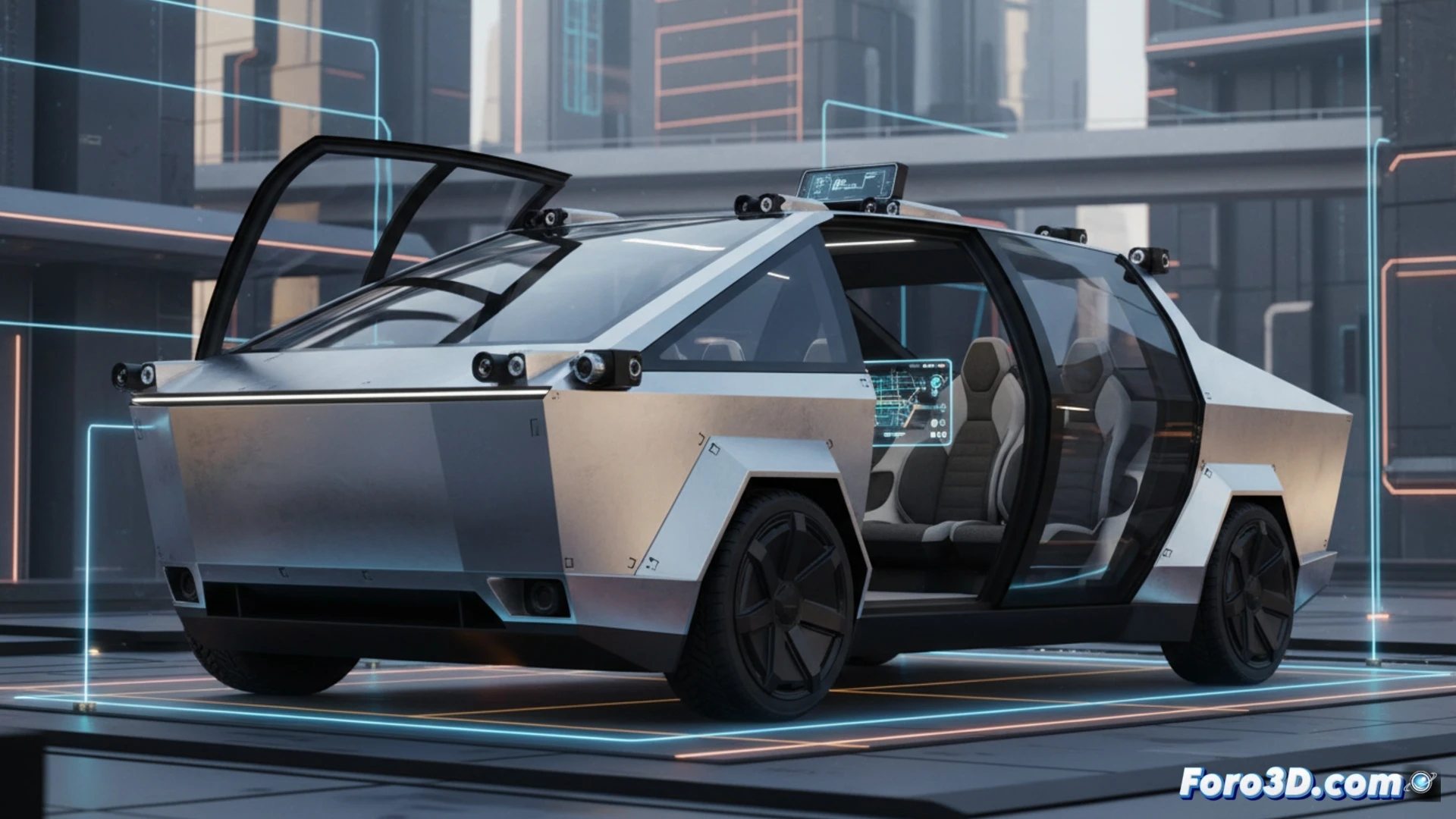
Sensor architecture and autonomous driving simulation 🚗
The Cybercab dispenses with any manual control interface, requiring total redundancy in its perception system. In 3D modeling, the arrangement of cameras, radars, and ultrasonic sensors must replicate a 360-degree field of view without critical blind spots. Autonomous driving simulation requires recreating complex urban scenarios where the vehicle makes real-time decisions. Furthermore, the absence of a steering wheel modifies the chassis structure, allowing optimization of interior space for passengers and batteries. Compared to other robotaxis like Waymo or Cruise, the Cybercab bets on a pure computer vision philosophy, without LiDAR, which directly impacts simulation algorithms and the generation of digital twins for virtual testing.
Wireless charging and urban fleet visualization ⚡
Inductive charging is another differentiating element that must be modeled in 3D to understand its integration into the subsurface of charging stations. Visualizing how the Cybercab positions itself over a wireless charging platform requires precision in coil alignment. At the fleet level, simulation allows representing how these vehicles deploy in urban environments, optimizing routes and charging times without human intervention. This digital approach is key to validating the system's feasibility before mass production.
How does the elimination of the steering wheel and pedals in the Cybercab affect the structural design and mass distribution in its 3D model to ensure passenger safety and comfort?
(PS: ADAS systems are like in-laws: always watching what you do) 😅