The carbon fiber mast of a super-catamaran from the America's Cup collapsed without warning during a backstay tensioning maneuver. Initial investigations point to a phenomenon of local buckling in the composite walls, a micro-deformation invisible to the human eye but detectable through advanced non-destructive analysis techniques. This case illustrates the need to integrate active thermography and laser scanning into predictive maintenance protocols for structures subjected to cyclic fatigue. 🏆
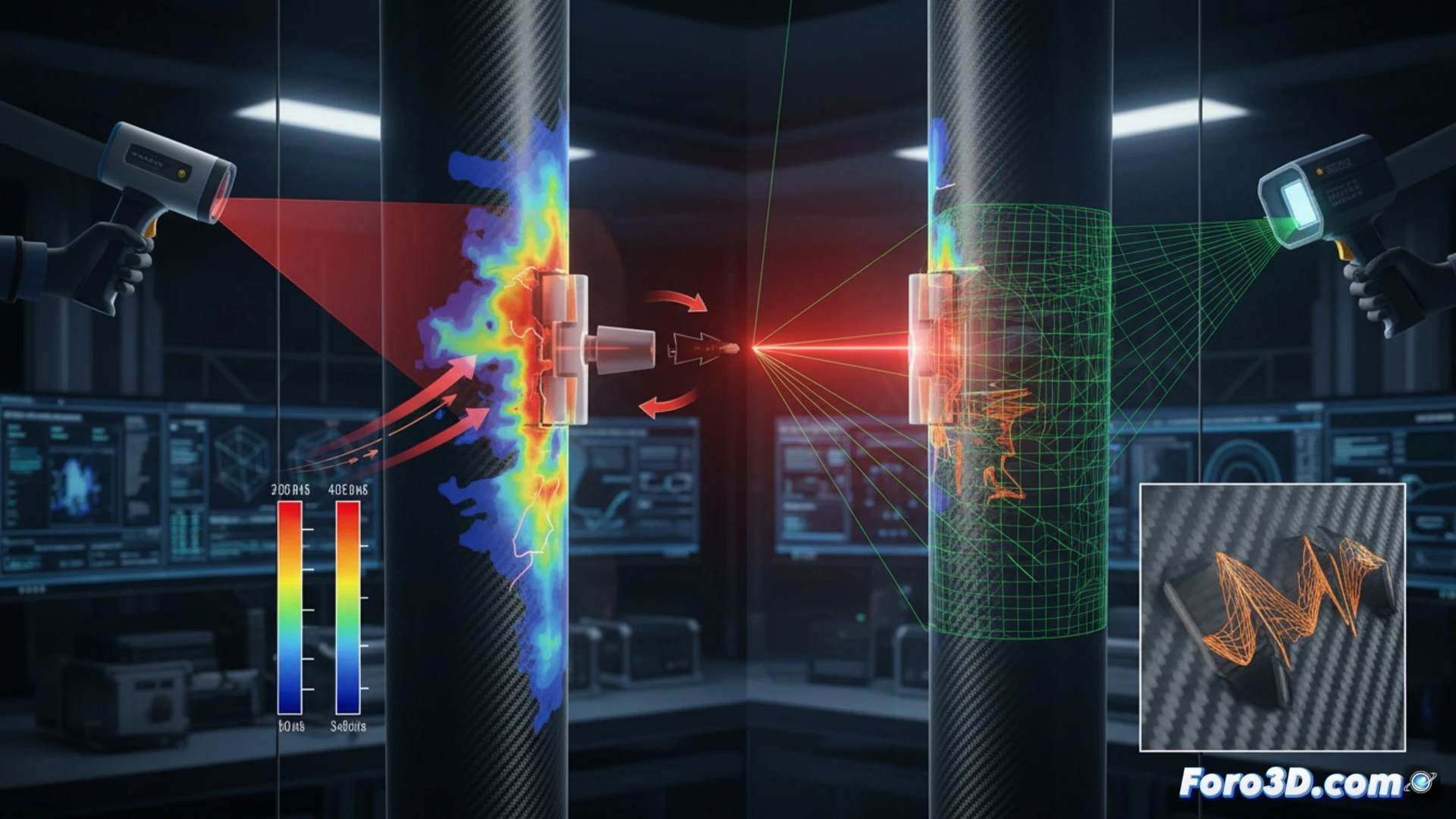
Workflow: from point cloud to stress simulation 🔬
The analysis process began with capturing the mast using high-resolution laser scanning, generating a point cloud of millions of coordinates that was processed in RealityCapture to obtain an accurate 3D mesh of the deformed geometry. This model was imported into Altair Radioss, where an impact and deformation simulation was configured to recreate the backstay tension conditions. In parallel, infrared thermography was applied to the composite surface to identify heat concentration zones, indicative of internal friction and active microcracks. Final geometric validation was performed in Rhino, comparing the simulated deformation with real scan measurements to calibrate the predictive fatigue model.
Failure prevention in critical structures ⚙️
The super-catamaran case demonstrates that catastrophic failure of a carbon mast is not random, but the result of an accumulation of invisible damage. Integrating thermography as a micro-deformation sensor and 3D scanning to validate finite element models allows anticipating structural collapse. For engineers and designers, this workflow offers a clear roadmap: capture the digital reality, simulate extreme stresses, and adjust fatigue parameters before the material says enough.
Is it possible to correlate the thermal emission patterns captured by thermography with the sub-millimeter deformations detected by 3D scanning to establish an early failure threshold in a carbon mast subjected to cyclic loads?
(PS: Material fatigue is like yours after 10 hours of simulation.)