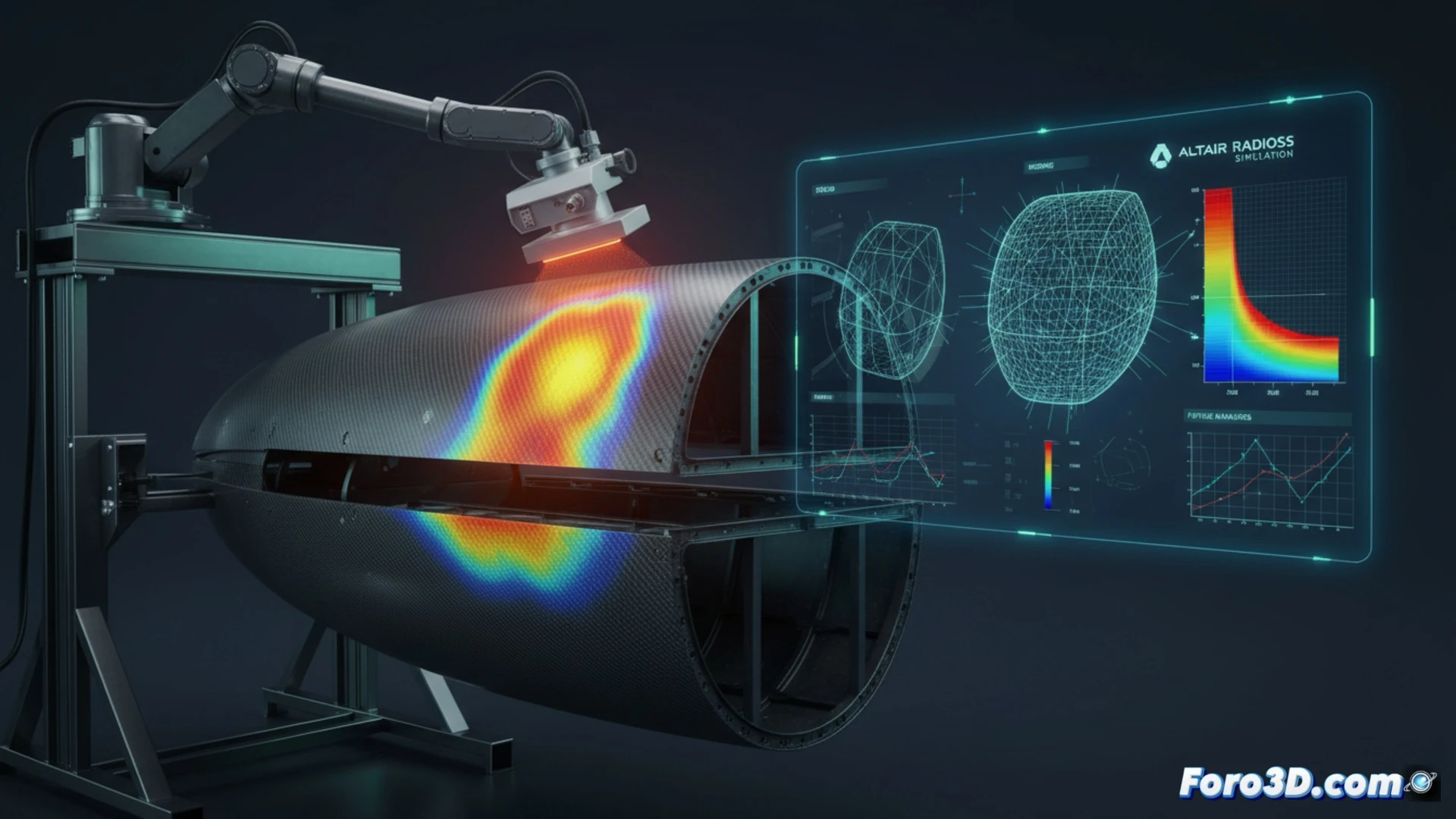
A carbon fiber fuselage of a VTOL aircraft suffers a bird strike that leaves no external marks but generates critical internal damage. The combination of active thermography and finite element simulation with Altair Radioss makes it possible to visualize this invisible delamination. This workflow, which integrates 3D scanning, meshing in MeshLab, and fatigue analysis, is revolutionizing the inspection of composite materials in the aerospace industry.
Technical workflow: from thermal scanning to the fatigue model 🔬
The process begins with active thermography, where an external heat source excites the fuselage surface. An infrared camera captures temperature variations that reveal internal delamination, as the air trapped in the crack conducts heat differently. This thermal point cloud is imported into RealityCapture to generate a precise 3D mesh of the damaged area. Then, in MeshLab, the mesh is refined, removing noise and optimizing the topology for structural analysis. Finally, Altair Radioss simulates the initial impact (bird strike) and damage propagation under repetitive loads, making it possible to predict the component's residual life without the need for destructive testing.
Implications for predictive maintenance of composites ✈️
This approach changes the game in VTOL aircraft inspection, where carbon fiber fuselages are lightweight but vulnerable to impacts with no visible marks. Being able to detect and model internal damage with active thermography and validate it through numerical simulation allows for planning repairs before a catastrophic failure. The integration of tools like RealityCapture, MeshLab, and Radioss offers fatigue engineers a virtual laboratory to study how composites degrade, accelerating the design of safer and more resistant structures.
How can active thermography and finite element simulation be integrated to differentiate hidden damage from a bird strike from a natural thermal variation in a VTOL carbon fiber fuselage?
(PS: Material fatigue is like yours after 10 hours of simulation.)