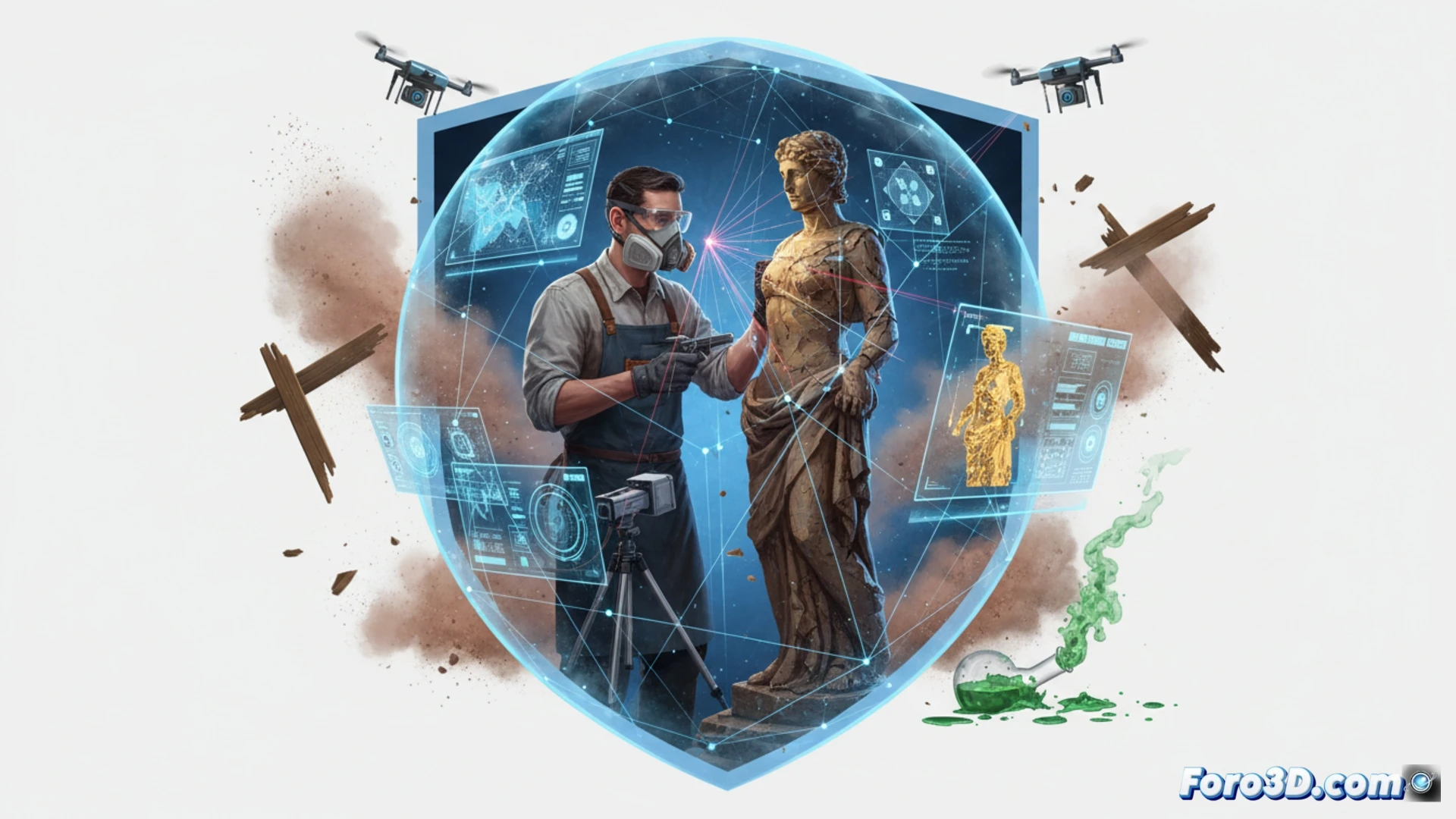
The profession of heritage restorer faces a constant paradox: to save history, it endangers its own health. Every intervention on a fresco, sculpture, or façade involves falls from scaffolding, inhalation of lead or silica dust, and contact with aggressive solvents. However, the emergence of laser scanning and photogrammetry is redefining workplace safety, allowing specialists to work from a physical distance, drastically reducing accident rates.
Virtual replicas and digital twins to avoid direct contact 🛡️
Remote documentation using drones and 3D scanners eliminates the need for ladders or scaffolding to take measurements or analyze pathologies at height. A high-resolution digital twin allows the restorer to study a cornice at ground level, without exposing themselves to the risk of falling. Furthermore, working on the point cloud avoids direct manipulation of historical materials that release toxic silica or lead dust. Intervention planning is carried out on a virtual model, applying resins or preservatives only in the simulation to calculate exact doses, minimizing real chemical exposure.
Preventive ergonomics: designing posture before the gesture 🧑🔧
Forced postures and cuts from hand tools are two of the most underestimated risks. With 3D technology, the restorer can ergonomically simulate their working position before touching the piece. An analysis of reaches and angles on the digital mesh allows adjusting the arrangement of scaffolding or tools, reducing muscle strain. Thus, heritage conservation ceases to be a physical sacrifice and becomes a discipline where prevention and digital precision protect both the artwork and its caretaker.
Is it possible for a restorer to digitize a piece with biological or structural risk and delegate all the physical restoration work to a robotic arm, completely eliminating their exposure to danger?
(PS: Restoring virtually is like being a surgeon, but without blood stains.)