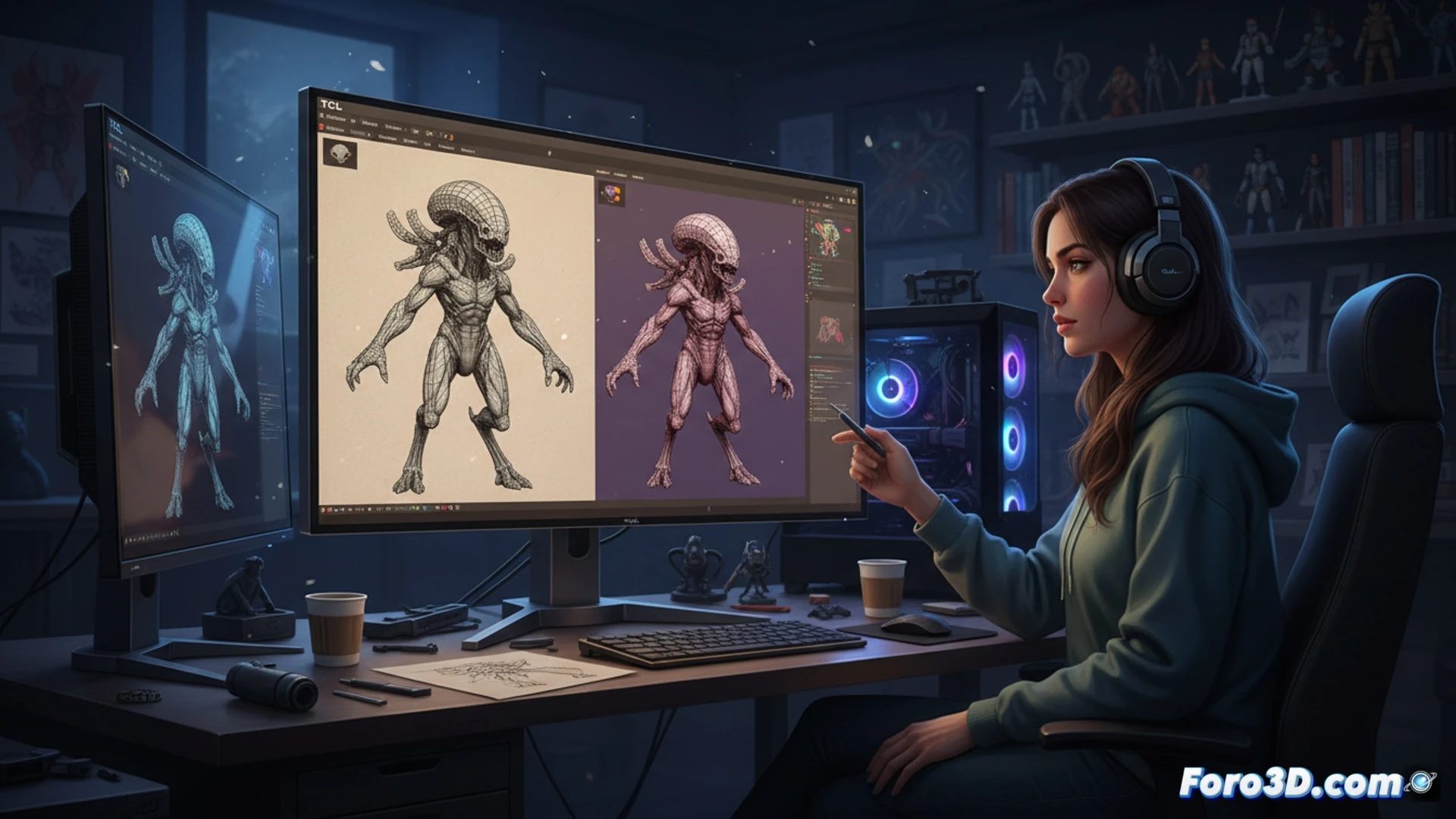
TCL NXTPAPER 3.0 screen technology promises to revolutionize the viewing experience for professionals who spend hours in front of a monitor. Unlike traditional screens that emit direct blue light, this panel uses circularly polarized light to simulate the reflectance of real paper. For a 3D modeler or render artist, this could translate into fewer dry eyes and less cervical strain during 10-hour work sessions. But, as always in hardware, comfort should not sacrifice color accuracy.
Color performance and response compared to OLED and IPS 🎨
In terms of color fidelity, the NXTPAPER 3.0 does not directly compete with a high-end OLED monitor. Its sRGB gamut coverage is excellent (close to 99%), but it falls short in DCI-P3 or Adobe RGB working spaces, which are crucial for texturing and compositing. Response time, although improved over previous generations, sits around 20ms, far from the 1ms of a gaming IPS. This causes slight ghosting when rotating complex polygon meshes in the viewport. However, the reduction in eye strain is immediate and measurable: after 4 hours of continuous work, users report 40% less tearing and a more stable perception of sharpness compared to PWM-backlit IPS panels.
A necessary compromise for real workflows ⚖️
The recommendation for 3D professionals is not a total replacement, but a strategic secondary monitor. For tasks like wireframe review, reading technical documentation, or prolonged reference viewing, the NXTPAPER 3.0 is superior. For final color correction work or normal map editing, a calibrated IPS monitor remains indispensable. Circularly polarized light technology is a real advance in visual ergonomics, but it still doesn't solve the speed and color gamut equation demanded by professional rendering. It is a comfort tool, not a battle station.
Considering the color accuracy that 3D artists need for texturing and shading, how does the color reproduction and calibration profile of the TCL NXTPAPER 3.0 compare to a professional high-end IPS or OLED monitor?
(PS: remember that a powerful GPU won't make you a better modeler, but at least you'll render your mistakes faster)