The profession of a tattoo artist, far from being just an art form, involves systematic exposure to hazards that public health must monitor. The biological risk from needle sticks and contact with blood places these professionals in a high epidemiological surveillance group for pathogens such as hepatitis B, hepatitis C, and HIV. Added to this are musculoskeletal injuries resulting from forced postures maintained for hours, making this trade an ideal case study for preventive data visualization.
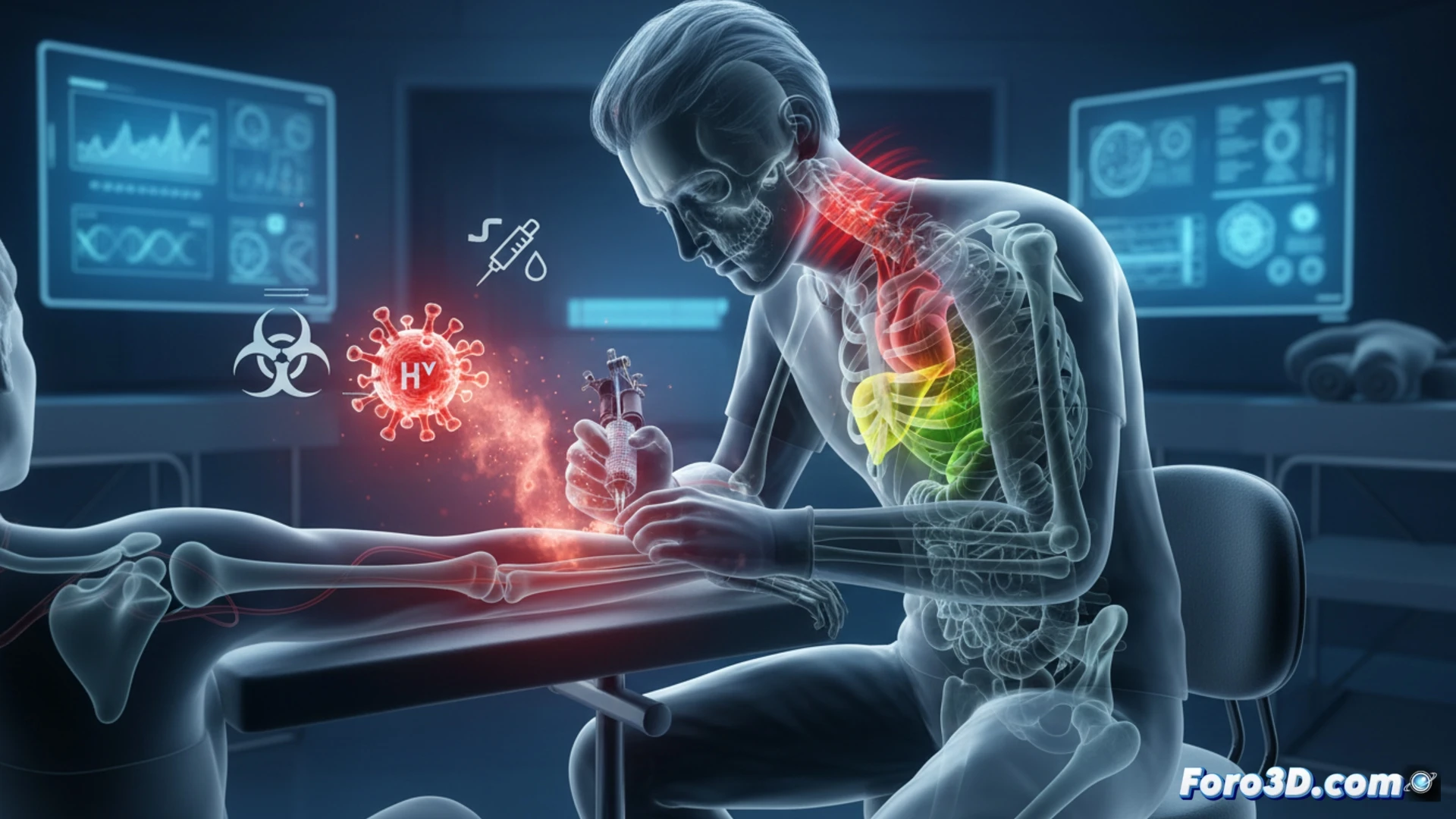
3D Mapping of Joint Strain and Pathogen Transmission 🧬
Our 3D model allows isolating the areas of greatest postural tension. Using volumetric heat maps, we identify a critical concentration of stress in the cervical and lumbar spine, caused by prolonged leaning over the client. Simultaneously, an interactive bar chart shows the relative incidence of hepatitis B versus HIV in percutaneous accidents, highlighting that the risk of HBV transmission is up to 100 times higher than that of HIV in a needlestick injury. The visualization allows rotating the anatomical model to see how the wrist and shoulder suffer repetitive microtrauma when handling the machine.
Visible Sterilization: The Autoclave as an Epidemiological Barrier 🔬
Prevention is not abstract; it is measured in autoclave cycles. We have designed an animated infographic that breaks down the sterilization process: from ultrasonic cleaning of the parts to the temperature and pressure curve inside the autoclave. Visualizing the thermal death of bacterial spores in a 3D animation reinforces the need to comply with protocols. Without this barrier, the risk of cross-infection skyrockets, turning a tattoo studio into a public health focus that must be monitored and educated through clear data.
What tools would you use to visualize the temporal evolution of this epidemic?