Tartessos, the enigmatic civilization of the southwestern Iberian Peninsula, has fascinated historians and archaeologists for centuries. Mentioned in biblical texts as a kingdom of immense wealth, its disappearance without leaving a clear location has directly linked it to the myth of Atlantis. Today, digital archaeology offers a new perspective to approach this mystery, using 3D technologies to virtually unearth what time has buried. 🏛️
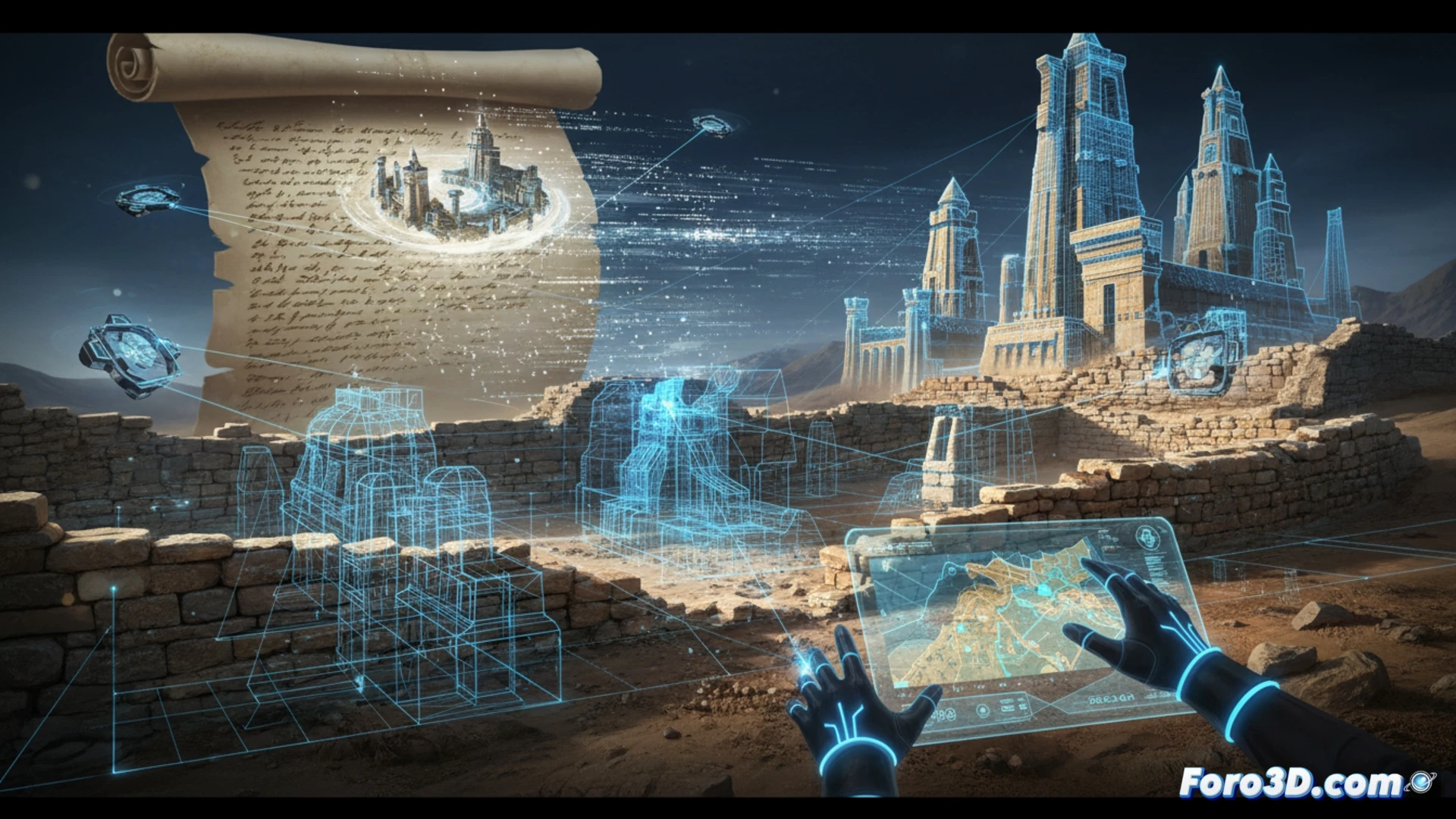
Photogrammetry and virtual modeling in the survey of the Guadalquivir estuary 🗺️
The main challenge of Tartessos is the lack of an identifiable urban core. Archaeologists now apply aerial photogrammetry with drones over the Doñana National Park to detect geometric anomalies beneath the sediments. This data, combined with multispectral satellite imagery, allows for the generation of digital terrain models that reveal buried structures. Subsequently, 3D modeling hypothetically reconstructs temples and ports, based on descriptions from classical sources and the goldwork found in the Treasure of El Carambolo. This workflow makes it possible to contrast the biblical narrative of Tarshish with the geospatial reality of the delta.
Are we reconstructing Atlantis or a real civilization? 🔍
The precision of 3D data forces a separation of myth from history. By digitizing the ceramic remains and adobe structures found, researchers can validate or discard hypotheses about the extent of Tartessos. Each vertex in a polygonal mesh is a piece of evidence that moves the debate away from Platonic speculation and places it in the realm of quantitative archaeology. Technology not only visualizes the past but subjects it to a rigorous scientific test, revealing a complex culture that does not need to be Atlantis to be extraordinary.
What role does the Bible play as a historical source in the digital reconstruction of Tartessos, and how does it mitigate or amplify the bias of current 3D models?
(PS: and remember: if you can't find a bone, you can always model it yourself)