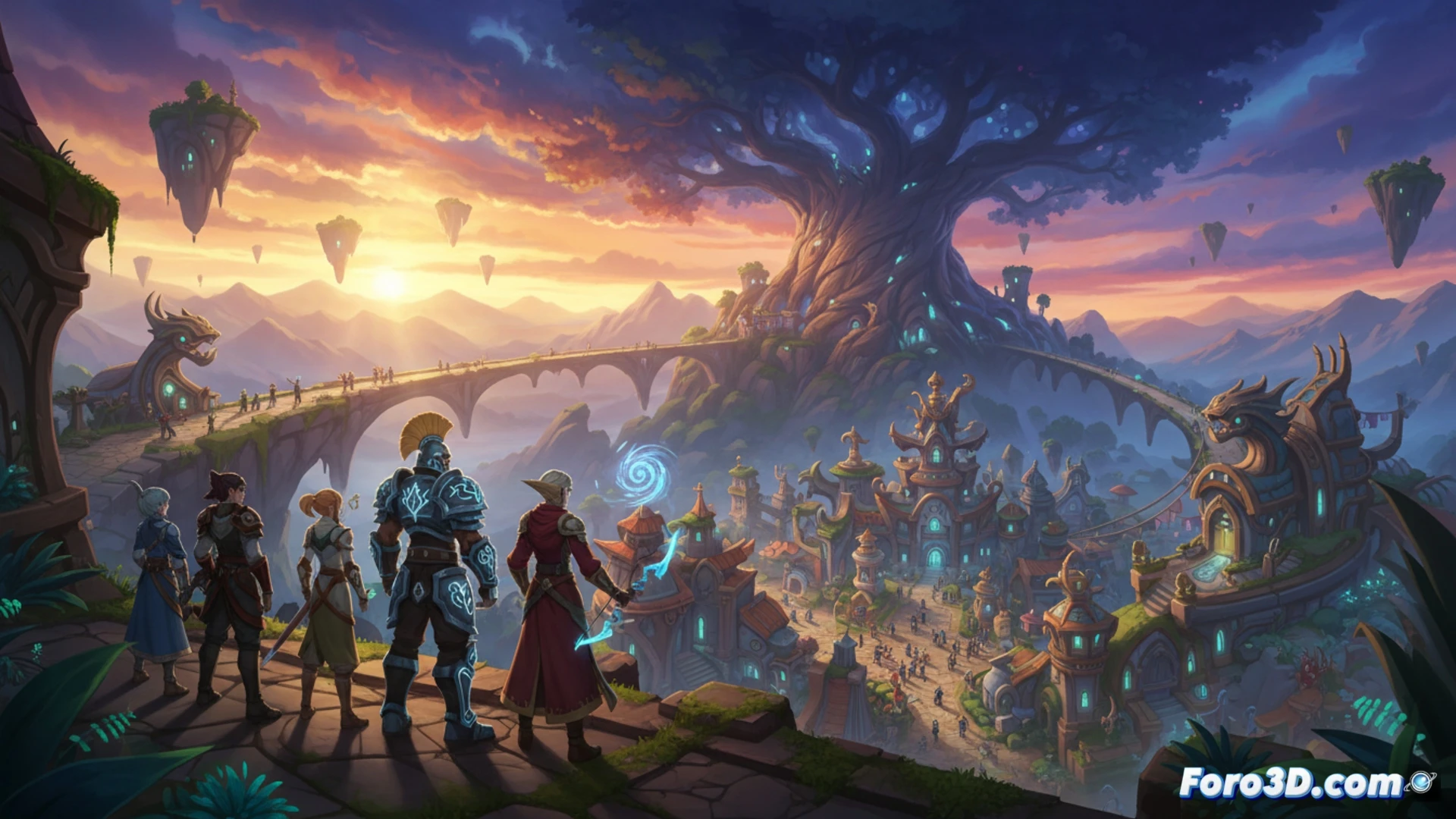
The rise of mobile and cross-platform MMOs demands robust engines that support persistent worlds without sacrificing visual identity. Tarisland, developed on Unreal Engine 4, seeks to compete in the stylized fantasy segment, emulating the visual legacy of World of Warcraft but injecting a layer of anime refinement. This article breaks down the technical workflow that allows a medium-sized team to achieve a vibrant color palette and polished magical effects, optimizing resources for massiveness.
Technical Pipeline: Modeling, Texturing, and Integration in UE4 🎨
The artistic process of Tarisland begins in Blender, where characters and environments are modeled with topology oriented towards animation and LOD (Level of Detail). Given the cartoon style and rich palette, geometry avoids hyperrealism; clean shapes and legible silhouettes are prioritized. Assets then go to Photoshop for the creation of PBR (Physically Based Rendering) textures with diffuse, roughness, and normal maps. The technical challenge lies in integration into Unreal Engine 4: master materials are used that allow modifying color, emission, and opacity parameters in real-time without recompiling shaders. For the refined anime-style magical effects, noise textures and vertex masks are used to control the intensity of emission and transparency, achieving particles that react to the engine's dynamic lighting.
Visual Optimization for MMO Identity ⚡
The key to Tarisland's graphical success lies not only in aesthetics but in optimization for thousands of simultaneous players. Unreal Engine 4 allows the use of culling (occlusion of non-visible objects) and time-of-day lighting systems (Day/Night cycle) that change the color palette without overloading the GPU. The magical effects, with their anime appearance, benefit from simplified shaders that simulate glows and sparkles without the need for expensive post-processing. This strategy demonstrates that a well-defined artistic style, supported by a pipeline from Blender to UE4, can offer a competitive visual experience in the saturated cross-platform MMO market.
As a video game developer, when working with the artistic pipeline of Tarisland in Unreal Engine 4, what specific technique for optimizing stylized assets did you apply to maintain visual quality on mobile devices without compromising the performance of the persistent world?
(PS: a game developer is someone who spends 1000 hours making a game that people complete in 2)