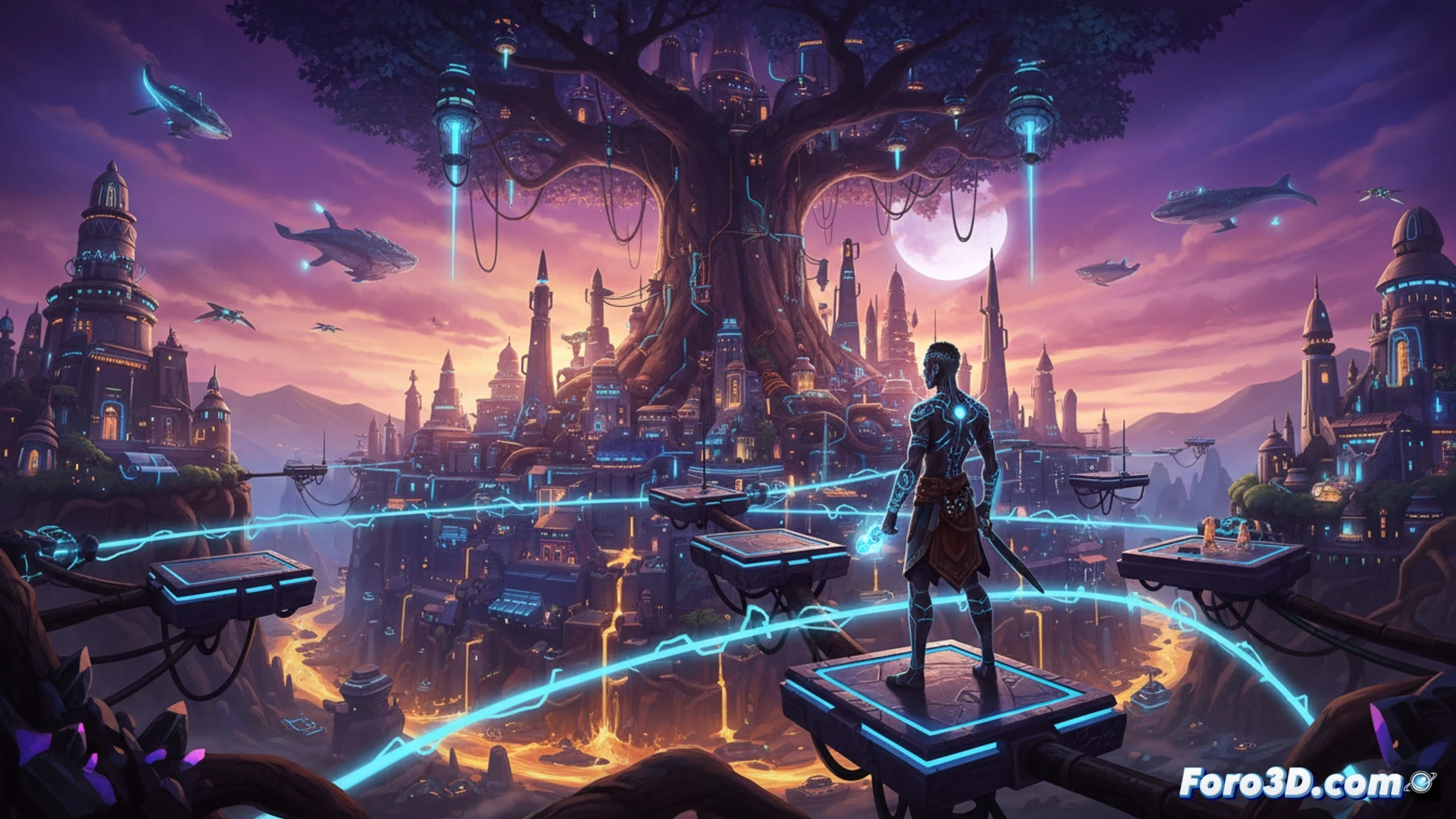
Tales of Kenzera: ZAU represents a fascinating case study for independent developers. The game uses Unreal Engine 5 to create a 2.5D action experience, combining the depth of 3D with the side-scrolling gameplay of 2D. Its Afrofuturist aesthetic relies on a masterful use of vibrant colors and dynamic lighting that highlights the fusion between African mythology and futuristic technology. The result is a visually striking world that demonstrates the potential of the game engine in projects with limited resources.
Artistic Pipeline: From ZBrush to Niagara 🎨
ZAU's artistic pipeline is an example of technical efficiency. Core assets, such as characters and environments, are modeled in Autodesk Maya with a high polygon density, then organic details are sculpted in ZBrush. The key lies in optimization: they are retopologized to maintain stable performance in 2.5D, where the fixed camera allows for aggressive level of detail (LOD) techniques. The Niagara particle system is the heart of the visual magic. It is used to generate spell effects, ancestral dust, and technological glints. These systems are designed with custom modules that respond to the game's physics, creating a sense of fluidity without sacrificing frames per second. The integration of African mythology is achieved through textures created in Substance Painter that mimic ritual fabrics and polished metals, all illuminated with Area Lights and Mesh Reflections in UE5 to give that characteristic shine.
Lessons for Independent Development 💡
Tales of Kenzera: ZAU demonstrates that indie development is not at odds with technical quality. The use of Unreal Engine 5 allows small teams to access high-level tools like Niagara and Lumen. However, the real value lies in the artistic direction. By restricting gameplay to a 2.5D plane, developers can concentrate resources on particles and shaders, avoiding the overhead of a complex open world. For any studio looking to stand out visually, this title is a clear roadmap: prioritize a cohesive aesthetic over pure realism, and master particle tools to bring culturally rich worlds to life.
As an indie developer, what key optimizations did you apply in Unreal Engine 5 to achieve the 2.5D visual style of Tales of Kenzera: ZAU without sacrificing performance on modest hardware?
(PS: a game developer is someone who spends 1000 hours making a game that people complete in 2)