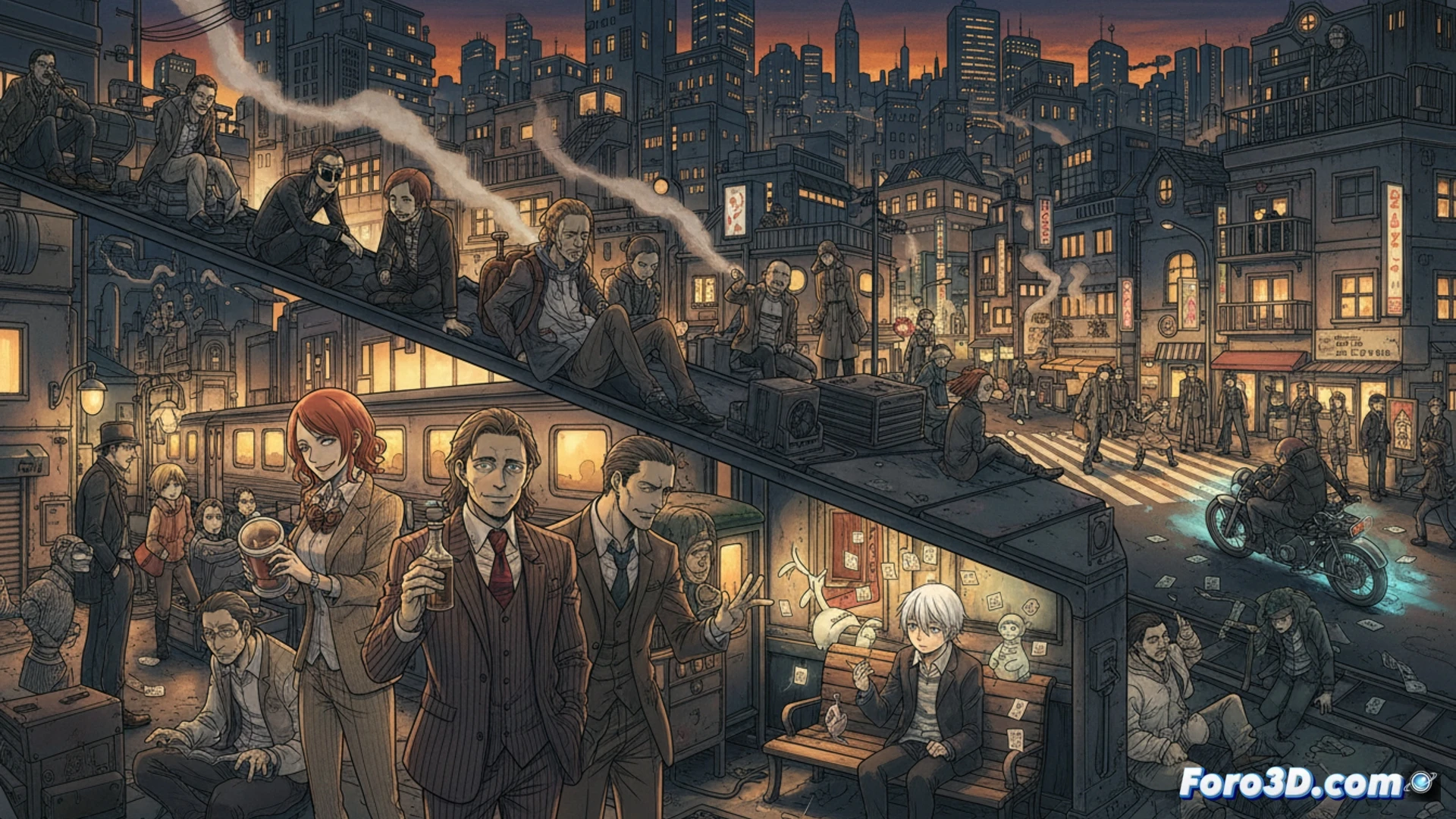
Takahiro Omori masters a narrative trick that few attempt: throwing a dozen characters onto a chaotic stage, fragmenting the story into loose pieces, and, in the end, making everything fit together like clockwork. From the violent train of Baccano! to the alleys of Ikebukuro in Durarara!!, his signature is clear: the character rules, visual noise is secondary. Even in Natsume's Book of Friends, where the supernatural blends with the everyday, Omori prioritizes pauses and glances over spectacle.
How Omori Builds Modular Narratives Without Losing Control 🧩
Technically, Omori employs a non-linear script structure that demands meticulous storyboard planning. In Baccano!, for example, time jumps and multiple points of view are coordinated through a system of colors and visual references in the animatic, ensuring each plot thread maintains temporal coherence. For Durarara!!, the director used limited animation and detailed backgrounds to create a dense atmosphere, where camera movement is slow and long dialogues allow the viewer to breathe. His method doesn't rely on big budgets, but on rigorous control of rhythm and fragmentation.
Controlled Chaos, or How Not to Lose Anyone Along the Way 🎭
Watching an episode of Durarara!! for the first time is like walking into a party where you don't know anyone and everyone is talking at once. Omori drops you in there, without a map, trusting that after ten episodes you'll remember the name of every supporting character and their relationship with the sushi delivery guy. And he pulls it off. But watch out: if you get distracted for a second, you lose the thread and end up wondering why a guy in a cat mask is arguing with a girl wielding a vacuum cleaner. That's not magic, it's craft.