The concordance between the bond and the cutaneous furrow represents a key phenomenon in materials science, where the microtopography of human skin, defined by dermatoglyphs, dictates the properties of friction and adhesion. This article analyzes how the morphology of these ridges and valleys influences the transfer of interfacial stresses, offering a framework for the design of bioinspired surfaces that optimize grip under dynamic conditions.
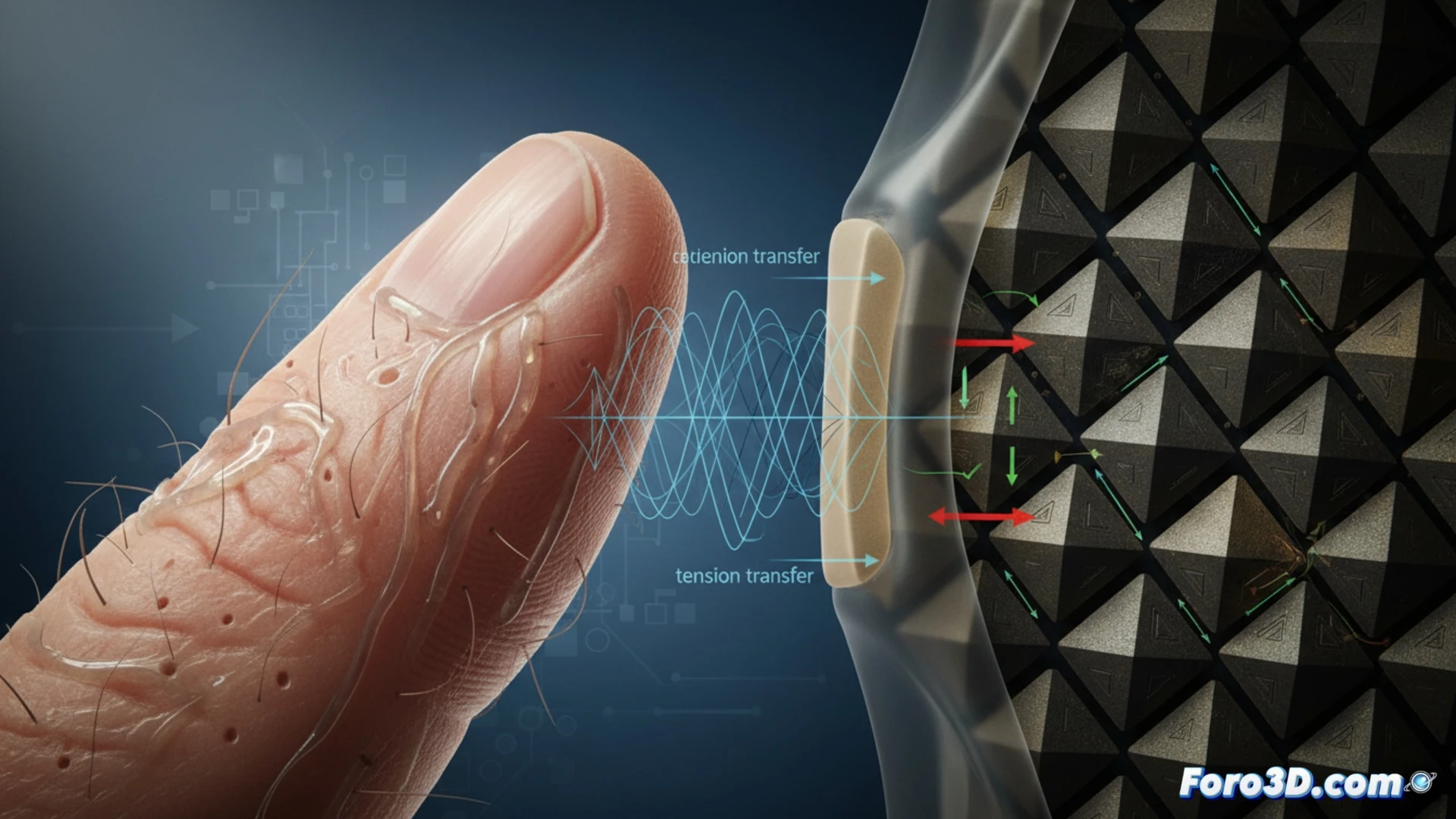
3D Modeling of Textures and Contact Simulation 🧬
To understand the mechanics of contact, 3D finite element models are used that replicate the periodicity and depth of cutaneous furrows. The simulations reveal that the ridges act as stress concentrators, while the valleys facilitate the evacuation of interfacial fluids, improving dry adhesion. By varying the roughness and elasticity of the material, it is observed that the geometric concordance between the substrate and the skin replica modulates the coefficient of friction by up to 40%. This principle is crucial for the development of prosthetics with adaptive grip surfaces and in soft robotics, where actuators require a firm coupling without damaging fragile objects.
The Lesson of Skin for Smart Materials 🔬
Nature teaches us that mechanical function depends not only on chemistry but on surface architecture. By studying the concordance of bond and furrow, we discover that human skin is a perfect passive sensor and actuator. For the materials engineer, this concept is a reminder that microstructure is the true language of design. Applying this lesson to synthetic surfaces not only improves adhesion but brings us closer to materials that respond to touch with the same subtlety as biology.
How the orientation and depth of cutaneous furrows influence the adhesion of biomimetic surfaces designed for applications in soft robotics or medical devices
(PS: Visualizing materials at the molecular level is like looking at a sandstorm through a magnifying glass.)